
Sports Sacred? How to Lose your Soul
Universities — and even some high schools — lose their souls by making sports sacred and untouchable, prioritizing them before academics and their core missions.
The Michigan State University crisis may be the worst sports scandal ever. The embarrassing headlines have continued for nearly two years.
Just last week, MSU, already on its third president in the past two years, saw its Provost June Youatt resign as the university was fined $4.5 million for the behavior of disgraced gymnastics team doctor Nassar’s and for Michigan State’s abhorrent response, Education Secretary Betsy DeVos said Thursday.
MSU’s fine was nearly double what Pennsylvania State University paid in its abuse case involving Jerry Sandusky. DeVos cited Nassar’s abuse of dozens of patients, as well as former MSU Dean William Strampel’s failure to properly oversee Nassar, as “disgusting and unimaginable… This must not happen again — there or anywhere else,” DeVos said.
Nassar was sentenced in January 2018 to more than 100 years in prison while Strampel was later sentenced to 11 months in jail for neglect of duty. MSU settled with families of Nassar’s abuse victims for $500 million last May.
A metaphor demonstrating how MSU sunk into a quagmire: When Gov. Engler’s appointment was announced, trustees literally looked away from the bad behavior occurring all around them as student protesters disrupted the meeting. Boards that ignore complaints and unpleasant issues eventually crash.
What Vietnam did for trust in government and what pastor scandals did for trust in relgion, has hit sports and education simultaneously. The traditional sense of assurance that a degree and/or success in athletics represent a “golden ticket,” is suddenly very much in doubt. Sports and education are both caught up in a perfect storm of public outcry and an intense feeling of betrayal:
Here is a step-by step guide showing how MSU (and other educational institutions) rose, how they can fall and how they can get back on track:
Founders determine organizational culture and a “true brand’’ and “true calling’’
Culture means the “cult of what you worship” (you shape your culture around the top priorities that are most important to you). Very similarly, your “true brand’’ is the one or two words people think about whenever they hear your name.
Finding your unique calling and “positioning” in the market.
MSU and Penn State both began in 1855 as America’s first land-grant schools with one main mission: agricultural colleges intended to serve “all the people,’’ (not just the elite who had traditionally sought a higher education). The first MSU students would get up early and work on vast farms and then apply what they learned in classrooms, learning, working and accomplishing things throughout the day.
By 1862, the great experiment was so successful that Congress and the administration of Abraham Lincoln passed the Morrill Act (in the midst of the Civil War) to establish similar land-grant schools across the nation. Over time, the land-grant mission evolved into peoples’ schools focused on “practical disciplines” including education, engineering, communications and business.
MSU was founded on February 12, 1855 as the Agricultural College of the State of Michigan (later State Agricultural College and Michigan Agricultural College). Just 10 days later, Penn State was established as “the Farmers High School’’ and then renamed Agricultural College of Pennsylvania. Both established Agricultural Extension Services, taking their research and services directly to the people who needed it most.
Growth dilemma: Succeeding generations must set, balance and maintain priorities as organizations grow larger and increasingly more complex
The great John Hannah (1902–1991) almost single-handedly transformed Michigan Agricultural College (with an enrollment of 6,000 when he took the helm in 1941) into Michigan State College and finally, Michigan State University (with more than 40,000 students when he left the presidency in 1969).
Hannah saw how sports grew schools and he got Michigan State into the Big Ten Conference (winning an intense battle against rivals) but he also enhanced MSU’s role in the elite Association of American Universities (the nation’s top 62 research universities). Hannah’s priorities were always clear and he became a national leader.
The Turning Point Decisions Boards must make: 1983 to Present
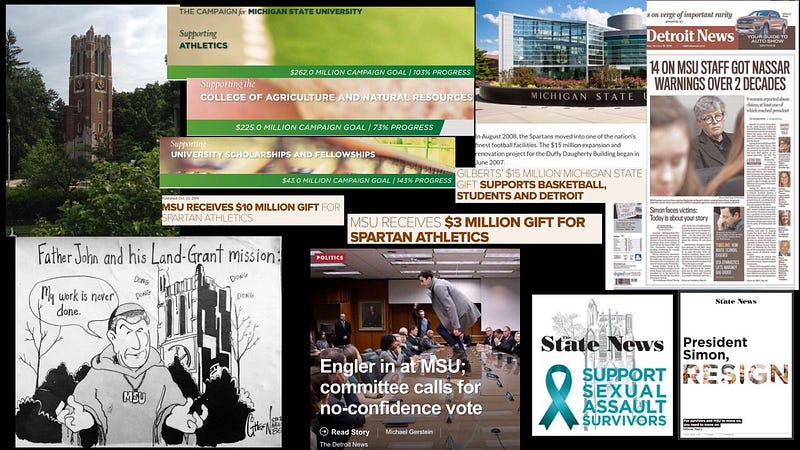
I arrived at MSU as a freshman in 1983, the same year George Perles became the football coach. Two years later, John DiBiaggio started as president. Hannah was one of DiBiaggio’s heroes and our student newspaper, The State News, ran a cartoon poking fun of DiBiaggio’s intense, constant focus on his “land-grant mission.’’ (See 1986 image above). Some lessons from those years:
- Your Vocation is “Who you Are,” what you are called to do. A true mission is indeed very much like a religious calling: a career is what you do for a living but a vocation is who you are. The University of Michigan focuses on being the “Leaders and Best.’’ MSU, as DiBiaggio repeatedly noted, was the “pioneer and premier land-grant institution.’’ DiBiaggio didn’t attend MSU but his career represented the land-grant mission perfectly: He rose from working-class East Side Detroiter to Eastern Michigan University and the University of Detroit (becoming a dentist). But he was called to education: earned his master’s in the University of Michigan’s top ranked higher education administration program, which lead him into leadership roles at the University of Kentucky, the University of Connecticut and MSU. He focused MSU on its true mission, started its first major capital campaign and the big money, never-ending campaigns began.
- Your Greatest Strength is also Your Greatest Weakness, DiBiaggio taught me the first time I interviewed him. An example: Critics derided MSU, a global leader in agriculture, as “a Cow College.’’ Many at both MSU and Penn State preferred to focus on more glamorous university activities like sports.
- Your investments show your priorities. DiBiaggio launched MSU’s first capital campaign, raising more than $200 million. The most recent MSU campaign has raised more than $1.5 billion. Dollars, particularly gifts, measure institutional priorities: the current campaign has raised more than $269.9 million for athletics (exceeding a $262 million goal) but just $164 million has been raised for MSU’s well-regarded agriculture programs and only $61 million has been raised for scholarships and endowments.
- Who — and what — do you consider sacred and untouchable? You can only have one “untouchable’’ №1 priority and the Spartans unfortunately allowed sports to become sacred (with skyboxes and stadiums serving as shrines to the false idols of sports), placing the chase for athletics glory over truth. The American Dream that sports success was the key to “the good life’’ eclipsed the dream that a great education was most important. You’d see it too often: members of the athletic programs misbehaved and officials chose to look the other way, focus on something else. Too often, board members get distracted by the day-to-day details of putting out fires and/or enjoying games and institutional politics while ignoring the big-picture policy questions related to keeping an institution focused on its long-term, overriding mission.
- Conflicts and the turning point decisions only boards can make. For MSU, the turning point came in 1991–92. Perles, who had helped MSU win a coveted Rose Bowl in 1988, wanted to be both football coach and athletic director. DiBiaggio argued that it was a conflict, concentrating too much power in one place. The board over-ruled DiBiaggio and gave Perles both jobs, bowing to the coach rather than their president. The battle between athletics and academics continued but the public saw who won. Eventually, the board gave in to its president and divided the positions again.
The public scars and ongoing battles sent a signal and the academically-focused Tufts University lured DiBiaggio away. Perles and other athletics people eventually rose to trustee positions on the board where they still serve to this day. Athletics continued to grow more and more dominant. Major gifts and shining, multi-million dollar monuments to athletics continue to rise across campus.
How to reclaim your Soul: Return to your primary mission
I’m saddened that I need to write something that is so obvious as this sentence: your students and victims of crimes are always more important than athletics. Students — not athletic facilities — are the primary product and mission of any educational institution.
Three pieces of leadership advice board members and chief executives should remember:
- How would it play on Page 1? My favorite University of Michigan president taught his students (me included) a priceless lesson: Every time you make a decision, ask yourself how it might look if it was exposed to the light and detailed on the front page of the state’s largest newspaper. MSU leaders, in contrast, got used to keeping decisions secret (but the truth eventually is revealed).
- You’re not the Messiah. A wise old priest told his seminarians to begin each day by looking in the mirror and reminding themselves they are not the Messiah (though they are called to carry on His work). The priest also warned that “the people” can be crazy (leaders of all institutions are often surrounded by admiring enablers who blindly agree with whatever they want to do). Wise leaders surround themselves with truthful, wise advisors who always remember the true mission and see the big picture.
- We Beats Me. Media watching State of the Union addresses keep track of exactly how many times a president says “I’’ and how many times he says “we.’’ The “We’’ priority is always more important.
Originally published at https://www.linkedin.com.


