
Spoiler Alert: Gen Z probably wouldn’t die first in “The Squid Game”
What one elder Millennial gets wrong about young people: their relationship with technology, the “harms” of video games, and why the bad takes will never stop.

Probably there is no period in history in which young people have given such emphatic utterance to a tendency to reject that which is old and to wish for that which is new. — “Young People Drinking More,” Portsmouth Evening News, 1936
There has been a lot of divisive “discourse” on Gen Z as of late, including a recent piece on Medium titled “Can You Imagine Gen Z In “The Squid Game” Without Their Beloved Technology?” I find this unsurprising, as will anyone who noticed that the hand-wringing quote sourced above does not relate to Zoomers or Millennials at all. It was written by middle-aged stiffs in the mid-1930’s. That quote was written about “the Greatest Generation,” who fought Nazi Germany less than a decade after the author published his rather trite observations. This isn’t new. The Roman poet Horace wrote the following in Book III of The Odes, published circa 20 AD:
Our sires’ age was worse than our grandsires’. We, their sons, are more worthless than they; so in our turn we shall give the world a progeny yet more corrupt.
But philosophers were already complaining about the kids on their lawns for at least 400 years before Horace. This type of hysterical blaming and shaming of the “youth” can be seen in Aristotle’s Rhetoric, published in 350 BCE. In fact, entire well-sourced articles are dedicated to the examination of this rather trite and banal estimation of youth culture and its cross-millennia propagation. But does it ever stop some newly middle-aged societal sleuth from writing more of this dreck? Not yet!
As the cohort of Millennials age into their 30’s and 40’s, it’s becoming more difficult to police their choices, blame them for killing entire industries, or blame their habits for the lack of economic prosperity and good health outcomes. As this generational hit-piece proves, we are already seeing the elder Millennials start their own mid-life hysteria about the freshest crop of youth cultures.
Bafflingly, this author chose to frame their gripes by focusing on the plot and concepts of the South Korean streaming television show called “The Squid Game. The writer even thought a snarky subtitle proclaiming anyone under 30 would “die in the first round” was a tasteful addition, despite citing few if any sources to back up their wildly disparate claims. So why would anyone under 30 die in this gory dystopian hellscape? Is it because the game Red Light Green Light is usually played sans assault rifle turrets? Don’t be silly! Obviously, this is due to a deep moral failing in Gen Z youth culture.
What are we using to blame young people in today’s game? Well, let’s spin the wheel and find out!
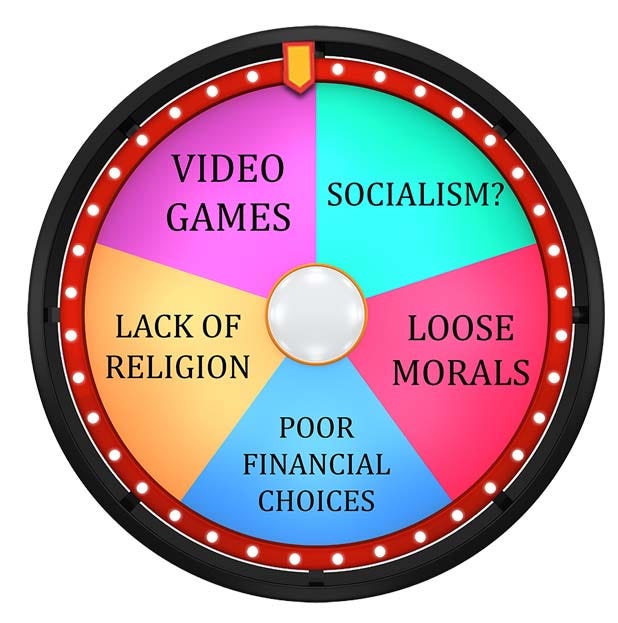
The blame wheel has spoken, and it is VIDEO GAMES and modern technological devices that have/will cause Zoomers’ collective, impending “Squid Game” deaths. How, you may ask? It’s elementary, my dear Karen! This is all due to the youth of today failing to know the sacred, eldritch rules of such hallowed cultural touchstones as Hopscotch, Kick the Can, and… playing with marbles? Yes, that appears to be their thesis statement.
Does the author play fast and loose with timely pop-culture references to prove a haphazard point about “kids today” and how they are squandering their youthful days? Most definitely. Has this person ever attended a public school gym class? Not evidently. Any self-identified “older Millennial” should know these games are still played in our decadent technological age. They are still mainstays in many communal spaces and situations where electrical sockets per person aren’t ideal for tech-based play. Gym class, summer camp, and cringe-filled “team-building” trips are all places where these games are still as common for Zoomers and Boomers alike.
Did the author consider that these games are so ubiquitous that both a western audience and South Korean creative team are 100% clear on the rules of games like Red Light Green Light? If the world population under the age of 30 has no idea how these plot-driving games are played, why has this show in particular succeeded? With all of its nostalgic imagery about these childhood games juxtaposed with survival horror, how has “The Squid Game” become the “most-viewed show on streaming services in 2021” and only the “sixth such program to reach over 3 billion minutes watched in a single week since the introduction of Nielsen’s streaming media ratings.” If nothing else is convincing, perhaps this statement from the show’s director will help make my point crystal clear:
“People are attracted by the irony that hopeless grownups risk their lives to win a kids’ game,” Squid Game director Hwang Dong-hyuk said in an interview.
“The games are simple and easy, so viewers can give more focus on each character rather than complex game rules.”
The author also pontificates at length about all the ways playing outside is unequivocally healthier and better for children than hours spent playing video games. The ideas and concerns listed could have been conceived during the 1990’s moral panic around video games. With no sources cited it is hard to tell, but the ideas are old and trite in today’s research landscape, where entire history books exist on the US military’s research, funding, and deployment of video games (to great success overall.) An APA research review from 2014 showed “playing video games, including violent shooter games, may boost children’s learning, health and social skills.”
This 2014 review actually rebuts many of the claims listed and . In other cases, the data shows that video games grant greater benefits to an individual than the “traditional” outdoor games listed in this piece. For example, the author lists “improvement of social skills” as a benefit of traditional games, meanwhile the research shows that more than 70% of gamers play with a friend, and online massively multiplayer games foster entire social communities that positively impact their ingroup members — all exclusively within a virtual shared space. The “real-world psychosocial benefits” of video gaming as a hobby are borne out not only in singular academic studies, but at a macro level of analysis and review by authoritative academic organizations.
The final call-to-action for parents to form real-world groups to “manage and revive” these “traditional games” is an especially sad and hollow point to make. The COVID-19 pandemic is quickly approaching it’s second anniversary on the world stage, and vaccination for ages 5–11 was only recently approved by the FDA. In fact, at the time of this article’s publication, the FDA was still 3 days short of approving the Pfizer vaccine for children ages 5–11. If this Millennial wants to talk about Baby Boomers and their idyllic childhoods, perhaps she should ask some of them about living through Polio outbreaks. At the very least it would make more salient points between our current cultural zeitgeist and actual social realities.


