
ESSAY | WRITING| SHOWING VULNERABILITY
How I Showed My Vulnerability Rather Than Hide Behind The Shield of My Timidity
On the call for submissions — “Are You Censoring Your Writing”

- Do I share my innermost thoughts for public consumption?
- Am I really being as honest and true to my feelings as I would like to believe?
- Or, am I instead writing not to offend?
- Do I censor my writing instead of putting it out there without hesitation?
- What do I do to prepare my mind for adverse feedback or criticism?
The short answers are, “Yes,” “Yes,” “No,” “No,” and “Nothing.”
The complete answer is, “It’s a little complicated.”
The short answers take us no further than here.
The complete answer gets us to the end of this piece.
Miseries and despondencies
A lot of what I have written is mémoires about relationships and love and loss. Thus far, I have based what I’ve written in those categories on my experiences.
I’m not shy about revealing my vulnerabilities and emotions. In these categories, I let myself feel what I write as I write it. Contrary to censoring my emotions, I strive to convey them to the reader. I want him to experience vicariously what I experienced. I can only accomplish that by opening up, showing him my passions, and exposing myself to the possibility of wounding.
Let me show you what I have done rather than describe what I’m willing to do or how I ought to do it.
Let me show you with this extended quote from the autobiographical A Tale of Two Souls, chapter three, A Care Giver’s Story, where I wrote of the anguish of one partner, me, in caring for the other partner at the end of his sixteen-month terminal illness.
Our doctor told me, but not Loy, what would happen. He said that the viruses would rampage unchecked in Loy’s brain, destroying neurons by the billions. His brain would become “like Swiss cheese.” As they multiplied and Loy literally lost more and more of his mind, his mental capacity would wain; his personality would regress to early childhood.
As the days passed, he was more and more bedridden…. His skin grew dry. I rubbed a moisturizing cream on it, usually at night just before crawling into bed myself.
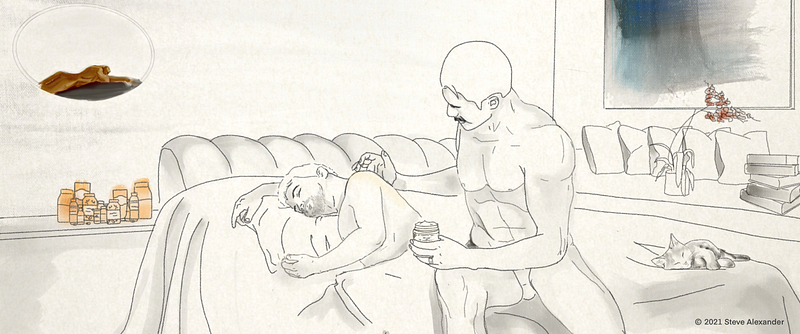
Touching his bare skin with my hand presaged my holding him, sleeping skin to skin during the night as we always had. Even though he was asleep and made no response to my touch, these were intimate moments. It’s counterintuitive and perhaps a bit morbid, but I treasured them.
By the end of November 1994, Loy was back in the hospital. That stay was to be for nearly four weeks. His mind was regressing. It was punishing to see him that way. I cried all the time when away from him. The tears silently flowed when I was with him as they do now. As I write this, I can’t see the keyboard for them.
He would ask why I was sad. One day during the last hospitalization two months later, he took my hand in both of his. He looked into my eyes, then glanced away.
In a child’s manner, he said, “Alex, I’m really sick, huh?”
I barely managed to choke out, “Yes, but it’s OK. I’m here.”
…
I had a hospital bed placed to the right of our bed, as close as possible. I put Loy in it, knowing he would never leave it alive. I slept as close to him as I could at the right edge of our bed, my right arm resting on the hospital bed’s rail.
…
I was alone with [him]. I didn’t leave him. He slipped into a coma, and my days became routine. Change the catheter; change the diaper; bathe him. Make sure he is clean. Mindlessly watch television in our bedroom, not knowing what it is, not caring.
…
Morphine dripped, dripped, dripped into his vein from the IV pump that I monitored — morphine sufficient to relieve his pain but not enough to end his suffering. Nor mine.
He died on the afternoon of April 28, 1995, just one of the 50,877 gay men to die that year. Woodenly, I called the funeral home. They took his body away. The black shroud they put over him wasn’t long enough. As they trundled him out, one naked foot dangled off the end of the mortuary trolley.
That was the last I saw of him — that exposed naked foot jerking with the trolley’s every bump and sway as they lifted it up and over the steps from our sunken living room to the entryway hall.
I never saw him again.
Now, as you can tell, this particular part of the story is about my love for Loy and grief at his dying of AIDS. I didn’t hesitate to show the reader, any reader, gay or straight, the emotions I felt for this man, my partner, my best friend, my accomplice in mischief, and my joy for nine years.
There is a Robert Frost quote that encapsulates this writing style in ten words.
No tears in the writer
— no tears in the reader.
I do not censor my tears that the reader may have his own and remember what he read the more because he felt it.
Desires and lusts
Not everything is about the extremes of grief and despair. There are also the extremes of ecstasy and rhapsody, of which I have had a fair share. One of the familiar places to find them is in sexual experiences.
I openly shared one of those experiences in this passage from Sex, Drugs, And Spirituality. Again, it’s an extended quote, but it is necessary to convey the depth and breadth of the emotive exchange between the two lovers.
Before we go further, let me apprise you that this passage contains some description of a sexual encounter between two gay men. The description is not there to be and is not gratuitously erotic. Rather, it powers a climax in a moment of extreme empathic sensuality. It’s intended not to shock but to enlighten, to reveal the depth of spiritual connection that is realizable between the participants in making love.
Nonetheless, if the concept of two men making love offends you, you might consider reading just the first three paragraphs and the last four.
Still, you will miss the ecstasy and rapture and the extraordinary empathic spirituality that we found.
The coke took effect. The high was immediate, gentle, and subtle. My mind seemed clearer and sharper. I felt a total openness with him, a connectedness and intensity I’d never felt before. There was an empathic resonance between us that was impossible to explain and impossible to deny. I felt invincible. I felt the rise of hypersexual energy and the promise of stamina and staying power. I could see in his eyes and on his face that he felt the same.
Containing the immediacy of our desire, we sat a moment more, surveying each other, loving what we saw. We had had a long experience with each other before I [spent a year away]. We knew each other’s bodies. We each knew what excited the other, what incited a response. We each delighted in doing those things — each his own pleasure heightened in the other’s.
We knew an immense love impended.
We took that knowledge and that desire to please with us as I put him on his back, slipped between his legs, and slowly moved into him. He moaned involuntarily and gripped my biceps hard. The sensation was intense. Our bodies fused as one. As I slid into him, our very cores slid into one another. We moved in union with each other and with the space that enveloped and warmed us.

We left off our concerns for performance and technique. Our perspectives changed. We were lifted out of the everyday. We shared an emotive receptiveness, a communion, and unity that transcended this plane.
The immense love was upon us.
It overflowed its containment. Its transformative power bore us into an altered state — a sacred, spiritual state that melded perfectly with our sexuality. In union, with me engorged inside him, with my stomach stroking his stiff cock in rhythm with the movement of my hips, with his breath pulsing against my shoulder and his heart against my chest, our minds moved from the carnal into oneness with the cosmos.

An hour, a decade, a lifetime later, we exploded in simultaneous orgasms; I in him, he pulsing in my hand as I gripped him. He shot over his shoulder — twice. The third spurt made his left nipple. He reached behind me and pulled me even further into him. I leaned over and licked his nipple clean, then kissed him, long and deep.
We found ourselves lying on the bed. He was on his back. I was prone on top of him with my left shoulder at his chin. My arms splayed out in front of me on either side of him. I was partially supporting my weight on my elbows to avoid suffocating him. It was a reflexive action. I hardly realized it.
I turned my head to my left. I smelled the light hibiscus scent of his conditioner. I slowly became aware of his still heavy breathing under me, the rapid rise and fall of the pressure of his pecs against my ribs. He was pulling me at the waist hard against him. I felt the remains of my erection trapped against his six-pack.
I became aware of my own breathing and my slowing pulse. Michael relaxed his hold on me. I rolled off to my right, landing on my back. Our arms brushed against each other. Our hands found each other, and our fingers intertwined as if by their own volition.
Clamping his fingers down, he said, “Christ, Alex. What did we just do?”
The better question right now is, what did I just do. I intended to carry you, the reader, into a time and space you have yet to encounter. I tried to do that by conveying what I felt at the time and from where those feelings arose.
If I have chosen the correct words and put them in the correct sequence, I have given you a vicarious experience of a spiritual encounter that you will remember just as you will remember those tears.
I did not shy from the explicit in the sexual descriptions. Except, and this is where it’s a little complicated, I did censor them to some degree.
I could have been more explicit.
However, my purpose was not to arouse you but to empower you on a spiritual journey with me. Greater explicitness would have steered you away from the direction I wanted you to go. It would have made the piece about something else. It would have diminished the spiritual nature of my encounter with Michael and accentuated the carnal — just the opposite of what I intended and just the opposite of what happened.
So, in a narrow sense, that is an instance of self-censorship. But in a broader perspective, it’s an instance of staying true to one’s original vision for the story.
Quiet sorrow and regret
Not every mémoire need be at one extreme or the other, loss and desolation or joy and rapture. There are quieter emotions, sorrowfulness and regret, for instance, such as that between an estranged father and son who can not come to a rapprochement no matter the march of years. Does one shy away from portraying one’s regret at his inability to initiate the reconciliation even though he has the requisite powers of self-analysis and introspection and his father does not?
In Be Open (More About Me) — The Death of Enmity, I do not shy away. I try instead to portray the muted sadness that pervaded my last encounter with my father in life.
It was a cool morning in mid-September 1977. We were parked at the reservoir in Dennison, Texas, where he was born sixty-four years earlier to the month. It was the first I had seen of him in three years and only the third time I had spoken with him in the five years since I talked him down from his intent to kill the man for whom my mother divorced him.
It was the last time I would see him in life, and the last time I would hear his voice until the afternoon in 1981 on the day of the night he died when his doctor put him on the phone; he said only,
“I’m really sick, son.”
…
Life around him was grim. I had feared him ever since I could remember, which was four. I had feared and hated him during my pre-teen and teenage years when he unrelentingly bullied and threatened me.

He had been a mean, emotionally abusive alcoholic who had made life a constant misery for my mother and me. The teenaged and twenty-something me had hated him not the least because of the two spousal rapes I witnessed at seven and again at thirteen.
…
By 1966, when I was eighteen, my hatred of him knew few bounds. That year, I left home a self-sufficient man bound for college with the intent never again to be anywhere that he was.
With time and distance, my white-hot anger cooled to smoldering coals. With my slowly widening understanding of him came empathy and tolerance such that by that September, I was open to a rapprochement, but only if he said the first word. He couldn’t, of course, however much he may have wanted to. It wasn’t within his power. And I wouldn’t, whether out of pride or a perverse need to make him feel the needful one I’ve never discerned.
So, on that September morning, our relationship was complicated. The silence between us in his pickup was strained. We did talk about something, I know, though I have no recollection of the words. I only remember the empty feeling and the sadness that these two men could not find a way to say to each other what each felt, “I love you.”
For me, it was complicated by the twin facts that forgiveness was hard to come by despite empathy and that I was gay but saw no reason to tell him. So long as I did not, there would be a distance between us because I would not give him the chance to know and accept the whole me. Not that I thought he ever would.
For him, it was complicated because I was no longer the child he had demeaned and bullied in his anger at life, but a man of whom he was proud but could not find the wherewithal to say so.
Our fathers leave broad swaths of influence and dominion wherever they tread through our lives, whether with heavy jackboots or light dancing Oxfords.
Until I was eighteen, it had been jackboots. But by that 1977 September day, it was Oxfords. I didn’t know how to deal with that, so I said a formal thank you for the Monte Carlo, shook his big, calloused, arthritic hand, and drove north toward San Francisco and my easy life without him until the day, four years later, when I got that phone call in Philadelphia.
Shame on me.
And there it is, my shame bared before the reader.
Sad but not broken by rejection
I lay out these emotions; I serve up these little bits of me to you without hesitancy and with no concern for wounding from adverse criticism or rejection.
Of course, I want to be well received and to have such talent as I may possess, recognized and enjoyed. But, if that is not to happen, I won’t regret having opened up myself to the view of all.
I am the product of my experiences. If they are insufficient to command the attention of an audience, it matters not. I am still me. I am sufficient unto myself. I will withstand the news that my experiences do not interest a wider readership. I will be sad, of course, but not broken.
For another story of a complicated relationship between father and son, read Marcus Benjamin’s


