
Spiritual Scaffolding
AKA Discipline
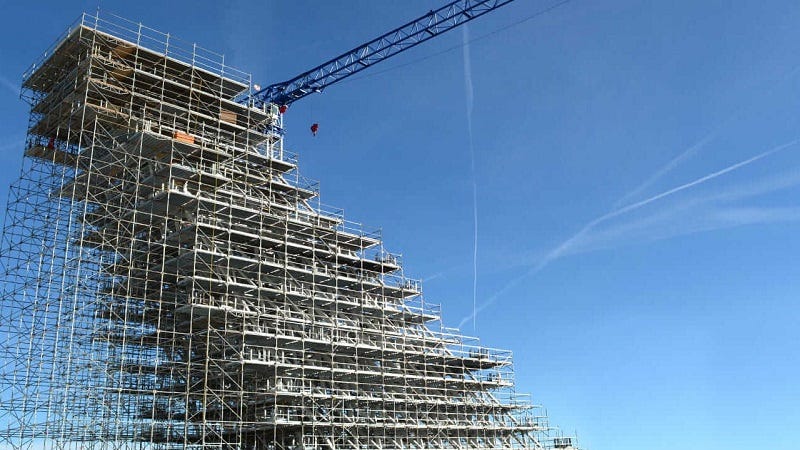
Discipline: Spiritual scaffolding
There are many prerequisites to meditative quiescence and liberating insight ranging from a conducive environment, to supportive friends, to few (if any) attachments, to wholesome food, to virtuous behavior (ethics), and others.
Most, if not all of these prerequisites call for discipline, especially when it comes to steering clear of attachment and staying an ethical course, and the underpinning of these important attributes is called discipline.
On an ocean-shore walk the other day I saw discipline as the scaffolding we erect to help us build our Temple of Path.
Discipline, the foundational practice.
Virtue, ethics, and self-discipline as scaffolding are not unique to Buddhism, of course. My impression (garnered from a lot of reading) is that all religions that offer a tangible (walkable) path to liberation call first and foremost for discipline. It’s the gate you have to open and enter through.
Yes, they also call for compassion, for generosity, for loving-kindness, for empathy, but the girders that must needs be in place to sustain all other attributes is discipline.
Have you ever erected scaffolding on your own? I’m asking because the work involved, the outright effort is a good metaphor for constructing and maintaining discipline.
A few years back I painted my house — all by myself. I have windows that no ladder can easily reach, and I have walls surrounding those windows that needed painting. The only affordable solution: scaffolding. I rented enough metal pipes and locks and clamps to build my way all the way up to those windows and surrounding rafters.
Let’s put it this way, this will not happen again, I’m just plain too old now. But I was a few years younger then and a little foolhardier and I did manage to erector-set the metal and planks together and I did manage to paint the house — quite well if I may say so.
But it was demanding work. Extremely hard work. And I was under time pressure as well for I had only rented the stuff for two days. It’s funny though, when in the throes of near blindingly hard work, you think of nothing else but the work (quite therapeutic when you think of it) and I thought of little else but scaffolding and paint for those forty-eight hours.
But now, with the luxury of looking back and musing, the then-effort rises again, and I see (feel) how very hard it was, how much work was involved. As I said, never again. Next time I’ll have to spring for a professional, and most likely for one of those portable hydraulic lifts. Still saving up for that.
But for me, the comparison holds. Self-discipline to the extent of paving the way to quiescence and insight is harder to build and maintain than mere physical scaffolding but it is scaffolding, nonetheless.
Spiritual scaffolding.
There are many prerequisites to meditative quiescence and liberating insight ranging from a conducive environment, to supportive friends, to few (if any) attachments, to wholesome food, to virtuous behavior (ethics), and others.
Most, if not all of these prerequisites call for discipline, especially when it comes to steering clear of attachment and staying an ethical course, and the underpinning of these important attributes is called discipline.
On an ocean-shore walk the other day I saw discipline as the scaffolding we erect to help us build our Temple of Path.
Discipline, the foundational practice.
Virtue, ethics, and self-discipline as scaffolding are not unique to Buddhism, of course. My impression (garnered from a lot of reading) is that all religions that offer a tangible (walkable) path to liberation call first and foremost for discipline. It’s the gate you have to open and enter through.
Yes, they also call for compassion, for generosity, for loving-kindness, for empathy, but the girders that must needs be in place to sustain all other attributes is discipline.
Have you ever erected scaffolding on your own? I’m asking because the work involved, the outright effort is a good metaphor for constructing and maintaining discipline.
A few years back I painted my house — all by myself. I have windows that no ladder can easily reach, and I have walls surrounding those windows that needed painting. The only affordable solution: scaffolding. I rented enough metal pipes and locks and clamps to build my way all the way up to those windows and surrounding rafters.
Let’s put it this way, this will not happen again, I’m just plain too old now. But I was a few years younger then and a little foolhardier and I did manage to erector-set the metal and planks together and I did manage to paint the house — quite well if I may say so.
But it was demanding work. Extremely hard work. And I was under time pressure as well for I had only rented the stuff for two days. It’s funny though, when in the throes of near blindingly hard work, you think of nothing else but the work (quite therapeutic when you think of it) and I thought of little else but scaffolding and paint for those forty-eight hours.
But now, with the luxury of looking back and musing, the then-effort rises again, and I see (feel) how very hard it was, how much work was involved. As I said, never again. Next time I’ll have to spring for a professional, and most likely for one of those portable hydraulic lifts. Still saving up for that.
But for me, the comparison holds. Self-discipline to the extent of paving the way to quiescence and insight is harder to build and maintain than mere physical scaffolding but it is scaffolding, nonetheless.
Spiritual scaffolding.
P.S. If you like what you’ve read here and would like to contribute to the creative motion, as it were, you can do so via PayPal: here.
© Wolfstuff


