
Spiritual Responsibility? Duty? Cargo?
I’ve been toying with terms to express what I mean and the process I’ve been evolving through in the last years. Responsibility or duty: both have a heavy connotation, not something done freely but something expected.
Within Maya communities there is the “cargo system” still in effect from colonial times. It has to do with civic and religious hierarchical positions, each held for one year. In the Andes, a similar system exists. “Cargo” may be translated as “burden.” Those “carrying cargo” incur expense, the higher the role in the hierarchy, the more monetary investment. In colonial times, the Spanish used the system as a means of control and exploitation.
Today, it’s supposed to be a means of mediating wealth and sharing. But in reality, it creates separation. Those who have the most to expend are the ones who rise in community stature. Hence, they have more prestige. This aspect of the construct is quite distasteful to me, not much different from what often exists in western churches.
Over the last 15 years, I’ve developed friendships with Hopi people who keep the old ways, and learned much about their traditions. Their clan system is complex, each clan and its members carry separate spiritual responsibilities. Their religious and cultural ceremonies happen monthly according to the cycles of the Hopi calendar. Each ceremony takes up a good portion of each month because of preparation in the kivas and kitchens, aside from the actual dance and closure afterwards.
I’ve witnessed the amount of work that goes into them, as well as listened to friends sharing what they can with an outsider. Truly, I marvel how they are able to get anything else done! For those who have chosen to maintain their traditions… it’s a huge investment of time and energy. Many have found it to be too much and put the sacred ways aside to a great degree. Tradition is going to the wayside.
That brings me to my own process. I founded Kenosis Spirit Keepers, as the volunteer-run nonprofit extension of Kenosis, back in 2007. I took that step because I fully believed the Indigenous wisdom traditions must be valued and supported in a time when powerful influences across the globe sought to devalue and deplete what was life-affirming. Little did I know that my decision would take me on an unexpected, personal odyssey.
Initially, there was abundant support, both financial and sweat equity. We were able to contribute significantly and support community projects in the Peruvian Andes, sponsor intimate meetings between Indigenous spiritual leaders, and eventually began to offer educational outreach in the local community. It was hard work but we could see the positive outcomes that resulted. Those were exciting times. It was exhilarating.
Then the 2008 recession hit. Funds dried up. People pulled back and holed up. I found that I was working harder and harder with few outside resources. My commitment to the mission never wavered. But such things eventually take a personal toll on the spirit and physical body.
Finally, a loud internal voice intervened when I was most tired and discouraged, “Why bother? No one out there cares. You’re wasting your time. It’s hopeless.” I’d set the questions aside but they’d return… until the voice became my nearly constant companion. First, you have to understand that it’s normally quite rare for me to have such messages play in my mind. I finally recognized that my internal struggle was a spiritual test.
Something happened during my January 2011 spiritual travel program in Chiapas, Mexico that shifted my perspective. During “free time” I’d gone to the Maya church in the traditional village of San Juan Chamula, taking those with me who wanted to return. Every year I spend as much time as I can in this powerful place where the very air vibrates with energy.
A few days prior we’d been there for the Festival of San Sebastián, during which the statues of the saints, wearing layers of robes, are taken out of their glass cases and carried on the shoulders of cargo holders in a processional in the main square. When we returned, the saints had not yet been returned to the glass cases that lined the walls. Maya men were removing the outer layers of vestments on the saints and carefully putting them away in special wooden trunks that would later be stored and protected in individual homes.
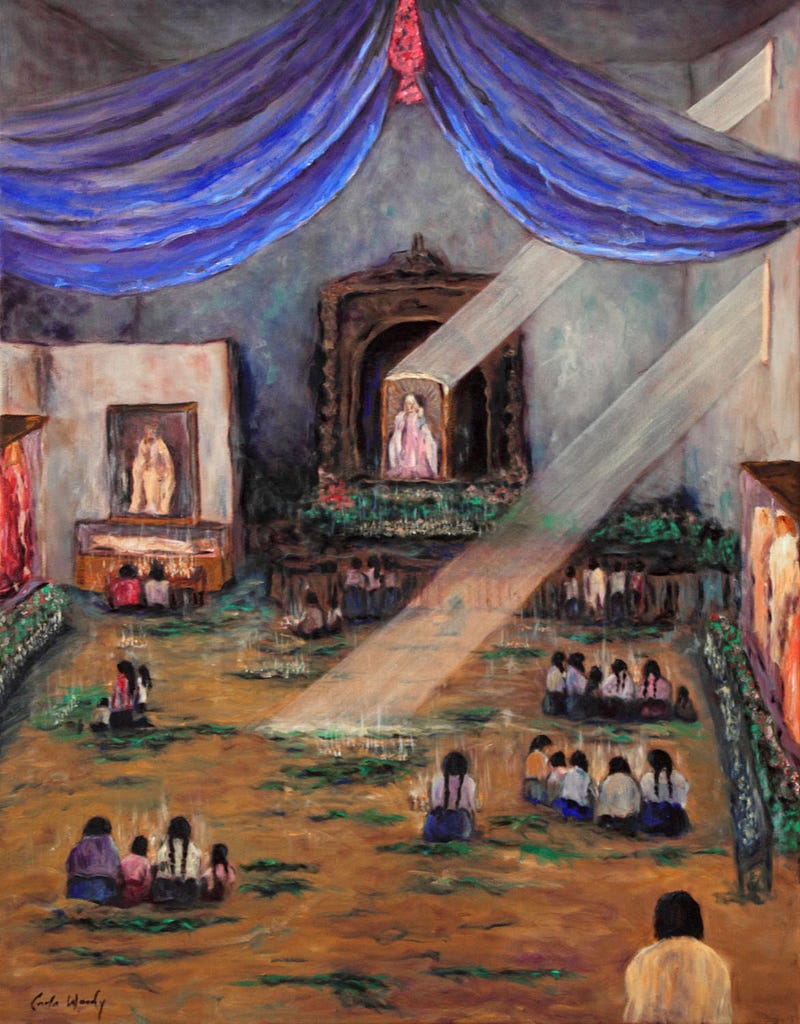
I stood watching a few feet from a table where Saints Lucia and Martha were resting. Maya women sat on the floor alternately talking with each other and chanting in unison. Candles were everywhere. Pine boughs covered the floor. Copal smoke was thick in the air. It was magical in the sense that deep reverence can be. I looked at Saint Martha’s painted eyes — and they suddenly seemed to come alive and gaze deeply into mine. I felt penetrated as though some sort of transmission had taken place.
Then one of the men motioned to another who then approached the table. Very carefully, he lifted Saint Martha in his arms and slowly walked over to her case against the wall. But before he placed her inside, he paused.
And then he danced with her, a beatific expression on his face.
My breath caught and my eyes filled with tears. Such a display cannot be from a “burden” one carries, but directly from the heart. Since then I find that each time I share what I witnessed, tears come again. I continue to be moved and the memory has rooted itself within me for purpose, I believe.
In May 2011 we were privileged to host Hopi Wisdom Keepers Harold and Charlene Joseph for our local series in Prescott, Arizona where I live. Some aspects they shared had to do with the involved process of Hopi weddings, their ceremonial cycles and community participation. People were touched, to the point that one participant later told me she had no words. Afterwards, a friend and I took Harold and Char to dinner.
We discussed the “Why bother?” questions that had been haunting me, although less frequently in the months since my experience in the Maya church. Surprisingly, those questions were common to all of us sharing that meal. Yet, we all persevere because the core element of spiritual belief and service is implanted somehow in our DNA.
So after all the months of testing — mental angst, physical exhaustion and spiritual inquiry — I returned again to one central theme that I learned years ago in the Andes: ayni, Quechua for sacred reciprocity. That’s the term I was looking for. It was under my nose all along.
This is what I’ve re-learned so far:
— Such ways of being are the invisible strands that hold the world together.
— It’s possible to operate within a construct that is riddled with shortcomings and still hold pure intent.
— Intangible things that you value spiritually are worth the hard work, sometimes requiring a lot of faith. It’s rarely tidy and often not pretty in the unfolding.
— Strike a balance in all things.
— Touch just one person and it touches others.
— Ask for help; some things take a community.
This essay first appeared in The Lifepath Dialogues in December 2012.


