
Spirits in the Material World
How an innovative American philosophy balancing inner peace with civil action can guide us through challenging times

Under the Radar
Let’s assume for a moment that you and I agreed — as a soul contract — to be on this planet at this time to be a force for awakening.
Today the United States — not to mention our world — faces challenges of autocracy, political polarization, climate change and more. We’ve said it before and often: America is closer to Civil War now than it has been in well over a hundred years.
Let’s be frank: it’s not for the faint of heart.
Living as a spirit in the material world — to paraphrase Sting — can be a tightrope act. It means being empathetic and a peacemaker while speaking one’s truth and not backing down in the face of aggression or bullying.
These are, as Thomas Paine said during the American Revolution, “times that try men’s (and women’s) souls.”
Yet the country has always found its way through— due, at least in part, to one significant mindset that has often flown under the radar.
A New Kind of American Thinking
William James, widely acknowledged as the father of American psychology, has been called by some the greatest thinker in American history.¹ Son and brother to 19th century American intellectual royalty, his godfather was also none other than the author, speaker and preeminent Transcendentalist Ralph Waldo Emerson.
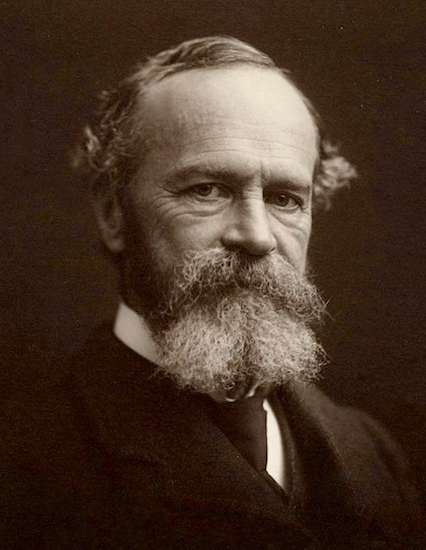

After attending Harvard Medical School during the Civil War, James would eventually chair Harvard’s new psychology department. There, he pioneered the systematic study of the psychology of religion (not to mention later co-founding The American Society of Psychical Research). He was also the first to draw America’s attention to the work of Sigmund Freud.
In his seminal, early 20th century book The Varieties of Religious Experience, James cited a growing American philosophy based on Transcendentalism and the “mind-cure” movement of the latter 19th century. Its focus was on well-being: mental, physical and spiritual.
James identified this school of thought as The Religion of Healthy-Mindedness. “For the healthy-minded individual, one’s happiness and contentment was regarded as evidence for the truth of their religion.”² In James’ estimation, this ideology was an “optimistic scheme of life, with both a speculative and a practical side… an intuitive belief in the all-saving power [and] conquering efficacy of courage, hope, and trust, and a correlative contempt for doubt, fear, worry, and all nervously precautionary states of mind.”³
Here was an “awakening” of a different stripe. James believed it the up-and-coming religious persuasion for the age.
He dubbed the movement “New Thought.” The name stuck.
“The greatest revolution of our generation is the discovery that human beings, by changing the inner attitudes of their minds, can change the outer aspects of their lives.” ~ William James
In James’ mind, New Thought was “America’s only decidedly original contribution to the systematic philosophy of life.”⁴ It predicated an essentially friendly universe in which the individual is infused with divine energy. Largely absent is redemption theology and the acceptance of the enduring reality of sin in the world.⁵ The human mind is assumed to be the supreme channel for this energy with its powerful healing and creative forces.
Pragmatism
At the same time New Thought embodied the view that religious belief should be practical, in tune with the culture of the age and consonant with scientific laws. One of James’ most famous publications was entitled simply: Pragmatism.
Transcendentalism — New Thought’s greatest influence — balanced one’s inner spiritual journey with taking determined action in the world. Transcendentalists such as Emerson, Henry Thoreau, Louisa May Alcott, Margaret Fuller, Theodore Parker, Walt Whitman and others lived in a time of immense American polarization. Their spirituality did not dissuade them from civil action; instead, they spoke out loudly against injustice, racism and sedition, forces that lead up to the Civil War.
Although New Thought has spawned only a handful of specific churches or religious denominations — Unity, Church of Divine Science and Religious Science (today called Center for Spiritual Living) come to mind — James believed the philosophy would eventually become the predominant spiritual mindset of the nation.
Called to Lead
Today, New Thought philosophy is inspired by some of the greatest non-violent revolutionaries that have walked the earth: Jesus, Gandhi, Martin Luther King and others. All of them faced existential challenges in times of division and crisis, calling their adherents to action, but never with physical force or violence.
These beacons of light are venerated today because as spirits in a material world, they chose to lead; not as kings, dictators or presidents, but as models in mastering the balance between the inner and outer life, between heaven and earth.
We are called to nothing less; we are called to lead. Not as belligerents. Nor as martyrs. As A Course in Miracles reminds us fear, sorrow, suffering and sacrifice are never required or justified. We are called to lead with the courage and trust of knowing our part to play in the advancement of an awakening world.
It’s time.
Segments of the preceding have been inspired by my upcoming book America’s Next Great Awakening — A New American Revolution in Consciousness examining the convergence of mysticism, religion, atheism and science. Go to christophernaughton.com
________
Notes:
¹Spiritual But Not Religious: Understanding Unchurched America, Robert C. Fuller, Oxford University Press, 2001, p. 113
²The Varieties of Religious Experience, William James, Longman, Green & Co., New York-London-Toronto (1902), Lectures IV and V.
³Ibid., pp. 92–93.
⁴ The Trial of Curiosity: Henry James, William James and the Challenge of Modernity,” Ross Posnock, Oxford Universiy Press, 1991, p. 238.
⁵The Obituary: The Rev Norman Vincent Peale, Malise Ruthven, The Independent (UK), Monday 3 January 1994