
Speed is money: introduction to High-Frequency Trading (Part 2)
Hi everyone, today I will write about the main tools used by high-frequency trading companies in their day-to-day trading activities.
First of all, to reach the top line of the order book and benefit from the best prices, high-frequency trading requires significant investments. The main goal is not to come second but to be first. Therefore, high-frequency traders need to focus on how fast their trade orders will travel from one data center to another.
It is all about speed. In a cinema, if somebody is in front of you in the queue and buys the last ticket, it is not illegal. They were just faster than you. The same principle applies to today’s financial markets.
However, it is not that simple. High-frequency traders need to focus on speed, but they also need to focus on reliability and data quality. What’s the point of being first if some part of my trade order was lost during the transfer from point A to point B?
Today, the NYSE has its servers in Mahwah, New Jersey. The Nasdaq also has its servers in New Jersey but in Carteret. The Chicago Mercantile Exchange has its servers in Aurora, Illinois. In the early 2000s, an HFT firm called Tradebot noticed that the price of Futures contracts on the Chicago Mercantile Exchange tends to move similarly before the prices of securities on the NYSE or Nasdaq. Therefore, to benefit from arbitrage strategies, HFTs started using optical fiber to send their orders as fast as possible between data centers in New Jersey and Aurora.
If the price of the E-mini (a future contract on the S&P 500 index) goes up on the CME, Tradebot will modify its bid on the SPYDER ETF (which replicates the performance of the S&P 500) to gain execution priority on the NYSE before the price of the SPYDER ETF goes up. Conversely, if the price of the E-mini goes down, high-frequency traders anticipate a similar move will happen in the stock market for underlyings on the S&P 500 (in this case, the SPYDER ETF). Therefore, a high-frequency firm will lower its offer to gain execution priority and sell the SPYDER before the price goes down.
At the beginning of high-frequency trading, optical fiber was the most efficient way for HFTs to transfer data, arrive first in the order book, and capture the spread (example with “Spread Networks”: from New Jersey to Chicago, a 1323km optical fiber journey for a latency of 6.49ms).
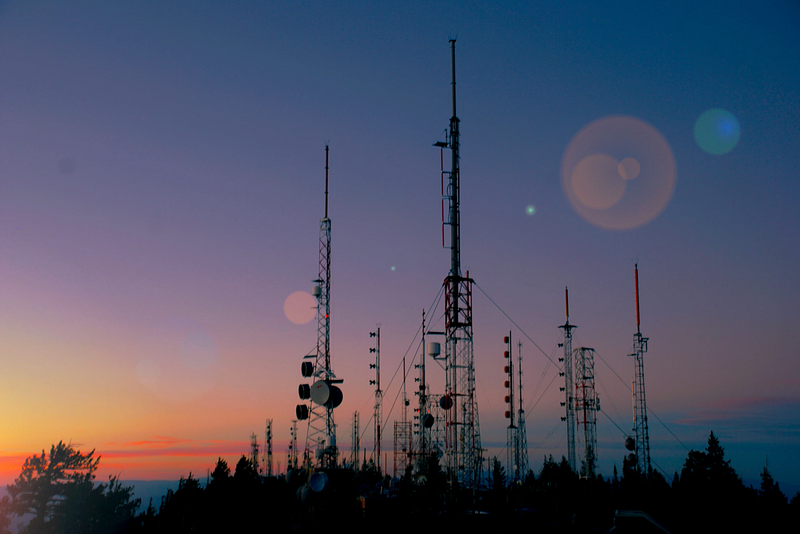
However, the speed of light in a vacuum is 299,792.458 km per second. In an optical fiber, light travels more slowly, about two-thirds of its speed because it bounces off the walls of the fiber. Consequently, some companies like Mackay Brothers LLC used microwave and millimeter-wave trading. Microwave and millimeter-wave trading use radio waves to transfer information from point A to point B. Compared to optical fibers, radio waves travel through the air at the full speed of light and in a straight line, thus having the advantage of being faster. Radio wave trading is faster but more expensive. Moreover, microwave and millimeter-wave trading are not relevant for long-distance transfers (for example, to transfer information across the Atlantic Ocean from the NYSE data center to the Euronext data center in Italy). With microwave and millimeter-wave, high-frequency traders need to invest in several towers in a line of sight, within a maximum range of 50 miles each due to the reliability of data transfer. Every 50 miles, the information will “jump” from one microwave tower to another until it reaches the final data center. Plus, the microwave towers need to be in a straight line without any buildings or trees in between. Otherwise, the information transfer will be impossible. Microwave and millimeter-wave trading rely on weather conditions. Rain can interrupt information transfer because water absorbs radio waves. Although optical fiber is slower than microwave or millimeter-wave trading, it remains the most reliable tool to transfer information, regardless of the weather. The bandwidth for data transfer with optical fiber is also higher than the bandwidth for microwave or millimeter wave.
In conclusion, you might have already heard the term “short-wave trading.” Short-wave trading is faster than optical fiber, microwave, and millimeter-wave. Plus, short-wave trading can be used for long-distance data transfer like optical fiber. Short-wave trading uses the 2–25 MHz band for communications. Transmitters employ sky-wave propagation, through which radio waves directed at the sky are refracted by the ionosphere and therefore can travel beyond the horizon and along the curve of the earth. However, the bandwidth and reliability of short-wave trading are extremely low. To summarize, short-wave trading is faster, relevant for long-distance, but with extremely low bandwidth, and information can be lost during the transfer.
That’s all for me today. In the coming months, I will continue to write articles on special order types and trading strategies used by High-Frequency Traders.
As I always say, do not hesitate to give me your feedback. That is the only way to improve my articles. I hope you enjoy the reading.
Let me end my article with a link to my book on High-Frequency Trading if you are interested:
https://amzn.eu/d/1XErUCl (in French)
https://amzn.eu/d/8B3XznD (in English)

Article written by William Troyaux, October 17th, 2023.
Subscribe to DDIntel Here.
Submit your work to DDIntel here.
Join our creator ecosystem here.
DDIntel captures the more notable pieces from our main site and our popular DDI Medium publication. Check us out for more insightful work from our community.
DDI Official Telegram Channel: https://t.me/+tafUp6ecEys4YjQ1


