
Speed and Accuracy; Three Thoughts on Fluency as a Fundamental Stage of Development
It’s not just a childhood thing, and it’s not ever a once-and-done.

Fluent in Fluency
I had a meta-moment last weekend.
One of the things I love most in life is when I have the opportunity to have deep, thoughtful, and interesting conversations. I love it even more when those exploratory conversations are with my close family.
Given the nature of life in 2024, the constant distractions of attention, and our collective ages and stages, those conversations are less frequent than I’d like, but when they occur, they truly buzz me out.
In the middle of one of those conversations, my eldest daughter, who is a schoolteacher, relayed a thought that she had come across that had changed the way in which she saw her vocation. She had a fresh understanding, a kind of revelation; that a large part of her role was to help and guide and prompt and create the environment for her students, in their respective and unique journeys of fluency.
It struck me that whilst as a teacher, she has a specific mandate to help her students become more fluent across a number of topics and domains, that we as parents have that same inherent role.
The meta-moment for me was sharing this deep conversation with her; that she has a strong enough grip on the topic and the speed of mind of engage and share in the processing of the topic. She was demonstrating an elevated kind of fluency in talking about the subject of fluency.
A Fundamental Stage
Since that conversation, I’ve been equally intrigued by the notion of fluency; the role it plays as a concept in how we understand the world around us, and how we interact with that world.
In a recent podcast with Rich Roll, Charles Duhigg, author of the acclaimed book The Power of Habit noted that our species’ superpower is the ability to clearly communicate with each other. A fundamental stage in the journey of communication, at individual and collective levels, is the stage of fluency.
Fluency can be defined as the ability to express oneself effortlessly and proficiently in a particular language, skill, or domain. It encompasses not only the capacity to understand and use the vocabulary and grammar of a language but also the capability to convey thoughts, ideas, and emotions smoothly and coherently.
“Fluency is the bridge between thought and expression; it is the vessel through which ideas traverse minds.” — Albert Einstein
Fluency implies a level of proficiency where communication is natural, fluid, and unhindered by hesitations or constant need for translation or clarification. It involves a combination of linguistic accuracy, speed, comprehension, and cultural understanding, enabling individuals to interact effectively and confidently in various contexts.
Fluency is more than just about language, though. The concept of fluency can be applied to all domains of thought and activity, from learning to drive a car to perfecting a golf swing; from understanding calculus to swinging an axe.
In the context of cognitive psychology and learning, fluency represents the ability to perform a task smoothly and efficiently. Whist many factors combine to create specific fluencies, fluency as a general concept boils down to a function of speed and accuracy, and a pursuit of an optimal balance between the two.
Speed x Accuracy = Fluency
I find the simplicity of this equation very attractive. Given that we live in a complex world, and that complexity is now our default setting, I’ve spent a bit of time trying to defend (even if just to myself) the simplicity of the equation.
If fluency is the product of speed and accuracy, it’s worth defining the two factors;
Speed refers to the rate at which a task is completed. In the context of fluency, being able to perform a task quickly can indicate a high level of proficiency. Whilst this holds true for cognitive activity, for physical settings speed and strength might be used interchangeably. For example, a footballer might strike a ball with strength, utilising a lot of leg speed.
Accuracy relates to the correctness or precision of task performance. High accuracy ensures that the task is performed correctly, and that the individual has a solid grasp of the underlying concepts or skills. Accuracy means that the outcome of the task is achieved; that the shot is on target, that the words are well-chosen and convey the right message, that the underlying maths used throughout solving the equation is correct.
The relationship between speed and accuracy varies, depending on the task and our levels of proficiency. In the initial stages of learning, we may prioritise accuracy over speed as we focus on getting a grip on fundamental skills or concepts. As proficiency improves, we gradually increase our speed 9or strength) while maintaining accuracy, leading to enhanced fluency.
Or, we may take the alternative route, especially when it comes to physical pursuits. We may work on gaining speed and strength, and then honing and perfecting accuracy.
Achieving optimal fluency involves finding the right balance between speed and accuracy.
Digging Deeper
We can form a better view of the relationship between speed and accuracy, and the levels of emphasis we give either, by using a two-by-two matrix.
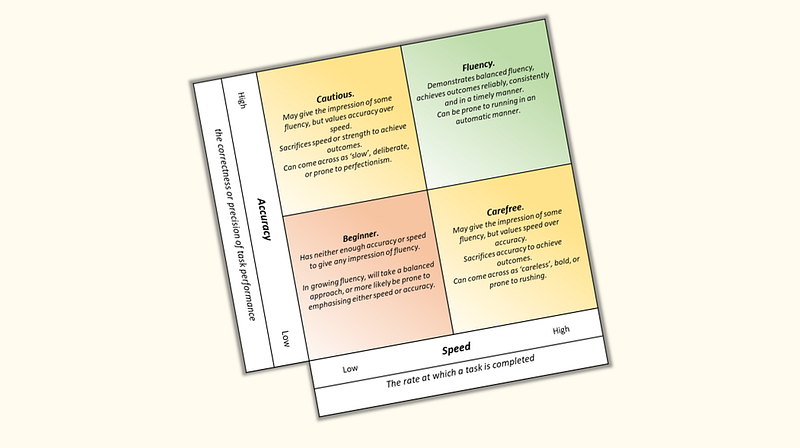
Low levels of both speed and accuracy puts us in beginner territory. We’ve all been here, in every domain that we’ve ever tackled, regardless of how proficient we’ve become in that domain. In this state, we’re typically very aware of our low levels of speed and accuracy, and as we build both, we begin to move towards one of the other three quadrants.
Relative high levels of accuracy, and low levels of speed put us in the cautious quadrant. Taking this route to fluency means that we value accuracy over speed. Given the general make-up of our education systems, this is also typically our default pathway to fluency.
Relative high levels of speed, and low levels of accuracy places us in a more carefree quadrant. In pursuit of fluency, in taking this path we value speed over accuracy. This is typically the path we take for sports and physical pursuits, given that many of our sports skew toward speed and strength as a measure of prowess.
An appropriate balance of high levels of speed and accuracy puts us in the fluency quadrant. Here we’re able to reliably and repeatable undertake the chosen task in a timeframe that is expected and accepted as good.
Analysing the relationship between speed and accuracy like this helps understand a few things about the fluency dynamic;
· The cautious and carefree quadrants are the zones of ‘yet’; we’re not yet fluent but are well on our way. There is a danger, however, that we linger in these zones, and not build enough capability to take us through to the fluency zone.
· These ‘yet’ zones are useful, and can hold danger. In either quadrant, we are able to show flashes of fluency and hence build confidence. We may be close to giving the impression of overall fluency. However, without the right kinds of calibration, we lay ourselves open to self-delusion on our actual levels of fluency.
· For cognitive domains in particular, our pathways to fluency through either speed or accuracy may have a lot to do with our personality traits and tendencies. Personalities that have tendencies towards task and achievement will be attracted to the speed route. Personalities that have an orientation to detail will be drawn to the accuracy route. Understanding these orientations are critical in helping navigate an appropriate, individualised pathway to fluency.
Fluency as the Gateway to Mastery
In thinking more about fluency as a stage in a broader journey of development, it occurred to me that fluency is a gateway to mastery. We can’t master that which we are not fluent.
I’m not sure we truly understand that link between fluency and mastery, in our Tik-Tok-ified, hustle-hustle, everyone’s-got-an-opinion kind of culture. A little like running before we can walk, we so often attempt to demonstrate mastery without yet attaining balanced fluency.
For us to be able to graduate to a stage of mastery, in any domain, we have to work on our fluency. In an ever-changing world, the context of our fluency is also ever changing, sometimes rapidly so. This means that fluency is not a once-and-done kind of attribute. Like a good knife, it needs careful handling and constant sharpening.
In service of gaining and maintaining our fluency, three thoughts come to mind;
1. Vulnerability is the essential ingredient. Everyone, in everything, begins somewhere. Our culture, though, has such an elevated sense of importance on achievement that we see ourselves as less-than in the process of growing.
In a way, this is the essence of vulnerability; to be comfortable being is a state of Not There Yet. To admit, inwardly, that we’re still on a journey of proficiency, and always learning.
“The beauty of fluency lies not in the absence of mistakes, but in the fluidity with which one navigates through them.” — Paulo Coelho
To be a beginner early in life is the most natural of things. However, the later in life we get, the harder it is to accept the mantle of a beginner. Some of that is the knowledge of the effort that it requires. Most of it, I suspect, is actually pride.
To be a beginner is to enter a world where mistakes and missteps outnumber achievements. To be a beginner is to know that Experience is the greatest teacher, and her teaching methods are agnostic to position or status.
Vulnerability comes into play in the ‘yet’ zones, too. To admit that we’re not quite fluent yet is sometimes harder to do than admit the status of beginner — the expectation of fluency may be greater, and the gap in the expectation and reality harder to reconcile.
This is when vulnerability becomes a value currency — the vulnerability to ask for help, to caveat input and outcomes, to leave space for correction.
2. Practice, practice, practice. In the learning process momentum is key. A stop-start approach to building skills and fluency is generally significantly less effective than a well-paced, cohesive and continuously approach.
The glue that provides that cohesion is practice. Any skill, cognitive or physical, worth building requires practice. Ideally that practice occurs in safe, simulated environments, but not always. Sometimes that practice needs to occur ‘out in the wild’, in live and uncontrolled spaces.
Practice situations are the ideal spaces to make and learn from mistakes. These are the safe spaces for experimentation, for trying different approaches, for shedding the expectation of perfection.
A good school provides this environment for its students. However, social engineering has meant that we seldom create for ourselves the practices zones for critical life skills once we leave school. We seldom create an intentional space where we allow ourselves to experiment, to get things wrong, to be able to learn from our experiences.
Creating such a space might look like groups of like-minded, like-intentioned folks meeting, sharing and practicing a specific skill set. The setting needs to lend itself to experimentation and growth, and not perfection and judgment.
As we’ve professionalised so many aspects of human activity, the difference between those that become true skilled professionals and those that straddle the line between amateur and professional isn’t talent alone, but rather practice and a mindset that values practice.
Amateurs practice until they get can it right. Professionals practice until they can’t get it wrong.
3. Take an embodiment approach. Somewhat counter to the two previous points, a pathway to fluency is to visualise the fluency before it occurs.
Becoming a good golfer entails knowing what the attributes of being a good golfer are. Playing a musical instrument to a high standard means inherently means that we know what that standard is, and how we’ll measure it and know when we’ve achieved it.
“To achieve fluency in any skill, one must immerse oneself fully in the process, embracing both the joys and challenges it brings.” — Maria Montessori
Getting started on a journey of fluency, especially later in life, means knowing what the fluency outcome is. Embodying that journey means that we’re able to make strong outcome statements.
Outcome statements are a kind of goal or intention, but that are made through the eyes of our future selves, speaking when the outcome has occurred, and looking back on the journey.
An example might be a goal ‘to become fluent in French’. That in itself might be our goal statement. However, taking an embodiment approach means turning the goal statement (to become fluent in French) into an outcome statement — ‘I am fluent in French, and I am able to travel throughout France and confidently engage in conversation in any setting’.
The outcome approach creates an embodiment of the learning process. It means that we’re keenly aware of the balance between the accuracy of the skill set, and the speed with which the skill set needs to be delivered.
It also means that we’re more likely to engage in the fluency process as an ongoing practice, rather than see it as a one-time thing. We see the value in continuously honing our skills, whether that’s becoming more accurate, or increasing speed or strength.
A good driver doesn’t stop learning to drive when they get their licence. They’ll discover ways to improve their safety, recognise the circumstance that improve (or impair) their reaction times, and their ability to read and predict the actions and behaviours of other drivers on the road.
~~~~
In processing the concept through thinking about, researching, and writing this piece, I think we’re in danger of becoming dangerously complacent to the role of fluency as an intentional practice, and the value of the fluency stage in development.
I’m grateful for deep and searching conversations that help highlight this — in itself, a kind of fluency practice.


