
BOOK RECOMMENDATIONS | PROMPT TIMES 11
Speaking of First books, My First Read in 2022 is “Speaking of Race”
Because conversations have the power to change hearts
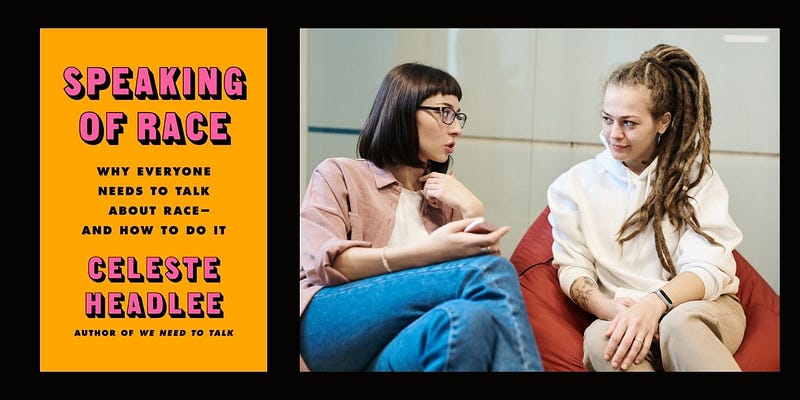
I first heard about this book on National Public Radio.
It turns out the author, award-winning journalist, Celeste Headlee, is a broadcaster for NPR.
Last November, Here and Now interviewed her about her new book, Speaking of Race.
Ms. Hardee is a perfect person to write this book.
She identifies herself as a Black Jew. Because her skin is very light, lots of white people assume she’s white like them and speak accordingly, even conspiratorily.
So she’s included in racially disparaging conversations. Which has taught her a lot about how we white people think.
Most of the time, she sets them straight and they apologize. Ms. Headlee takes advantage of those openings to explore the issue further, applying what she’s learned from having an insider’s insights into white minds.
And now she’s sharing her lessons with all of us.
From what I can tell so far, they are gold!
She wrote Speaking of Race to empower and support any of us who want to talk about the issue to people we care about, whose ideas may differ from ours.
She cites a study showing that white people have more impact on changing the minds and hearts of other white people than do people of color. So there’s our mission, should we decide to take it on. We can be effective.
Even if we consider ourselves a work in progress. She writes:
First, everyone is a work in progress when it comes to prejudice and human diversity, with room for education and enlightenment. Second, racism has wasted enough of our time. Action need wait no longer for further information. We know enough about racism to know it must end.
On the radio, she spoke about finding common ground with people whose views are different from ours.
This is what grabbed my attention. It was an aha moment. Instead of being confrontative, can I be curious? What makes them do or say or think that? If I understand them better, I’ll have a better chance of touching their heart. Ms. Headlee reminds us:
Debates have changed very few minds, but conversations have the power to change hearts.
Her book is about how to have those conversations.
Not with Neo Nazis and the like.
But with people we care about. Friends and family members. The ones who may have voted for a certain president whose name we’d rather not say. The ones who make it hard for us to relax at holiday gatherings. And yet, we love them.
That love is our starting place. A platform to build from.
It helps if we point out racist words and deeds without having to label a person as racist. But there may be times the shoe fits. Ms. Headlee quotes Ibram X. Kendi from his book, How to Be an Antiracist:
Racist is not…a pejorative. It is not the worst word in the English Language; it is not the equivalent of a slur. It is descriptive, and the only way to undo racism is to consistently identify and describe it–and then dismantle it. The attempt to turn this usefully descriptive word into an almost unusable slur is, of course, designed to do the opposite: to freeze us into inaction.
If we can use this word without getting all defensive, we can explore if, when, why, and how specific words and deeds are so hurtful and harmful.
Ms. Headlee relays a story about a neighbor who asked her to take his mail in while he was on vacation because he didn’t want ‘those people’ to know he was not at home.
She answered him, I’m happy to get your mail. But just so you know, I’m Black, so I’m one of ‘those people.’
When he insisted that he was not a racist, she retorted, You absolutely are! But I’m still going to get your mail, don’t worry. Have a great vacation!
She could have called him out, rejected him, and refused to help.
But she would have lost a teachable moment.
Instead, she did a yes/and–a technique I learned in improv. Yes, you’re racist, and it’s not the end of the world. You’re still a person and my neighbor and I will help you.
Note she did not let him off the hook.
That’s where the rubber meets the road. If we are not clobbering folks over the head, do we let them get away with their offensive crap without comment? This only encourages them to continue.
Somewhere in there is a middle ground which will probably take us lots of practice and some failed attempts to find. But our efforts will be well worth it. This is a conversation we need to have as a country, Ms. Headlee points out. Given the ubiquitous nature of our peculiar breed of this dreadful disease.
As New Orleans’ Mayor Landrieu told her in an interview after he proposed removing Confederate statues remaining on municipal land:
But we’ve never practiced having a productive conversation. How can we be good at it? Germany did it. South Africa did it. We’ve never done it.
Being inexperienced is not an excuse. This is a skill acquitted through experience. We have to start somewhere. We have to start sometime.
I just flipped to the last line of the book to see how it ends. She says:
I wish you patience and joy in discovery. Good Luck.
Patience. With ourselves. And the folks we choose to talk to. A word worth remembering as we head into all the unknowns of this new year.
As these conversations take courage, enjoy these inspiring words from Janice Eastman about courage and determination as modeled by Atticus Finch from the pages of To Kill a Mockingbird:
Thank you Marrisa W., for your Reading in the New Year Book Times Prompt!
Marilyn Flower writes humor to laugh at the changes she wants to see and make. She’s the author of Creative Blogging: Ninja Writers Guide to Character Development and Bucket Listers, Get Your Brave On: How to Do the Thing You’re ‘Too Old’ & ‘Too Scared’ to Do. Clowning and improvisation strengthen her resolve during these crazy times. Stay in touch!


