
Speaking Kind Words Can Break Curses
Use opportunities to speak kindness — you never know the power your words might have over a wounded soul

My older brother (by 12 years) — a wry and witty fellow who I always thought could have been a stand-up comedian if not for his shyness and low self-esteem that has inhibited him his whole life — had a nickname for me as a child.
Mary Ugly.
I’m sure, in his teenage way, he thought this to be a great joke, maybe even an endearment. I don’t recall him ever saying it with cruelty or vindictiveness, just a sing-songy voice that would greet me, “Hey, it’s Mary Ugly.” I doubt he ever intended to hurt his preschool sister or plant seeds of self-doubt and body image shaming in my tender soul.
He couldn’t have known the way I was wired, the way I took words to heart, the way I sought — even as a young girl — the approval from those I looked up to. He had no way of understanding how his words were truth to my fragile self-identity.
A man sees in the world what he carries in his heart. — Goethe
Looking at pictures of myself as a child, I see I was far from ugly. A petite blonde with too-large-for-my-head eyes in a distinct golden green hue, I was cute, probably adorable. But the only word that bounced around in my head when I looked in the mirror was ugly.
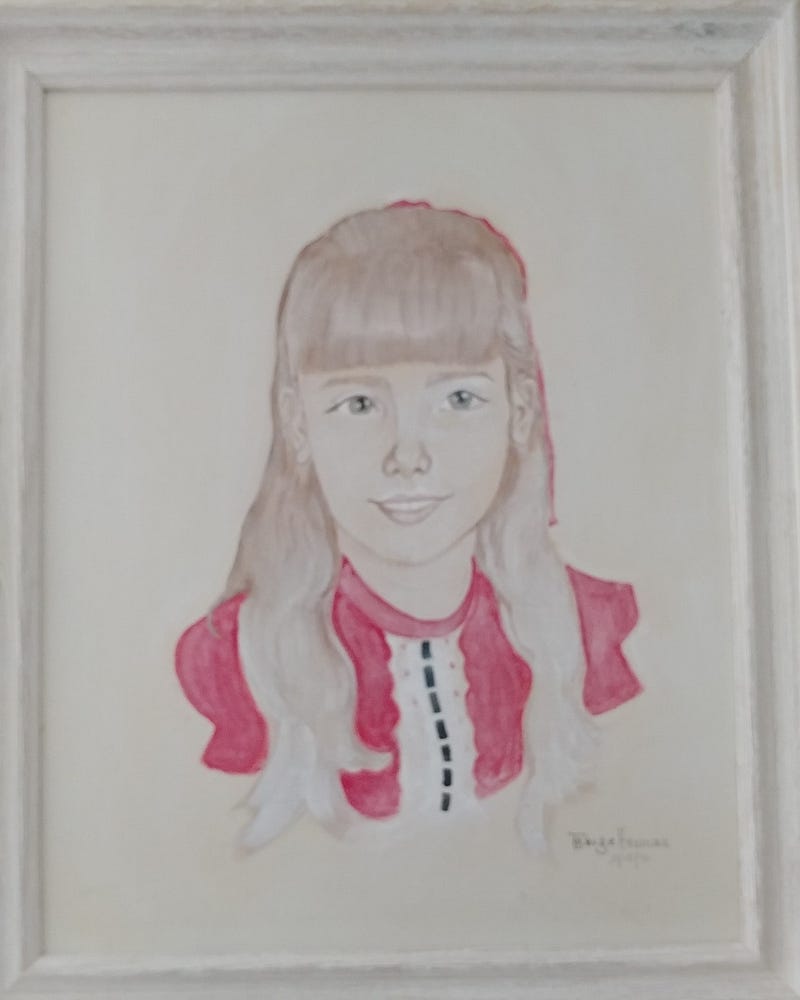
This hidden fear over my appearance was growing as I entered middle school and hormones started doing strange things to my body — a time when all children feel gawky and unattractive — known as the ugly duckling stage. My skin turned oily and my bony frame began to flesh out as I developed faster than my peers. My almost white hair darkened into the dreaded “dishwater blonde” and thickened into an unruly mane that I pulled back into an austere ponytail. The idea that I was ugly grew to a head as whiteheads formed on my forehead, confirming what I had known all along: I was Mary Ugly.
Customary shyness was burgeoning into self-consciousness. The little girl who used to color outside the lines and dance around the house sans underwear was now fearful of drawing undue attention or criticism her way, so she tried to fade into the background, to become unnoticeable, indistinct.
Try as I might, this strategy failed and attention was what I was getting in the form of intolerable teasing from boys. I misinterpreted this teasing as hate, or confirmation that was indeed Mary Ugly and would have to bear that curse the rest of my life. We all know that little boys tease girls as a cover-up for their embarrassment over their emotions and attraction toward them, but no one had explained that to me.
Then the curse breaker set me free.
I’ll never forget the setting.
William Foster Elementary School in an ordinary suburb in middle America. Sixth grade, the inside of the main doors to the building, lunch hour. I was dressed in my crossing guard uniform awaiting the return of the bunch who went home for lunch to Campbell's soup and grilled cheese sandwiches.
I waited with another crossing guard, a boy who two years earlier had presented me with a “diamond” ring as proof of his love for me. Embarrassed, I had tossed the ring and his love letter in the garbage, telling no one. Weeks later, he begged for the ring back, confessing he had stolen it from his mother’s (perhaps sister’s — these details are fuzzy) jewelry box and now needed it back. I still wonder what punishment he received for giving away what I later realized must have indeed been a real diamond ring!
Nevertheless, here we stood, two years later, as he relentlessly teased me (details are again a bit unclear but the shame and embarrassment still rings clear in my memory). Rich Rosa, our school’s janitor and an overall great guy who always talked to the kids and made us feel welcome in his presence, was interacting with us.
I can still see him leaning over his mop and pail, dressed in his green janitor uniform as he became my guardian angel and curse breaker. Over the years this image has grown in proportion to my gratitude for his kindness, making him look a lot like Frankie Avalon as Frenchy’s guardian angel in the Beauty School Dropout scene from Grease. To be fair to my schoolgirl imagination, Rich Rosa was dark-haired and suave looking like Frankie Avalon— albeit less renowned and he did not sing to me.
What he said were words that spoke truth to a wounded spirit and helped me step out from the curse of Mary Ugly. Rich told my tormentor that I was indeed the prettiest girl in our sixth-grade class. “You’ll see,” he said to my classmate, “She’ll be the most beautiful girl in high school.” (I guess Rich knew about that ugly duckling stage too.)
I felt like Cinderella at the moment the prince slipped the glass slipper onto her foot and silenced her jealous relatives. I began to see myself differently from that day forward. Attention from boys (and men — it’s sad but true) proved my guardian angel’s words to be true as I spent my teen years fending off unwanted advances and catcalls.
While I am not suggesting outward beauty is what makes us beautiful inside, I am admitting that I needed to hear that truth spoken over me as an insecure young girl.
Guardian angels show up when we least expect them and sometimes they’re dressed like servants with mops and brooms.
God may use a willing but unexpected person to lay hold of our hearts to break curses and bring freedom. Lean into this magic and allow the curse breakers to speak over your life. Then move forward with the truth you receive, speaking chain-breaking love over others.


