
Speaking English With An Accent
What happened when I discovered that I spoke English with an accent…
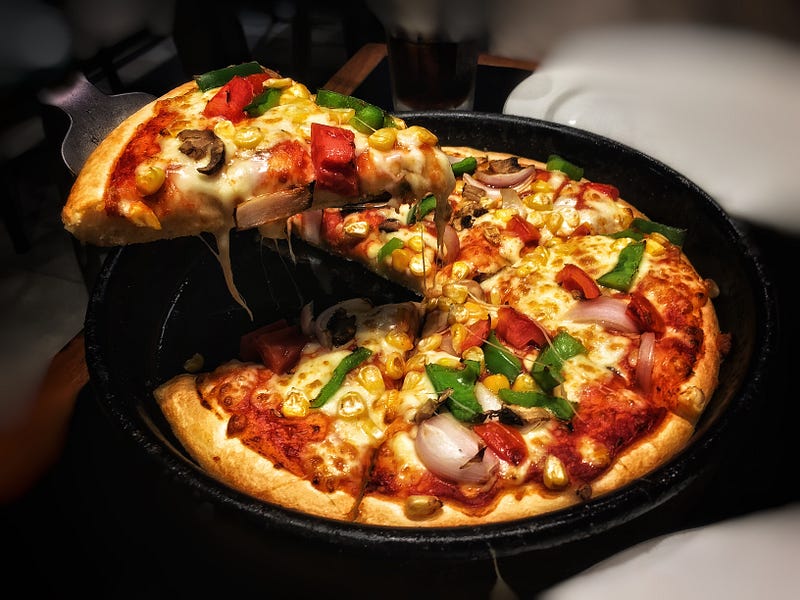
Four days after I moved with my family from Mumbai, India, to Cleveland, Ohio, I picked up the phone to order pizza. I’d eaten pizza twice before in Mumbai — at a small eatery that served a spicy-sweet tomato sauce and cheese on a six-inch pizza base. (This was over twenty years ago. Pizza is now widely available in India.)
But now that I had come to America, I couldn’t wait to try America’s favorite food.
I dialed a number from a flyer that had come in the mail. “Hello, I would like to order pizza.”
“Sure,” said a young male voice at the other end. “You have Q-pins?”
Q–pins? “Is that something you need to order pizza?” I asked.
There was a short silence. Then the voice began talking Q-pins all over again. I thought: He’s speaking English, but what is he saying?
In India, my medium of instruction through school and college was English. I had watched American sitcoms and Hollywood blockbusters. I had read any number of bestsellers set in New York, Chicago, Dallas, and Beverly Hills.
I was no stranger to American English.
Or so I thought.
Now in Cleveland…
Now, in Cleveland, the kid finally stopped talking. I jumped in quickly before he could go off once more on Q-pins.
“I would like to order a pizza,” I said, “with edges that are crisp not burnt. And please don’t put too much cheese. Or too much— ”
“Come again?” said the kid.
Come again?
“Sure,” I replied. “But this is the first time I’m ordering pizza from you. If I like it, then I’ll come again.”
“Ex-cuse me — ”
For what?
“Uh… what should I excuse you for?” I thought it better to ask.
I heard a huff at the other end. I didn’t know what was happening, but it sounded like the kid and I had our wires tangled. Still, I was going to eat pizza today or die trying.
I took a deep breath and began rushing out my order. The kid got in a word edgeways, something about “toppings.” I rattled past the unfamiliar word. When I finally stopped, I was breathless.
And that was when the kid said, “I’m sorry, Ma’am, but-” He spoke politely but slowly, as if each word had a period after it. “I. Don’t. Understand. Your. Accent.”
Now that I understood. My mouth fell open and stayed that way long after I banged down the handset.
How dare that boy imply I had an accent! His words ran into each other. He spoke as if he were singing. My diction was perfect.
I didn’t have an accent. He did.
I stood with my arms braced against the kitchen counter, breathing as if I’d sprinted up five flights of stairs. My cheeks were on fire; my heart thudded against my eardrums. Any minute now, I was going to burst.
And then, suddenly, shockingly, I burst out laughing.
It was as if somebody had stuck a pin into the bubble of my self-righteousness. When had I appointed myself Supreme Decider of the propah accent for the English language? When had I decided that anyone who didn’t speak like me had an accent?
It was nonsensical. I’d better not tell anyone. So I never did.
And Q-pins?
Q-pins? I finally figured that one out. Only I pronounced the word as “koo-pawns.” (Coupons)
We don’t have accents…
Two years later, I signed up for a Speech and Communications class. Our instructor was Ms. Davis, a forty-ish woman with sharp hazel eyes and bobbed blonde hair. On the first day of class, Ms. Davis walked in and said, “Please put up and your hands if you think you have an accent.”
The emphasis on the word, “think” was unmistakable. I put up my hand, as did the four other immigrants in our class.
Then I waited for the other shoe to drop.
Ms. D. called on three of the twenty students who had not put up their hands. “So you don’t have accents. How come?”
We were born here. We grew up here, they said.
“Where?”
Boston; Huntsville (Alabama); and San Jose.
“So… do you speak exactly like each other?”
Of course not! Our accents are different.
“Then you do have accents,” said Ms. D.
She would have made a stellar addition to any courtroom.
The students looked at each other, then back at Ms. D. Their expressions took me back to that evening in my kitchen when, fresh off the boat, I was trying to order pizza.
“We all have accents,” said Ms. D., “because an accent is how one speaks a language.”
And now this…
Actor Tom Hanks reportedly told his Philadelphia co-actor, Antonio Banderas, “Don’t lose the accent. If you do, you’re lost.”
When Tom Hanks gives advice, I listen.
Twenty-five years after coming to America, I still haven’t lost my Indian accent. But I speak slower now. Sometimes, I roll my “R”s. My vocabulary is more American. I say “gas” and “apartment” instead of the British/Indian terms: “petrol” and “flat.”
I no longer feel self-conscious about my accent. Now I wear it as a cultural badge of honor.
I see English — or any language — primarily as a mode of communication. I see English as a language, not an accent.


