
Spain’s Darnius Lake Isn’t What It Used To Be
Prophecy, drought, and a ghost town beneath the waves
The lake isn’t new
Not to me. Not to anyone.
Darnius Lake may be in Spain, and not in France where I live. But in the EU, borders are as flimsy as the space between one word and the next. The Roussillon plain I now call home is an astonishingly dry place. And getting drier by the year. The closest thing to a lake around here is the vast salt ponds that breed mosquitoes and flamingos in equal measure and collect pools of light on their shimmering surface while the sun shines every day. The nearest real lake to me is Darnius.
Between here and there, mountains rise. High enough to block or at least redirect the wind, the tramontana that comes roaring across the South of France and curls cold fingers around Narbonne, Perpignan, Cadaques, Girona. When the wind blows too hard at home to launch a boat, when the sea swells and swirls and breaks white in frosty corrugations from here to the horizon, I take my kayak to the lake instead.
Yesterday was Canada Day
The startlingly recent birthday of my old home.
I have no time for patriotism. But there’s a difference between being proud of something you yourself didn’t achieve and being grateful for the citizenship bestowed on you. So I went with my wife to have a poutine in honour of the vast country we left behind to settle here instead.
My family is spread like pollen across the earth. Wherever I might go, I’m leaving someone behind. When we left Canada, her concerns were for her mother and her friends.
Mine were for the wilderness I was leaving behind.
Half an hour from where we used to live, I could reach the stony shore of ice-cold Harrison Lake and have it all to myself. In winter, the water would steam like a smoking mirror, and eagles watched as I glided like a ghost through perfect silence.
By Canadian standards, almost everywhere is overpopulated, including Europe. I didn’t imagine I would find that kind of solitude here.
I was wrong about that.
It’s Sunday. It’s early July. The sun is shining, and the wind is uncharacteristically low. The lake is not deserted. Cars cluster in the parking lot, their windows cracked to let the heat escape. Fishermen cast strands of silk into the water. Families splash around in the shallows.
But my kayak is what it has always been, a magic carpet that can get me far away from the chatter of the human world and into the heart of the breathing silence.
I know this lake. But not every corner. Following the shoreline into what I had always thought was a shallow bay, I found instead a channel carved through cliffs. The parking lot and the families on the beach soon disappeared. The only sound was the hum of the cicadas in the trees and the splash of my paddle rising and falling in the water.
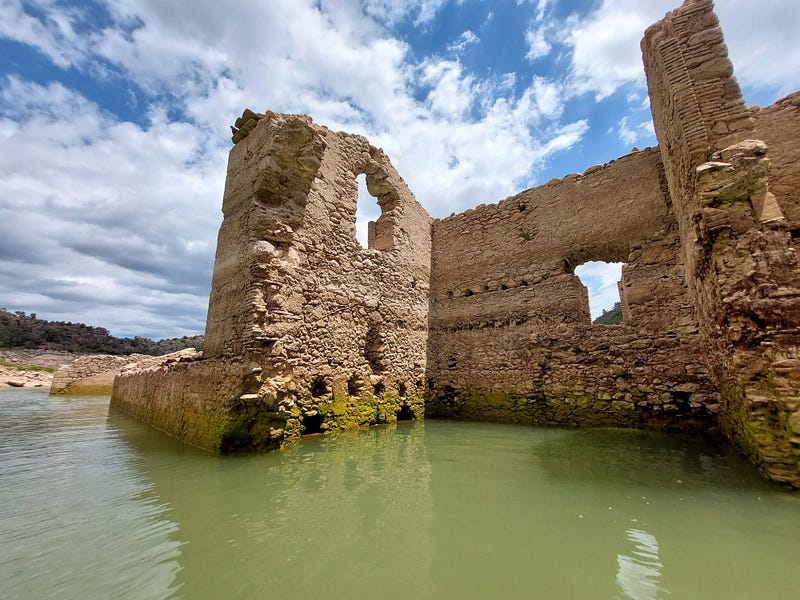
Then I turned the corner and saw it. Out of the grey-green water of the lake, stained with algae and time, the dust-brown remnants of a submerged town.
You have to be careful about what you write in your twenties
At that stage, you’re all heart and hormones. You may have a purity of focus and an ambition you will come to miss in later life, but you don’t have much of a brain.
I had read somewhere about a drought in Spain that had caused the church tower of a town sunken in a reservoir to reappear, and the image nudged me in that special way certain images do to tell you there’s a story coming in, whether you like it or not.
I wrote a story about two friends saying goodbye to one another as one goes travel to Spain, the other staying behind in Canada, neither of them knowing it’s the last time they’ll speak (give it a read! It’s free!). Back then, I didn’t know how to write stories without killing at least one character.
And the town rising from the lake seemed to promise exactly what the characters in the story couldn’t have. The horrible power of the past. The drowned town rising again, the ghost of its silenced bells ringing out over the evaporating water.
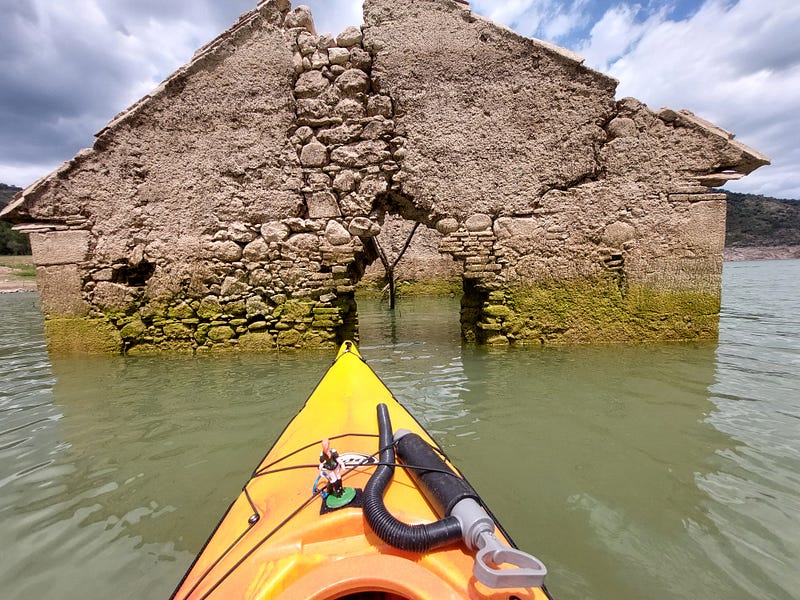
Twelve years later, I find myself paddling my kayak through the yawning doorway of a building in a Spanish town I never knew existed.
Danius Lake is a reservoir
The dam was constructed in 1969 at one end of a wooded valley. The townsfolk were evacuated from their homes before the water began to swell around the foundations of their building. The town was lost completely, only the Hermitage of Saint Sebastian on its hill visible from time to time when summer made the water level drop.
But now, the rain doesn’t fall at all. This year’s snow on the mountains is just as feeble as the year before, and Europe is running out of water.
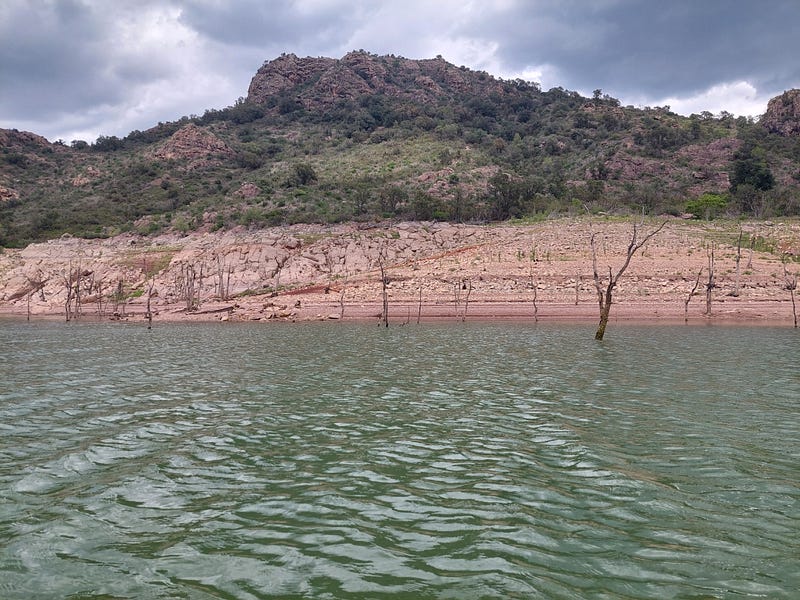
Paddling along the surface of Darnius Lake, I can see the sharp line where the trees end, the divide between land and water that now sits a good ten meters above my head. Dead trees rise out of the water all around me, reaching blindly toward the sky they never thought to touch again. And the buildings rise with them, the crumbling stone walls reflecting flickering bars of light from the water that’s leaving them behind, returning them to the bright sun and wind of the land and of the living world.
A story is not a prophecy
Not mine, and nobody else’s, either. But if a story has some grain of inner truth, no matter how young and dumb the writer, it will cast some faint shadow on the world. Some hint of my drowned Canadian past suddenly rising above the shrinking water again.
Over the silence of the lake, with no other human around, I can hear again the ringing of those church bells I heard all those years ago when I picked up my pen. I’m still hearing it now. While I write and drink and pray for rain, pray to gods that were less kind to me then than they are now, to bury the town at Darnius Lake under the airless weight of water again.
The lake is not new. The town is not new. Drought and dry spells have happened before and will happen again, which is why the dam was built in the first place.
I haven’t been here long enough to know what’s normal and what’s not, whether the sunny aridity of my new home is the way it’s always been, or another example of the unwelcome changes we can cause, but can’t seem to stop. The vanishing water of the lake and the reemerging drowned town suggests it’s all our fault, as usual.
There’s no denying that it was a strange thrill to paddle my boat through the yawning windows and doorways of the town that was flooded when the reservoir was built. But I hope, no matter what the climactic trends say, that I’ll never see it again.


