
SpaceX’s Starlink Expanding Beta Testing to Civilians
SpaceX is accelerating and expanding beta testing of their global, high-speed, broadband satellite internet service
1. What is Starlink…
A couple weeks ago I reported on SpaceX’s efforts to conduct a rigorous beta test of their Starlink internet system (beta test is a late-stage trial of a product by a restricted population of real users who are independent of the company developing the product). SpaceX continues to accelerate and expand that beta test to more users, according to a recent filing with the Federal Communications Commission (FCC).
The divisive, disruptive, and wildly successful entrepreneur Elon Musk has begun building his global broadband satellite internet, Starlink, to bring internet to people and places currently lacking. Musk is in the early stages of building a vast constellation of very low-earth orbit (VLEO) satellites. The constellation may consist of up to 42,000 small satellites, according to recent FCC filings, in orbits that range from 328 (below the International Space Station) to 1,200 kilometers in altitude.
I wrote about the brief history of Starlink six weeks ago, so for more information about the company, check it out in the link below.
Although Musk and Starlink are still years away from building out the whole Starlink constellation, there are enough satellites in orbit to provide service in certain locales, and for emergency purposes.
That is exactly what is going on now in their beta tests.
2. Recent beta test in Washington State…
Earlier this year, Starlink provided free satellite terminals and internet service to Washington state as part of a private beta test.
Washington state’s emergency response personnel used Starlink to bring internet service to hard-hit regions during their August wildfires.
Malden, Washington, was hit by fires that began around Labor Day and destroyed about 80% of the town’s buildings. They received SpaceX terminals set up by the Washington Emergency Management Department (WA EMD).
Specific uses of Starlink included using the terminals to coordinate water drops onto fires, requesting additional support, resources, and supplies from WA EM.
The WA EMD has several even larger disasters planned for including a massive earthquake from the nearby Cascadia Subduction Zone, which they project could leave the region without power for weeks.
A spokesman for WA EMD said about Starlink, ““This is a device we could definitely utilize should we have more wildfires or even larger disasters”.
3. Starlink’s FCC filing…
SpaceX submitted a filing with the FCC a couple days ago which included a presentation with slides which are included here.
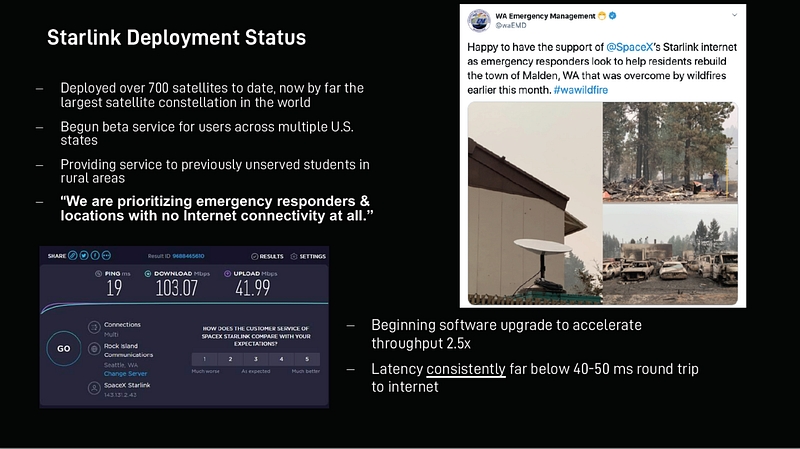
The status slide shown above states that over 700 satellites are deployed (they have approval for up to 42,000 satellites, though it is not clear that they will actually deploy that many).
My article a couple weeks ago noted the Washington State beta test, as well as tests with different branches of the U.S. military. The SpaceX slide notes beta tests in multiple states, though I don’t know whether that includes the different military tests I discussed previously, or if civilian beta tests are now occurring.
Importantly, SpaceX notes software changes that accelerate throughput by a factor of 2.5X, and a latency below 40–50 milliseconds (ms), round trip.
For terrestrial networks, one study suggests online gamer’s enjoyment of gameplay decreased with latency in the system above 100 ms. Latency of 50 ms was not noticed in users who controlled RC-cars over a network. More recent gaming broadband articles suggest gamers should look for latency less than 75 ms. SpaceX easily comes in far below these arguably strenuous requirements.
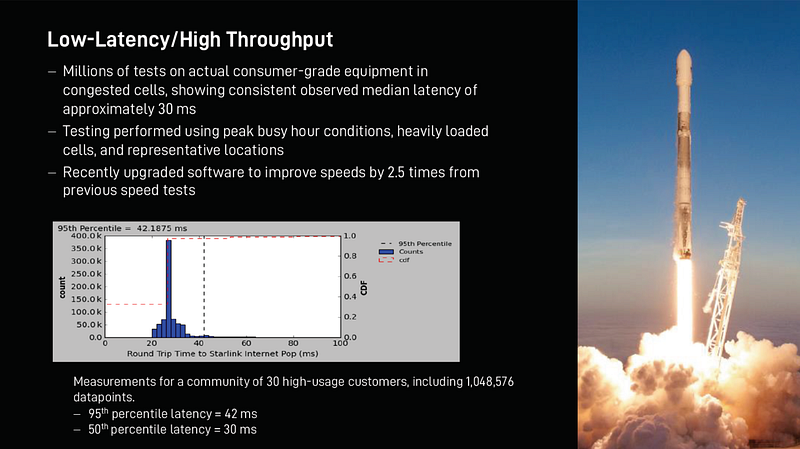
SpaceX then showed data demonstrating that under tough consumer conditions of “congested cells… peak busy hour conditions… representative locations” on consumer-grade equipment, their median latency was 30 ms, and the 95th percentile latency was about 42 ms. All well within necessary consumer-grade and even online gamer requirements.
There are reports coming in, however, with beta testers not happy with the performance of Starlink already. This is an August 2020 article in The Independent claiming that a company, Ookla, tested Starlink’s download/upload speeds and found latencies between 31 to 94 ms. Here is the Reddit site credited by The Independent in collating the speed data.
The vast majority of the data comes from Seattle, but also included Los Angeles, Chicago, and Honolulu.
Then the next slides start to get pretty wonky. SpaceX discusses some modifications to their satellite constellation, lowering “remaining” satellites to 540 to 570 km. The International Space Station is at about 409 km. Previous altitudes ranged as high as 1,200 km, but also as low as 328 km.
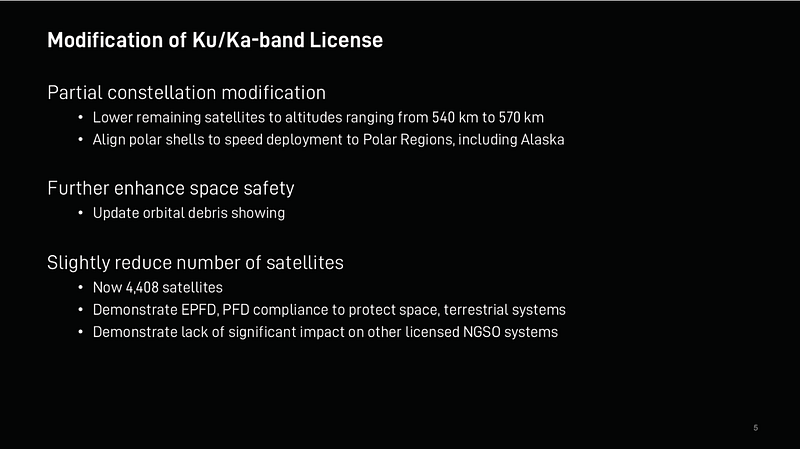
SpaceX also discussed aligning some satellites over polar regions including Alaska, enhancing space safety by controlling space debris, and reducing the total number of satellites.
Then SpaceX throws some acronyms around, EPFD and PFD. PFD is “power flux density”, and EPFD is “equivalent power flux density”.
These acronyms refer to regulations and calculations established to limit signals broadcast from satellites from interfering with other satellites and ground stations. SpaceX makes the point that their system meets these requirements.
The last slide gets into competitive issues that seem to impact SpaceX. They refer to the mother of all acronyms, MVDDS. Multichannel Video and Data Distribution Service. Wikipedia helpfully says MVDDS is a
“…terrestrial based wireless transmission method [which] reuses Direct Broadcast Satellite (DBS) frequencies for distribution of multichannel video and data over large distances.
The spectrum is in the 12.2–12.7 GHz range, offering fast downloads but requiring other frequencies for uploads. It is seen as a potential competitor to cable for delivery of triple play or triple-threat services (voice, data, video)…”
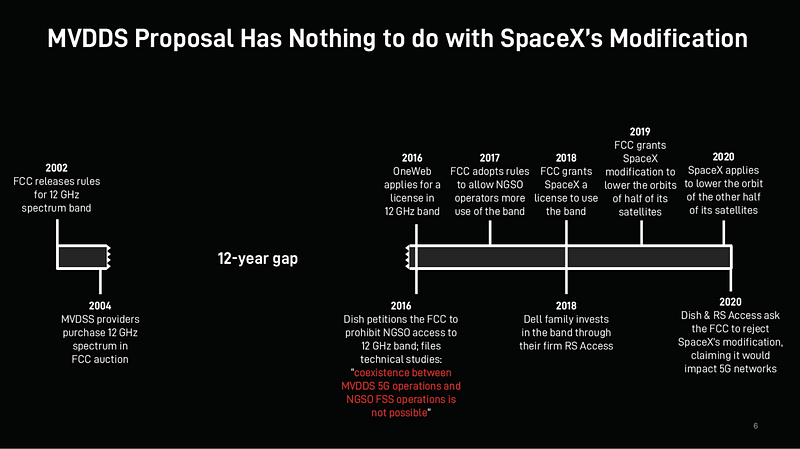
SpaceX’s cover letter to the FCC refers to MVDDS licensees attempting to introduce changes to the FCC’s current regulations on 12 GHz band use. Who are these licensees? Companies like Dish, Cass Cable TV, Go Long Wireless, RS Access, Vision Broadband, etc.
As far as I can tell, these are not satellite operators, but are carriers who operate terrestrial networks, and who expect to rely on a satellite or other network to provide the long-distance internet backbone. I can’t tell what exactly the dispute with SpaceX is, but I can image these companies would prefer to be able to control Starlink as needed. Furthermore, one can imagine that these companies see Starlink as a future potential competitor, since Starlink will be able to receive and transmit direct to consumers who install an inexpensive satellite dish (Musk’s now-famous UFO on a stick). I foresee these other licensees trying to push modified FCC or other regulations prohibiting satellite internet operators from delivering direct to consumers.
IF this indeed comes to pass, each and every one of you needs to make an effort to derail any such restrictions on SpaceX. Whether at the local, state, federal, or international level, make sure MVDDS companies like Dish and others noted above do not weasel through regulations to restrict competition. Make sure SpaceX and Starlink remain free to deliver satellite internet direct to all consumer’s homes and businesses.
4. What it means for us…
The fundamental purpose of Starlink is to provide low-cost high-speed broadband internet to all locations around the globe, but especially to areas and to people currently lacking such access. That is why these private beta tests are so important — to verify Starlink’s ability to deliver in internet-poor areas under the most critical times such as during emergencies.
If we live in such areas, we will benefit directly.
If we don’t, we’ll benefit anyway as people around the world connect and look for products and services and content not currently available to them.
My first Starlink article alluded to the cliché of a rising tide lifting all boats, referring to Musk’s motivation to expand internet access. We all benefit when we all have access to basic infrastructures such as internet.
And finally, Musk mentioned that when Starlink revenues become stable and predictable, he plans to hold an Initial Public Offering (IPO), in which retail investors (if you are reading this, you probably qualify as a retail investor, the average Joe, supposedly the “dumb money” according to professional investors).
5. Disclosure…
I am a happy owner of almost the oldest possible used Tesla Model S, and am also happily invested in Tesla the company.
You may also like my recent review of Netflix and their culture here:
The recent review of the early Starlink beta test is here:
And again, the Starlink historical review is here:
And a totally wacky short story gratuitously referencing SpaceX that I know you will love is here:


