
SpaceX Drone Ships — The Evolution of Space Launch and Recovery

The first satellite launched into orbit around the earth was the Soviet Union’s Sputnik 1. It was launched on October 4, 1957 on a modified Soviet R-7, an intercontinental ballistic missile (ICBM) based on Nazi Germany’s V2 rocket design.
After 116 seconds of flight time, the strap-on boosters detached from the rocket and crashed to the ground. The core stage of the rocket continued until an altitude of 223km (139 miles) above sea level, successfully launching Sputnik 1 into orbit. This momentous achievement shocked the world, particularly the Americans, kicking off the Cold War space race.
Fast forward 58 years to December 21, 2015. Elon Musk’s company, SpaceX, is preparing to launch its Falcon 9, flight #20, from Cape Canaveral Space Force Station in Florida. It’s an orbital launch mission on behalf of SpaceX client ORBCOMM to launch 11 satellites into orbit. The launch went off without a hitch… and so did the landing of the booster back on the launch pad. It was history’s first landing of an orbital launch rocket.
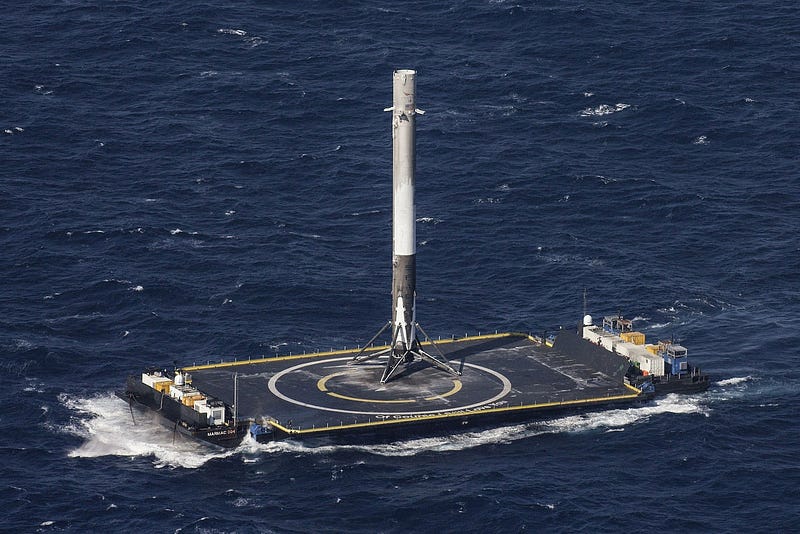
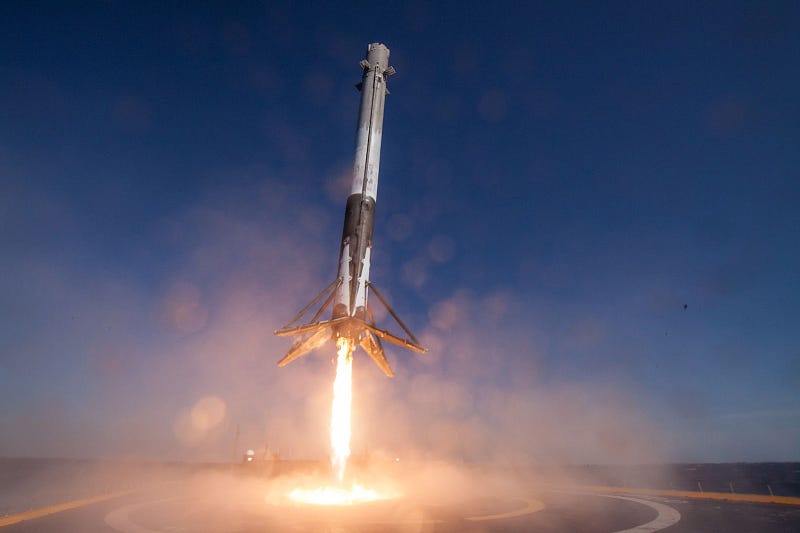
Fast forward again, to April 8, 2016, off the coast of Florida. Falcon 9, flight #23 is coming in for a landing on the drone ship Of Course I Still Love You. It’s SpaceX’s third attempt at landing a rocket booster on a drone ship — and third time proves the charm. The landing is another historic one, bringing SpaceX closer to its ambition of “full and rapid reusability”.
What Are Drone Ships?
Given the above events, one might ask what a drone ship is and why SpaceX decided to land their rocket booster on one, instead of a traditional landing pad.
SpaceX’s drone ships are repurposed barges that have been outfitted with a landing platform, thrusters for staying inert, and a robot for securing the boosters to the deck. Ship dimensions are approximately 170 meters (560 feet) long and 50 meters (160 feet) wide. The ships also have multiple thrusters which allows them to maintain their positioning within 3 meters of the target.
The vessels allow SpaceX’s rocket boosters to safely land after deploying their payloads. A landing over water is for the added safety, as well as for boosters not carrying enough fuel to return to the launch site.
To get to the booster landing location, the drone ships are towed into place by tugs, but once there they are capable of autonomously maintaining their position using their thrusters.. Among the ships, ASOG is the only one that has demonstrated the ability to autonomously sail to and from the landing site in addition to automatically maintaining its positioning.
SpaceX currently has 3 drone ships in operation: Of Course I Still Love You (OCISLY), A Shortfall of Gravitas (ASOG), and Just Read the Instructions (JRTI). All names taken from Ian M. Banks’ Culture series of sci-fi books.
The whole launch sequence consists of five main stages:
- Launch of Falcon 9 and separation of the second stage. The second stage continues, carrying the payload.
- Several of the engines on the detached booster reignite so it can maneuver itself towards the droneship, using onboard guidance systems.
- The center engine reignites to slow the descent and orient the booster fully vertical. Grid fins extend to stabilize the rocket.
- The booster performs a final landing burn to slow itself even further. Landing legs are protruded.
- The booster is secured to the deck of the barge, manually or using a robot.
Part of the problem with landing the Falcon booster is that a barge is not as stable in the water as some other vessels would be. This puts a strain on booster maneuvering and drone ship stabilization, which must be precise enough for the booster to land within the limits of the barge deck, even in choppy seas and with GPS errors. Additionally, the booster must remain upright for long enough to be secured to the deck. It’s a process reminiscent of attempting to land a jet on an aircraft carrier.
When it comes to the choice of landing vessel, there could be several reasons for using repurposed barges instead of something else that might be more stable. The barges can operate without a crew, they can use shallow ports for docking instead of deep water ports (saves cost), they operate under looser maritime regulations leading to cost savings, and barges are easier and cheaper to acquire. Additionally, a barge sits low to the waterline which makes it easier for a crane to remove the already tall Falcon 9 booster from the deck.
A Brief History of Drone Ships

Let’s go through a brief timeline of the drone ship fleet:
- 2009: Elon Musk expresses his determination to create a paradigm shift in the traditional attitude to reusing rocket boosters.
- October 2014: Announcement from SpaceX that they have contracted a Louisiana shipyard to build a floating landing platform for reusable rocket hardware.
- December 2014: The first drone ship, the Marmac 300 barge, is used for testing.
- January 2015: Musk announces that the ship is to be named Just Read the Instructions (JRTI).
- April 2015: Original JRTI is scrapped due to damage.
- May 2015: The drone ship Of Course I Still Love You (OCISLY) goes into service.
- June 2015: A new barge is converted into a drone ship to replace the previous JRTI.
- June 2017: The OctaGrabber robot is used for the first time to secure a landed rocket to the deck of the drone ship.
- July 2021: A Shortfall of Gravitas (ASOG) begins operations.
Benefit and Purpose of Using Drone Ships
The main reason for using drone ships is the rocket booster fuel savings, which allow for increased payload capacity. The rocket can carry a payload about 40% greater by not needing to carry additional fuel to return to the launch site.
Many of the benefits of using drone ships as landing pads revolve around flexibility. Launching over and landing on water opens up more geographic locations for use, as well as enabling many more orbital trajectories. All of these additional geographic locations and trajectories greatly increase launch opportunities, which is needed to meet the requirements of different customers.
The flexibility allows SpaceX to choose the most optimal launch location for a given mission, as some orbits are more easily reached from certain points on the globe. And the drone ships allow the use of launch sites that would otherwise be disqualified due to lack of suitable landing sites.
Another benefit of landing over sea is the added safety. It is far away from any populated area and the relevant region of the ocean can easily be blocked off by the coast guard during a landing. A drone ship could also function as a backup landing location in the case of error. The rocket can then be diverted away from its original landing location toward a nearby drone ship.
Scalability is also a consideration. As the cadence of launches increases, the demand for landing sites in a given location will increase. This is especially true given SpaceX’s dedication to launching all the satellites for its Starlink satellite network which aims to extend internet access to people around the world. Drone ships help mitigate this problem as they can be moved to wherever they are needed. This is easier and cheaper than building multiple fixed landing sites in multiple locations; a drone fleet can be moved from location to location instead.
Future developments
Continuous work is being done on the drone fleet with upgrades to functionality and procedures.
Fully autonomous sailing, rather than just maintaining a stationary position, is one possible upgrade for the fleet. As mentioned previously, ASOG is the only drone ship known to have this capability, though JTIR is rumored to have the ability also. Autonomous sailing would allow operations without using tug boats, but would require more diesel for the onboard thrusters; it’s unclear whether this would be economical.
JTIR has had its old retractable thrusters replaced with much more powerful electrically-driven ones that are permanently submerged. They should allow the drone ship to maintain its position better in rough seas and weather. It’s possible the other drone ships will follow suit.
In 2019, SpaceX was granted permission by the US Coast Guard to employ its own aids to navigation (ATON) system to create traffic exclusion zones in the Atlantic Ocean during launches from Cape Canaveral. Meaning there is less need for coordination and participation from the Coast Guard during drone ship landings, as the SpaceX controlled ATON system tells other ships to steer clear.
Conclusion
As we have seen, SpaceX’s use of drone ships is a critical part of their business strategy, enabling launch flexibility, additional safety, and cost savings.
It all started with the historical landing of a rocket booster and then the equally historic landing on a drone ship. Since then, the drone fleet has been expanded and improved, the rate of successful landings have continued to increase, and the rapidity of launches is increasing.
It’s likely SpaceX will continue to expand and improve on its drone fleet in the years to come, as continued cost savings, increased launch cadence, and maximum reusability are among their priorities.