
Spacewalk? Spacefloat would be more appropriate!
At least, that’s what I thought…
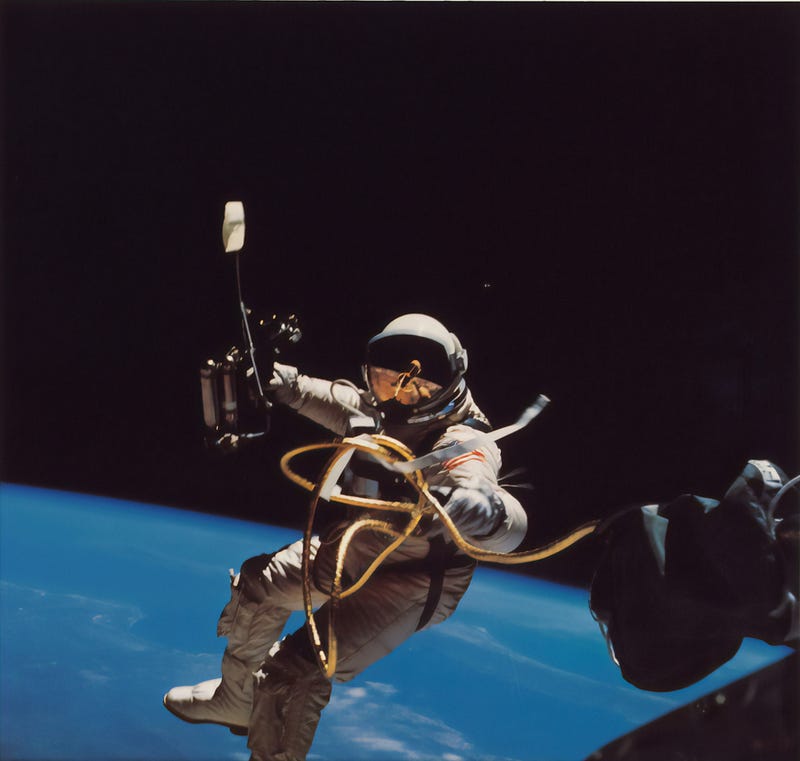
As I write this article, astronauts Matthias Maurer and Raja Chari have just come back from today’s spacewalk outside the International Space Station (ISS).
They had to replace and install different components of hardware outside the station.
If you watch just a couple of minutes of the accompanying live stream though, you will observe (surprise, surprise) that they’re not actually walking.
Raja Chari was attached to a robotic arm via a foot restraint to move around for most of the time, while Matthias Maurer used handrails to move from one position to the next.
They were connected to the station using multiple tethers to prevent them from floating away, because, you know:
In space, things just float around freely. Or do they?
Actually, they’re falling!
You may have heard of this before, just like me. It took me multiple approaches to understand this and I’ll try my best to make you grasp that principle now:
The first thing to know is that there’s gravity everywhere in space. In some places, it’s more intense, in others less so.
Gravity is a force that pulls things towards its center.
For example: The gravity of Earth pulls everything that is in space around Earth down towards Earth, like the ISS, the Moon, all the satellites in orbit and so on.
And eventually, everything would fall into Earth, if you didn’t fight that force.
How do you fight it?
By going very fast.
The ISS moves around Earth at 17,500 miles per hour.
Imagine you stand on Earth and you throw a ball forward and up (you’re aim is to throw it as far away as possible). It’s trajectory (flight path) would have the shape of a curve. The higher the speed of the ball (the harder you throw) the longer the curve will become and the longer it will fly.
The ISS also has a curved trajectory. But it moves so fast that the curve it forms is exactly the same curve as that of Earth’s surface. (The lines of the two curves are practically parallel, like a smaller circle and a bigger one around it if you drew it on a piece of paper.)
And because of that, the ISS (and everything else in Earth’s orbit) falls around our planet constantly.
I hope this makes sense.
Bonus info for the super-interested: This process isn’t perfect. Earth’s gravity still manages to pull objects down towards it. It takes a long time, but it happens. Every once in a while, astronauts on the ISS have to fire its thrusters to lift the station a bit higher again and make up for the loss of distance that Earth’s gravity caused.
But if everything’s falling, why is it still called “walk”?
Spacewalk is a simply a term that’s easier to understand than the official one: EVA. That in turn is short for “extra vehicular activity”.
That’s the term used by all astronauts, ground personnel etc.
On Quora, people have also voiced the opinion that “spacefloat” makes the whole thing sound kind of lazy, and which taxpayer would be content with the government spending millions of dollars on lazy activities?!
By the way: People at or associated with NASA would neither say “spacesuit” but EMU, which again, is the abbreviation for “Extra Vehicular Activity Mobility Unit”. Which I think is quit fitting, because it’s more than a suit.
The most mobile component of this unit (people at NASA seem to love abbreviations) is the SAFER component.
I’ll spare you spelling that one out. But it is, simply put, a kind of jet pack with two mini thrusters that can be controlled by the astronaut using a joystick, almost as if they were playing a video game.
Although when this one comes into use, they’re in anything but a fun state! If the aforementioned tethers should ever loosen and they drift away from the space station, the astronauts have to activate the SAFER immediately to help them fly back to the station and (hopefully) grab something to hold on to and get back to safety.
If that doesn’t work out: Game over!
Luckily, no astronaut has ever been lost during a mission so far and I sincerely hope it stays that way.
Get access to each and every Medium article. Directly support me as well as thousands of other writers. Join a community of passionate readers and creators. For just $ 5 a month. Right here:
Sources:


