
Spaced Repetition of the Books You Read
In our school and college before exams, there was a single most important thing: revision. Even if we studied sincerely the entire year, we had to revise!
Then we grew up and we do not have someone testing us on a certain day about what we read or learned in the past six months or year.
But life continues to test us almost everyday about what we learned.
How many times we read a book or an article online, and we tell ourselves that we should read this every morning. But then we get busy with life and forget about it.
If we are lucky, one or two quotes get stuck in our head for a few days.
Each one of us wishes to always the great words of wisdom we read once in a while. However, we do know that forgetting stuff is a way of our brain to stay healthy and keep learning new stuff. To create space for new memories.
To help our brains in this dilemma, why not use the trick that was almost innate to our younger-selves: revision.
Or the improved version: spaced revision/repetition.
What is Spaced Repetition?
It is a learning technique where you keep increasing the time interval between subsequent review of a previously learned material.
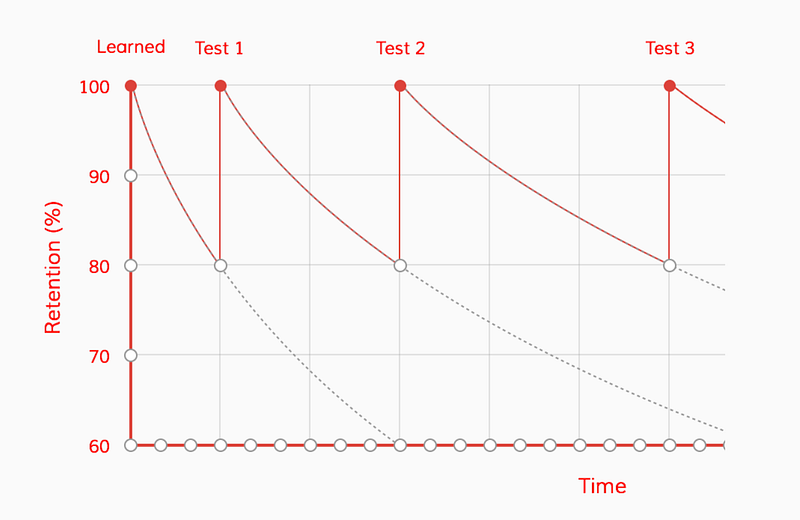
For instance, you read a book and really loved it. You re-read it again after a month, then again after three months, then again after six months, and then again after a year….
Going back to school memories: if you had to read the entire History book night before the exam? It would be almost impossible and quite impractical one, given that you need a good night sleep before the exam.
We can use the same solution here as well.
Instead of re-reading the entire book again, highlight, mark, underline, add notes,… do whatever you can to make your revisit quick and effective.
And do not just do it the first time you read. Do it every time you review to help your future self who will be visiting the book after some time.
Here are some of the techniques I use to make my repetitions easy:
- Highlight or underline the parts you like, but don’t highlight the entire book.
- Add side notes. This is supported by the hardcopy of the book as well as most of the reading software.
- Keep a notebook with you to summarize certain ideas you had trouble or took your time to completely understand.
- Maintain a calendar to mark the last time you read the book and when is the next review scheduled.
The last point is the most important one.
We read a book. We think that we will always keep it under our pillow. Then after a few days, we forget about it and vaguely recall reading it once only when someone mentions it.
Just consider this practice as scheduling regular sessions with your favorite person who inspires you.
And as you grow, you will find new meanings and new things in the book each time you read it again.
“If one cannot enjoy reading a book over and over again, there is no use in reading it at all.” ― Oscar Wilde


