
Space Manufacturing: The Next Big Step Into the Space Economy
Taking advantage of zero gravity, a robust capability to build in space will be our real launchpad beyond low Earth orbit.

For the past half-century, we have been transporting objects into space piece-by-piece and assembling them to construct space stations. But assembly is far from the real “holy grail” of putting things together in space. Actual manufacturing — creating essential components using raw materials — is how space travel’s economic advantages will be realized.
NASA’s program to address this need is called simply ISM, for In-Space Manufacturing, and comes with an official logo: “Make it, Don’t take it.”
The cost of taking a kilogram of payload mass into orbit has seen an enormous reduction in the past few decades. In the 1980s, the price ranged from the low tens of thousands of dollars to nearly $200,000 per kilogram. Today, thanks primarily to the efficiencies of SpaceX, a Falcon Heavy rocket has brought the cost to below $1,500 per kilogram.
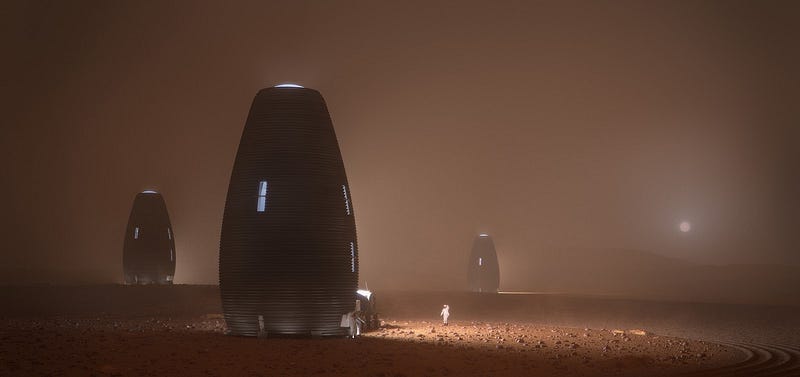
In 2019, NASA sponsored a challenge to see the kinds of potential human habitats that could be designed using 3D printing technology. The teams were restricted to raw materials only found on Mars, the Moon, or other feasible off-Earth sources. The top two contestants were startup AI.SpaceFactory of New York and Pennsylvania State University. AI.SpaceFactory ended up winning the first place prize for their habitat design nicknamed “Marsha.”
3D printing is one of the most versatile methods of manufacturing goods in space. Several advantages of 3D printing, whether used on Earth or space, are:
- On-demand creation
- Rapid prototyping and iteration
- Speedy production of small components
- Optimization of strength to weight ratio for components
- Low waste
- Design flexibility
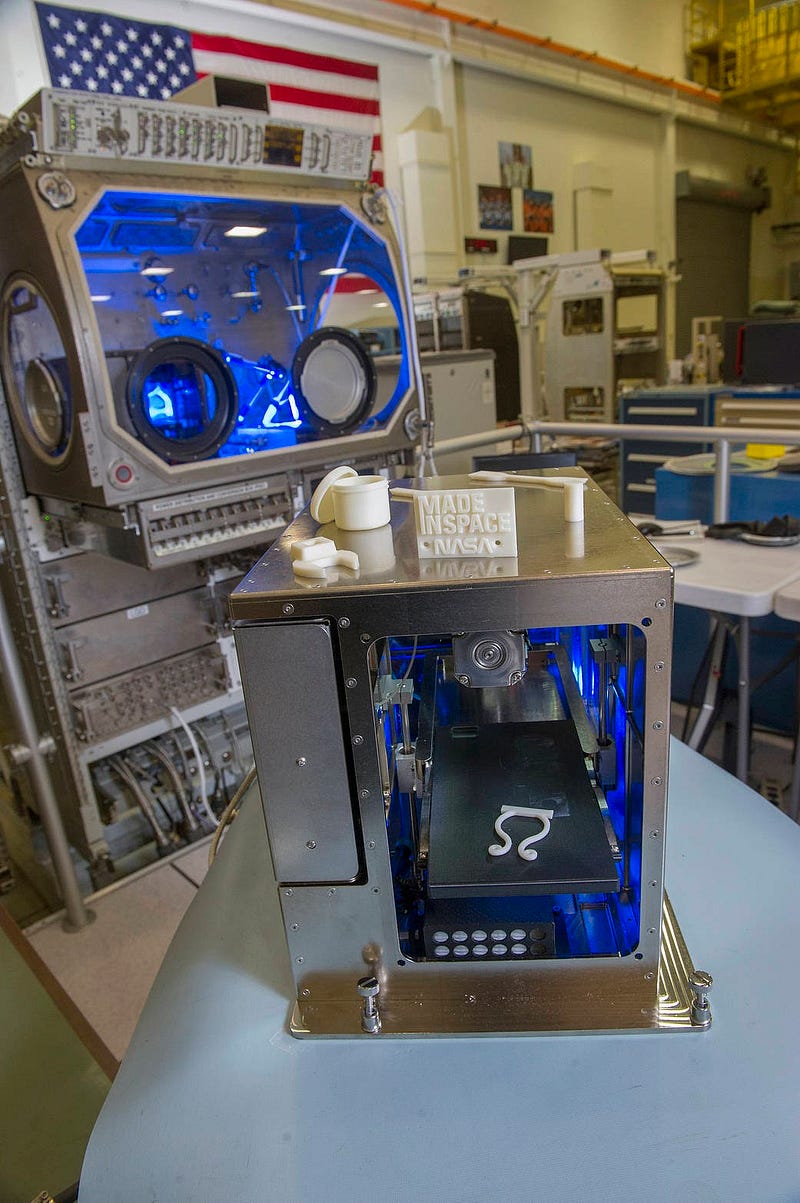
NASA and other space programs currently provide astronauts with 3D printing access to quickly create small, useful tools and parts. Eventually, larger 3D printers will be taken into space and used to build large-scale projects like the “Marsha” habitat. There are plans to bring 3D printers along as part of NASA’s Artemis program.
Artemis aims to land astronauts on the moon again as early as 2024, and for the next decade, the real importance of 3D printing in space will be obvious. It’s one thing to carry the payload of 3D printing feedstocks (plastic pellets, metal, and ceramic powders, etc.), and another thing to be able to draw those feedstocks from a celestial body.
If all goes well, our next adventure on the Moon will see astronauts use the Moon itself to build habitats and rocket parts that will be used to construct launch vehicles to one day take human explorers to Mars. Oversize 3D printers are currently being tested on Earth with rocket part manufacture. NASA has its program called RAMPT ( Rapid Analysis and Manufacturing Propulsion Technology ), focused on 3D printing thrust chambers, nozzles, and rocket combustion chambers.
While 3D printing will be a keystone to the success of an ongoing space economy and its space manufacturing vertical, equally critical will be the continued advancement of robotics, artificial intelligence, and energy technologies necessary to power the backbone of this new realm. 3D printers will craft pieces big and minuscule, but it will be mechatronics ferried about on nuclear-fueled shuttles that will stitch those elemental bits together into satellites and space stations.
The ultimate dream is seeing human civilization spread across our Solar System and, eventually, the Milky Way. Space manufacturing is a significant first step to realizing this dream. Venture Capital firms like SP8CEVC, founded by partners Capt. Franz Almeida and Junaid Mian, RPh. are helping to make this dream come true.