
Space
My father left because he needed space — are we intoxicated by space?
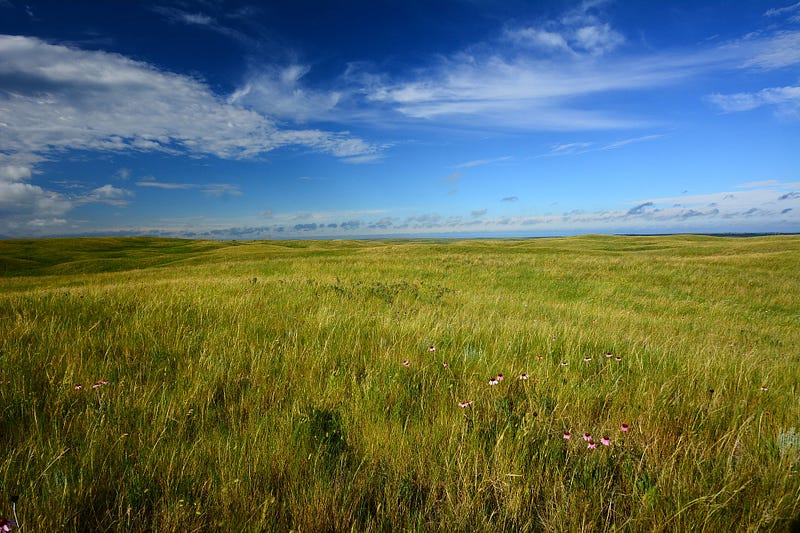
My father left because he needed space and, by the time I thought I was grown, I needed space, too. So, my mother sent me to stay with my father in North Dakota, where I could get all the space I wanted.
Coming from Connecticut, the first thing I noticed about the Great Plains was the sky. All my life the sky had been a limited shaft of sunlight sneaking through the leaves as if through a high window in a dungeon cell. The trunks of trees were like prison bars and hills like guards. In the Great Plains, the sky opened its arms wide and embraced me like a lover who’d been waiting outside the gates. Every day she fed me mounds of cotton candy they call clouds, and, every night, she brought out her jewels and glittered. They’ve got lots of space in North Dakota. Space is what I craved. Soon it became my intoxicating drug of choice.
The moment I arrived at my father’s farm, the space got me hooked. Standing on a hill in North Dakota, the tallest thing in sight, with nothing but the sky doting on me, I started to think I could be someone and make something of this country. I didn’t know I shared it with hordes of pests, their eggs lying dormant underfoot. I didn’t think the big-haired sky would fickly withhold her rain and batter everything with hail. I didn’t know space is just another word for loneliness, not just the loneliness of a Saturday night when you ain’t got nobody, but the howling, desolate, helpless isolation that drives a man to do target practice with his own skull.
The letter Ma sent the week before sat, unread in the mailbox, along with a fistful of payment notices. The ceaseless wind played with the barn door like a loose tooth. A herd of pigs, broken out of their pens, turned over the yard, rooting for grubs. A weakened watchdog, chained to a stake by the door, hunkered down and dusted the ground with her tail, forsaking all pretense of a bark. I knocked and hollered at the door, but no one was home. I checked the barn; a disemboweled tractor sat waiting for a mechanic to put it back together. I returned to the house and let myself in, after setting free the dog, who ran off immediately to lap up the water in a cattle trough by the fence. I stepped through the bachelor kitchen, sink piled high with dishes, the tractor’s carburetor in pieces on the table, to a dusty living room. There was Pa, a tidy red mark on his forehead, like a Hindu’s spot. The back of his head was blown all to hell.
The sight and smell of it was enough to drive me out of the house, where the rejuvenated dog joined me, licking my hand. She sniffed the bouquet of the living room. A quick jog to the neighbors, the dog following close behind, and a phone call, brought a flock of sheriff’s cars and an ambulance to the farm. The medics could do little more than help herd the pigs back in the barn. Long sitting, dead in his easy chair, Pa remained sitting on the stretcher when they loaded him up. The procession filed stately to town. I stayed at a neighbor’s place and they all helped bring in the wheat. Ma, who would never live on the farm, came out to sell it and bring me back, but I wouldn’t leave.
I found an old motorcycle in the barn next to the eviscerated tractor. It was in one piece and, soon after the neighbor had shown me how to kick start it and change the gears, I was tracing ruts up and down the Dakota Hills and wallows, dodging cow chips, and frightening the stock. In one of my rides, I came upon a gang of Prairie Hellions heading out from the Sturgis Rally, encamped by some cottonwoods. I showed off by doing a few jumps and donuts. They were suitably impressed, but they were more impressed with my bike, which they explained was a classic Indian Four. I petitioned to join them, but they told me to go back home to Ma. But, I would never go back East to Ma after seeing the Great Plans. In the morning, when they were ready to leave, I grabbed a hold of the nearest sissy bar and vowed never to let go, even if they beat me to a pulp. A few of the bikers did just that, but I hung on until the captain of the gang, impressed with my grit, ordered the men to stop. He offered to make me a prospect.
I never rode my father’s Indian Four again. The gang forced me to trade the Indian for a sickly Honda CV and gas money. On long rides, the humiliating Honda puttered and spat so far behind the pack I was often in jeopardy of losing them. Fortunately, there are few roads on the Plains and I could follow the gang by spying the dust that trailed them. I refused no task they gave me, whether it be washing the bikes, or worse. I happily made himself their slave so that I could live free. In the end, I found that being the minion of a gang of outlaw bikers was a little different than being a boy back East, but by then I had made member.
Am I still intoxicated by space?
Here’s the thing about space. As soon as you get it, all you fucking want to do is fill it up.


