
Space as Social Worker: How the Built Environment Impacts Health and Transforms Lives
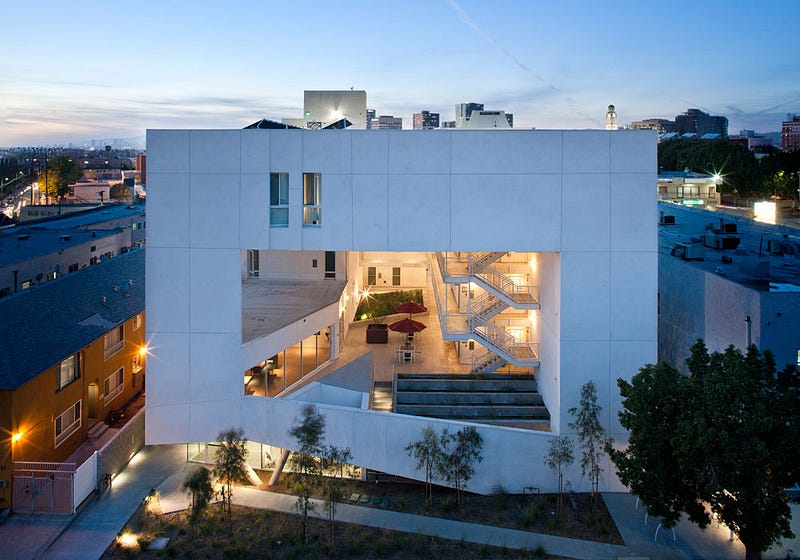
Beauty may be in the eye of the beholder but is its appreciation contingent on the beholder’s social status? Not according to the founders of nonprofit housing developer, Skid Row Housing Trust (the Trust), who believe both that the homeless are no different from the housed and that our innate capacity to respond to beauty can provide a solution to one of society’s most rapidly growing and pressing problems — the swelling number of individuals living on the streets.
More than three decades ago, founders Alice Callaghan and Candy Rupp, working closely with architect Jim Bonar, envisioned a new public housing model based on the idea that beauty in the form of well-designed buildings would transform the most blighted neighborhoods of downtown Los Angeles as well as evoke a sense of home for residents of public housing that would encourage them to stay off the streets.
No easy task. In the late 80s, housing developers worked within tight funding parameters and public money was thought better served increasing the quantity of units instead of focusing on the resident’s quality of life. Bucking this trend, the Trust asked architects to consider how the built environment could help the chronically homeless — most of them wary of institutions and struggling with mental health or addiction issues — find “home” in a 150 square-foot room in the middle of one of the most destitute neighborhoods of Los Angeles.
The Trust’s first projects, Jim Bonar’s 1989 renovation of the Genesis and Pershing hotels in downtown Los Angeles, were significant in that they “taught the Trust what not to do,” according to Bonar. Bonar found himself up against buildings and codes that allowed for little aesthetic intervention: for example, unit windows that looked out onto brick walls and entrances that lead into dark alleys. Improvising, Bonar’s team sought ways to beautify the buildings through light, paint, and graphics.
Within a few years, the Trust saw that while buildings restored with high aesthetic standards encouraged better behavior in the residents and were thus easier to manage, long-term residential stability required connecting residents both to services and to each other. In 1992, the Trust created its Supportive Housing Program, dedicating rooms in each building not for housing but for on-site case management. At the same time, the Trust began re-adapting the historic hotel lobbies and the community kitchens into spaces for informal gatherings and support groups.
In the early 90s, the Trust invited architectural firm Koning Eizenberg Architecture to design the Simone, the first ground-up residential hotel built downtown in over 30 years. Working with a blank slate, the firm subtly integrated architectural elements that would set the precedent for future buildings. Koning Eizenberg broke ground by designing the Simone with the “safety, comfort and dignity” of the residents as an aesthetic guide, incorporating natural light, lounge areas and open sight lines that minimized the use of surveillance equipment. In 1993, the Simone won the prestigious AIA award — a revolution in housing for the poor.
Four years later the firm designed their second building, the Boyd, which was the first Trust building with a courtyard that not only logistically moved air through the building keeping residents cooler but also increased opportunities for “accidental social interactions,” explains Julie Koning — interactions that would help residents build community and feel invested in the building.
Twenty-four buildings later, the Trust continues to make headway in the public housing sector by using a marriage of aesthetic considerations and programmatic parameters to create living spaces for the homeless. While their mission remains the same — to reduce the number of people on the streets by encouraging the homeless to chose permanent, supportive housing — their focus has evolved from using design not just to “provide homes,” as Molly Rysman, Director of Special Projects for the Trust, explains, “but to transform both lives and communities.”
Fast forward to present and nowhere is Ms. Ryman’s observation more apparent than the Trust’s latest buildings: Koning Eizenberg’s third building, the Abbey Apartments, the Rainbow and Carver Apartments, designed by Michael Maltzan Architecture, and the New Genesis (in construction) designed by Killefer Flammang Architects.
In 2003, the Trust contracted Maltzan to design a building a block away from San Julian Street, the most crowded homeless encampment in the Skid Row area where hundreds sleep under cardboard boxes. Working in the Trust tradition, Maltzan envisioned a building that would use design to restore a sense of dignity and place to the homeless while contributing to a new aesthetic narrative for the downtown area.
Like all Trust buildings, the Rainbow carefully balances budget restrictions — each building uses tax credits, conventional debt, and fundraising for its development but must sustain on tenants’ rents — with a desire to create architectural structure which positively impacts residents. The Rainbow is built in a C-shape around an open courtyard, which brings in natural light throughout the day. Maltzan defined internal sight-lines such as the open-air walkways that overlook the courtyard, allowing residents to interact with their neighbors, and external sight-lines that provide views of the city through rooftop decks, connecting residents to the outside world. Residents access their “homes” by a broad, boldly colored stairwell that protects the heart of the building, located on the second floor, from the trials of the street while also welcoming visitors and encouraging residents to share a moment as they are enter and exit the building.
The Rainbow Apartments launched an investigation into how the buildings themselves could become a part of the rehabilitative process, and the next three buildings, the Abbey, the Carver and the New Genesis, push this concept further. Like the Rainbow, both the Abbey and the Carver offer the equivalent of an architectural “welcome home” by inviting residents in with broad open stairwells that spill into sun-filled courtyards. Each building is thoughtfully landscaped and encourages spontaneous social encounters among residents through open-walkways, centrally located laundry rooms, lounges and large communal kitchens.
While the Trust notes that the success of each new development is the result of design knowledge accumulated from the earlier buildings, these buildings push farther ahead. Each new building is designed to respond to and complement the urban environment. Architecturally, the new buildings move beyond the limitations found in renovating the historic hotels and instead amplify structural elements that intentionally intervene in and positively modify resident behavior. Space as social worker.
The timing couldn’t be more appropriate. Earlier this year, John Eberhard, the founding director of the Academy of Neuroscience for Architecture, challenged the architectural profession to think about a “new paradigm for architecture,” where architects “shift away from an emphasis on solving the puzzle of designing a building…to studying how to accommodate human activities correlated with responses of the brain and the mind.”
The idea that architecture could affect our well being stems from a landmark study conducted by Roger Ulrich in 1984. Ulrich, an environmental psychologist working at a suburban Pennsylvania hospital, noticed patients in beds with views of nature were healing faster than patients without a view. Intrigued, he analyzed 9 years of patient records compiling a study group of 46 individuals who had each undergone the same surgery and received the same post-operational care. Ulrich noted that the 23 patients whose beds were near windows with views of nature left the hospital almost a full day sooner than the 23 whose beds offered views of a brick wall. Additionally, the patients with views of the trees required fewer doses of pain medication.
Ulrich’s findings laid the foundation for architects to consider the same questions the Trusts’ architects are now beginning to ask: Could the aesthetics of space be constructed in a way to create sustainable positive outcomes in residents?
At the Carver, which is located adjacent to Interstate 10, a handful of residents have begun independently planting grass in the median across the street from the building. Through their efforts, the area is becoming a small park and they excitedly show off their work to anyone who will cross the street with them.
Other residents have taken over the garden boxes that line the perimeter of the building and have started their own gardening group. With the love of new parents, they devotedly tend to the cantaloupes and herbs that grow under their watch. Like their peers beautifying the streets under the freeway, these gardeners excitedly share their plans for future seasons with anyone who will listen.
As medical professionals tell us, a patient’s first sign of healing is when his interest turns away from his sickness and towards the external world. The residents of the Carver confirm this by their actions. Gardening gives them the opportunity to be creative, provides a much-needed psychological break from the grit of city life, and connects them to the larger world.
For years architects working with the Trust have used design intuition to renovate residential hotels and the gloomy 10’ x 15’ single resident occupancy apartment to create a sense of home. And they have done this with incredible success. For some of the residents I met, including Jake, a 7-year resident of the Olympia Hotel, a clean, well-managed building was enough to keep him off the streets. But it was Samantha, a tenant in one of the new buildings, who described her studio apartment as “home.”
Samantha, an attractive African American woman in her mid 40s with a quick smile, recognizes her need for help and beams when recounting the work she’s already done — she takes the train twice a week to an adult school where she is finishing her GED, she gardens the median and she makes sure each resident feels welcomed. Since moving into the Carver, she also feels she has a place to invite her family to visit, an important piece of the rehabilitative puzzle.
When I asked Samantha why she liked living at the Carver, she first sited the staff and her friends — the other residents. When I asked if she liked the colors of the building she enthusiastically responded that the yellow walls, “made her feel happy and that the building felt very bright.” She then added that it was hard to have a bad day in the building.
While we can’t know specifically what elements of the Carver cause Samantha or any of the other residents to feel “at home,” we can use new data found in neuroscience and immunology to evaluate our physiological responses to space and make some pretty good educated guesses.
What we see every day — the view, colors, textures and light; what we hear (the round shape of the Carver helps deflect the noise of the freeway); and what we smell influence the amount of stress we experience. Stress, in turn, triggers various chemicals in the brain, which impacts both our mental health and our immune system altering the homeostatic conditions that keep us healthy.
Architect Julie Koning sums it up best, “It only takes a few things to keep people in housing: an outdoor space or access to green space, building configurations that support social space, and room for social services.” Incorporating these elements into public housing contributes to residents choosing to stay housed longer, which it turns out, is not only better for individuals but also cheaper.
Studies both nationally and at the local level affirm that permanent supportive housing is a considerably more cost effective option for the chronically homeless than the streets. One Los Angeles study found that the public bears a cost almost 5 times higher per month ($3,000 vs. $600) to support individuals living on the streets when emergency shelter, medical care and crime management are added up.
As Wade Killefer, part of the architectural team for the New Genesis remarked, “Even if you don’t care about the homeless, its just a complete no brainer to design housing like this. It keeps the homeless off the street and, at the most selfish level, it makes the city a better place to live.” The statistics are hard to ignore. If we know that its cheaper to keep the homeless off the streets, that well-designed public housing creates personal and community pride, and that the aesthetics of where we live actually contribute to our health and could help the chronically homeless participate in, instead of burdening, the community, then shouldn’t we all take note? Skid Row Housing Trust is on to something.