avatarJillian Amatt - Artistic Voyages

Free AI web copilot to create summaries, insights and extended knowledge, download it at here

4329

Abstract

d no food growing, things were certainly desperate.</p><p id="21c0">But wait a minute! Why are people starving at the equator? With year-round growth, we couldn’t figure out why each person didn’t have a nice small home garden that would keep them supplied with food. Well, it turns out that the answer to that question isn’t as easy as one would think. But one thing was for sure, their soils were devoid of nutrients, and their farming practices were doing no favors to the soils either.</p><figure id="4d16"><img src="https://cdn-images-1.readmedium.com/v2/resize:fit:800/1*pMRTKbAUwrsplClFeZMKRQ.jpeg"><figcaption>All that was left of many gardens in Kikorongo after a particularly deathly dry season. Photo Credit: Author</figcaption></figure><p id="1296">We knew that feeding them was only a temporary solution. What would really make a difference, would be to help them to learn how to rebuild their soils by using ingredients that they had available to them for free. Only a couple of weeks into bringing food to the villagers, we told our host to look out for a property in town where we could build a compost and community garden. We wanted a central place that we could use to teach them how to build rich and healthy soils, and to demonstrate how to rebuild their soils that are already on the ground, using numerous permaculture techniques.</p><p id="2648">At first, I think, they were skeptical. Build soils? How the heck do you build soil? They had just succumbed to the fact that they had bad soil, and that was just their lot in life. They had also decided that they had been cursed by “too much sunshine” and that growing food was fruitless because the sun would just burn it all. Instead, they had decided that it was best to seek out money in a different way so that they could buy the food they needed. They mostly did this through tourism, which, of course, is almost non-existent these days.</p><p id="e38e">We managed to secure a small property in the village that had a small brick building on it. Deciding that it would make a great controlled area to start building a compost pile for them, we began the process of demonstrating how to do it. We built the first pile partially out of available ingredients that already existed on the land. We chopped up the dead plant matter (carbon) that had been left to dry and whither, we pulled leaves off of an invasive tree that grew abundantly and very fast, and we sent flour sacks around the community to collect banana peels and other food scraps (nitrogen) that were simply just dumped on the ground or thrown into the trees by the villagers.</p><figure id="363c"><img src="https://cdn-images-1.readmedium.com/v2/resize:fit:800/1*Mebu4YE78lRsATg6uZwfkg.jpeg"><figcaption>Our Kikorongo friends are proud of their first compost pile! Photo Credit: Author</figcaption></figure><p id="6e42">We would meet a committed group down at the site every 4 days to turn the compost pile. Different people came and went to see how things were progressing and many people stopped by to learn about what was going on. We also started to let the plants on the property just grow. Over time we realized that there were bananas, yuccas, yams, and other goodies that were popping up amongst the foliage, so we started to trim back the non-food plants to a height of about 2 feet, to let the food plants get the light they needed to continue growing, while still shading the roots and locking moisture into the ground down low.</p><p id="5c03">To this day, this property lies in stark contrast to its neighboring plots. While ours is a lush green oasis, theirs are cultivated and tilled, exposing the soil to ‘too much sunshine’ exactly like they were taught to do by the colonizers so many years ago. Which of course, simply continues to deteriorate the soils further.</p><figure id="2aaa"><img src="https://cdn-images-1.readmedium.com/v2/resize:fit:800/1*rDFQGtqCedoN8SK3zHOFdg.jpeg"><figcaption>Bananas, Yams and Yucca (Casava) growing strong above the green foliage below. Photo Credit: Author</figcaption></figure><p id="b3c8">Over the 6 months that we spent in the village, we turned out numerous piles of compost that we then dispersed onto the ground around the building, while planting seeds and other vegetable plants in the new soil.</p><p id="98a8">While we have now

Options

been away from the village for 3 months, our committed crew sends us updates on their progress by social media to let us know that they have not forgotten what we taught them. But we have one more project to help them with.</p><p id="04f8">It has come to our attention that they are in desperate need of a reliable freshwater source. They don’t have piped water, a river, or even a lake to collect water from. Instead, they rely heavily on rainwater. But even that is very unreliable these days, and the drought seasons are unpredictable. We can see that it makes no sense to teach them about composting and gardening if they don’t have access to water, so we are headed back to Uganda and are going to help them to fundraise to get a borehole (well) dug.</p><p id="3d9a">We know that we can’t help everyone that is suffering on the planet, but if we can just focus on this one village, then we know that they will then teach others, and the information will ripple out.</p><figure id="004c"><img src="https://cdn-images-1.readmedium.com/v2/resize:fit:800/1*mSk-tGfaUx8SkyIAWjc4nA.jpeg"><figcaption>The author and her partner Chris collected dried leaves from the side of the road for building another compost pile for the village. Photo Credit: Masareka Yasoni, Kikorongo Resident</figcaption></figure><p id="8aed">We are so grateful to be able to do this important work. We never set out to do it, but the universe has shown us our true purpose in this life, and we simply can not turn our back on it.</p><p id="8e3a">Slowly but surely the seeds of change have been planted, and now they can do nothing but grow!</p><p id="0e33">If you are wishing to donate to our ongoing campaign to raise funds for the villagers of Kikorongo, please visit our GoFundMe page at <a href="https://gofund.me/190cfdbd">https://gofund.me/190cfdbd</a>. We have numerous updates there on the projects that we have already done.</p><p id="f798">Thank you!</p><p id="d2d5">Together We Are Stronger!</p><figure id="ea11"><img src="https://cdn-images-1.readmedium.com/v2/resize:fit:800/1*FPhxaPRp8QVe_lys05LS_g.png"><figcaption></figcaption></figure><p id="da3d"><b>If you enjoy my writing, why not consider subscribing to the Medium platform? For just $5/month you will have unlimited access to millions of articles on the platform on every subject. Plus, if you sign up through my affiliate link below, I will get a small commission for your patronage. Thank you so much for your support and happy reading! :)</b></p><div id="610a" class="link-block"> <a href="https://artisticvoyages.medium.com/membership"> <div> <div> <h2>Join Medium with my referral link - Jillian Amatt</h2> <div><h3>As a Medium member, a portion of your membership fee goes to writers you read, and you get full access to every story…</h3></div> <div><p>artisticvoyages.medium.com</p></div> </div> <div> <div style="background-image: url(https://miro.readmedium.com/v2/resize:fit:320/0*hyrkN_1QOHNzch8m)"></div> </div> </div> </a> </div><figure id="6a51"><img src="https://cdn-images-1.readmedium.com/v2/resize:fit:800/1*FPhxaPRp8QVe_lys05LS_g.png"><figcaption></figcaption></figure><p id="1a97"><i>Hi there, we are 2 Canadians, Jill and Chris from Artistic Voyages. We have been nomadic since 2017 living in numerous different countries, and experiencing the life and diversity of our planet on the ground and firsthand. We have now been on the African continent for 2 years! Join our adventure by hitting the links below!</i></p><p id="29ae">Website: <a href="http://www.artisticvoyages.com/">www.artisticvoyages.com</a></p><p id="369b">Patreon: <a href="http://www.patreon.com/artisticvoyages">www.patreon.com/artisticvoyages</a></p><p id="a58c">Facebook: <a href="http://www.facebook.com/artisticvoyages">www.facebook.com/artisticvoyages</a></p><p id="b34c">Instagram: <a href="http://www.instagram.com/artisticvoyages">www.instagram.com/artisticvoyages</a></p><p id="a5d0">Twitter: <a href="http://www.twitter.com/artisticvoyages">www.twitter.com/artisticvoyages</a></p><p id="23ce">YouTube: <a href="http://www.youtube.com/c/artisticvoyages">www.youtube.com/c/artisticvoyages</a></p></article></body>

Building Compost | Permaculture

Sowing the Seeds of Change

How we give back while we travel.
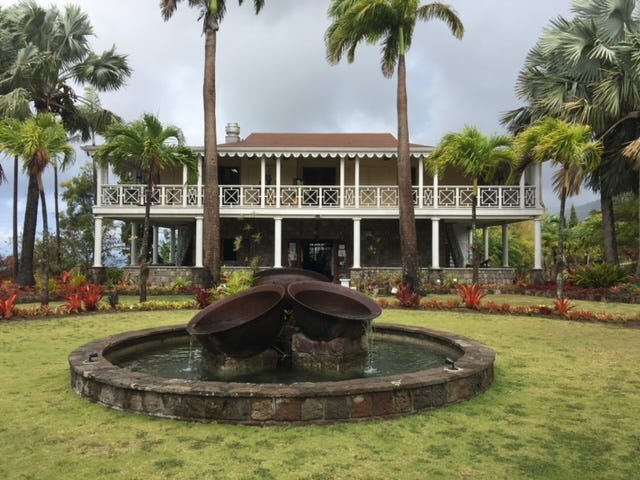
The restaurant and gift shop at the Botanical Garden of Nevis with the fountain in front. The large pots in the fountain were salvaged from sugar mills that have long since shut down. Photo Credit: Author

When we left Canada in 2017, to travel full time, we thought that our gardening days were over. Of course, we knew that trying to garden while we would be moving from place to place is a ludicrous idea.

However, in 2019 we found ourselves volunteering for a botanical garden on the island of Nevis in the Caribbean. Almost immediately upon arrival, the owner asked us to commit to staying there for 6 months. Her deal came with a house to live in, a small food allowance, and a gas-filled truck to use for personal reasons. How could we refuse such an offer?

Our initial role was to help with maintenance jobs around the property, which included a daily routine of sweeping and raking leaves off the lawns and pathways each morning. After only a few days of doing this, we suggested to the owner that instead of dumping the refuse in a big burn pile, we could start building compost. One look at the soils in the garden and we could see how devoid of nutrients they were. We knew that creating a healthy composted soil would be immensely beneficial to her plants and the garden ecosystem. She liked the idea but assumed that we would be putting a lot of effort into something that would never be continued after we left.

At first, we were dissuaded by her, despite our best efforts to convince her, but once we discovered that the island had a problem with seaweed washing up on the shore, we took the initiative to take our truck to the nearest beach, loaded up the bed with seaweed, and took it back to the garden to start a compost.
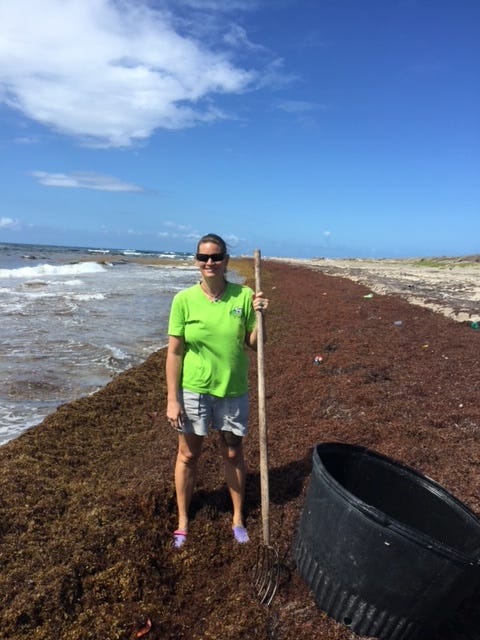
Sargassum seaweed is a real problem in the Southern US and the Caribbean these days. It is completely covering beaches, but makes a great nutritional compost! Photo Credit: Chris DeCap

After finding another free nitrogen source, a fast-growing green algae that formed in one of the garden ponds, our compost piles were thriving, and new soils were building. When the soil was finally ready, about 6 weeks later, the local head gardener of the Botanical Garden (who had worked there for 30 years) was amazed! He could not believe that, all along, he too had the capability to create rich and healthy soil. He eagerly scooped up the black gold into his wheelbarrow and carted it off to be added to the nutrient-devoid beds.

We don’t know if the composting continues at the Botanical Garden, but a spark was lit, and we knew that we left the place in better shape than we found it.
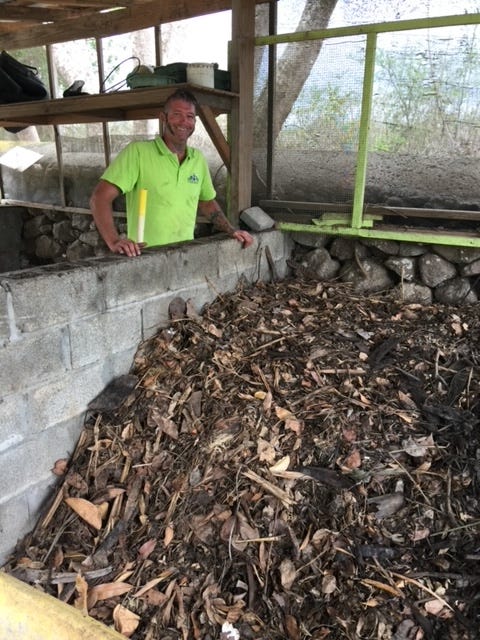
My partner Chris standing in front of his first partially decomposed compost pile. Photo Credit: Author

2 years later, we found ourselves in a similar situation, however, people were literally starving because of the nutrient-depleted soils. This time we were in Uganda, Africa, near the small village of Kikorongo.

June 30th, 2021 is when we found out that many of the villagers in Kikorongo were starving. We had originally come to a small accommodation provider near the town to paint murals, as we sometimes do while we travel. But when we heard this devastating news, we jumped into action to raise money to help get them food that would carry them through this latest crisis.

They had a double whammy of bad luck. First Covid had devastated their economy because of lack of tourism, and next an extended drought season had killed all of the farm crops that rely solely on rains to water them. With no money, and no food growing, things were certainly desperate.

But wait a minute! Why are people starving at the equator? With year-round growth, we couldn’t figure out why each person didn’t have a nice small home garden that would keep them supplied with food. Well, it turns out that the answer to that question isn’t as easy as one would think. But one thing was for sure, their soils were devoid of nutrients, and their farming practices were doing no favors to the soils either.
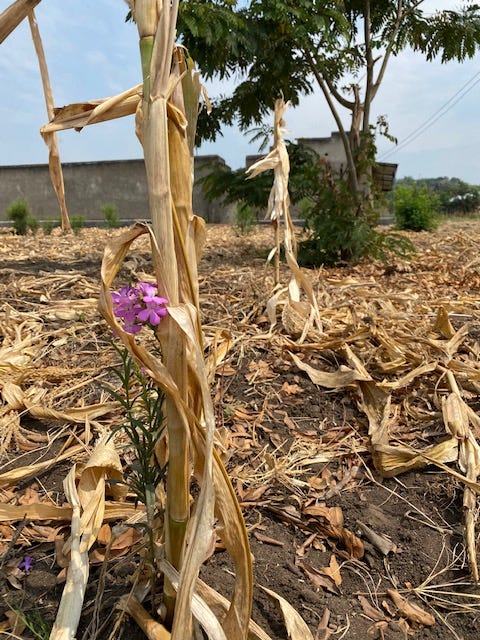
All that was left of many gardens in Kikorongo after a particularly deathly dry season. Photo Credit: Author

We knew that feeding them was only a temporary solution. What would really make a difference, would be to help them to learn how to rebuild their soils by using ingredients that they had available to them for free. Only a couple of weeks into bringing food to the villagers, we told our host to look out for a property in town where we could build a compost and community garden. We wanted a central place that we could use to teach them how to build rich and healthy soils, and to demonstrate how to rebuild their soils that are already on the ground, using numerous permaculture techniques.

At first, I think, they were skeptical. Build soils? How the heck do you build soil? They had just succumbed to the fact that they had bad soil, and that was just their lot in life. They had also decided that they had been cursed by “too much sunshine” and that growing food was fruitless because the sun would just burn it all. Instead, they had decided that it was best to seek out money in a different way so that they could buy the food they needed. They mostly did this through tourism, which, of course, is almost non-existent these days.

We managed to secure a small property in the village that had a small brick building on it. Deciding that it would make a great controlled area to start building a compost pile for them, we began the process of demonstrating how to do it. We built the first pile partially out of available ingredients that already existed on the land. We chopped up the dead plant matter (carbon) that had been left to dry and whither, we pulled leaves off of an invasive tree that grew abundantly and very fast, and we sent flour sacks around the community to collect banana peels and other food scraps (nitrogen) that were simply just dumped on the ground or thrown into the trees by the villagers.
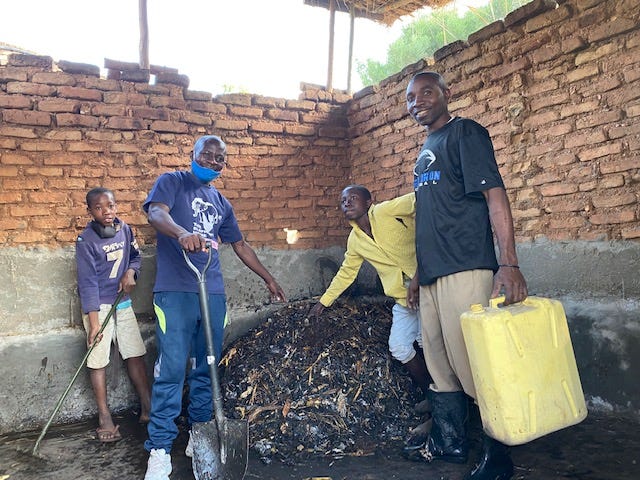
Our Kikorongo friends are proud of their first compost pile! Photo Credit: Author

We would meet a committed group down at the site every 4 days to turn the compost pile. Different people came and went to see how things were progressing and many people stopped by to learn about what was going on. We also started to let the plants on the property just grow. Over time we realized that there were bananas, yuccas, yams, and other goodies that were popping up amongst the foliage, so we started to trim back the non-food plants to a height of about 2 feet, to let the food plants get the light they needed to continue growing, while still shading the roots and locking moisture into the ground down low.

To this day, this property lies in stark contrast to its neighboring plots. While ours is a lush green oasis, theirs are cultivated and tilled, exposing the soil to ‘too much sunshine’ exactly like they were taught to do by the colonizers so many years ago. Which of course, simply continues to deteriorate the soils further.
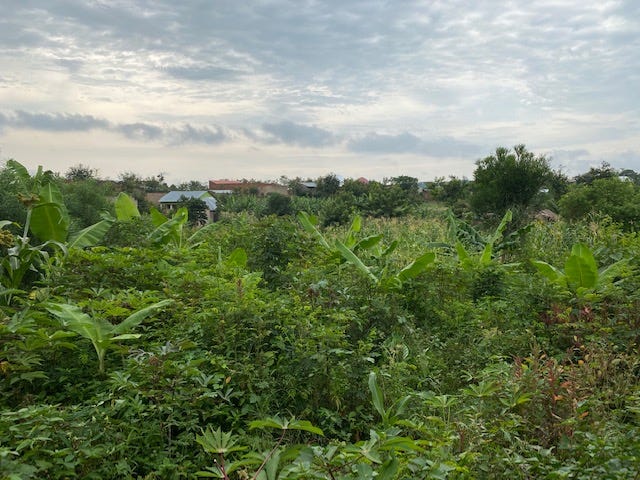
Bananas, Yams and Yucca (Casava) growing strong above the green foliage below. Photo Credit: Author

Over the 6 months that we spent in the village, we turned out numerous piles of compost that we then dispersed onto the ground around the building, while planting seeds and other vegetable plants in the new soil.

While we have now been away from the village for 3 months, our committed crew sends us updates on their progress by social media to let us know that they have not forgotten what we taught them. But we have one more project to help them with.

It has come to our attention that they are in desperate need of a reliable freshwater source. They don’t have piped water, a river, or even a lake to collect water from. Instead, they rely heavily on rainwater. But even that is very unreliable these days, and the drought seasons are unpredictable. We can see that it makes no sense to teach them about composting and gardening if they don’t have access to water, so we are headed back to Uganda and are going to help them to fundraise to get a borehole (well) dug.

We know that we can’t help everyone that is suffering on the planet, but if we can just focus on this one village, then we know that they will then teach others, and the information will ripple out.
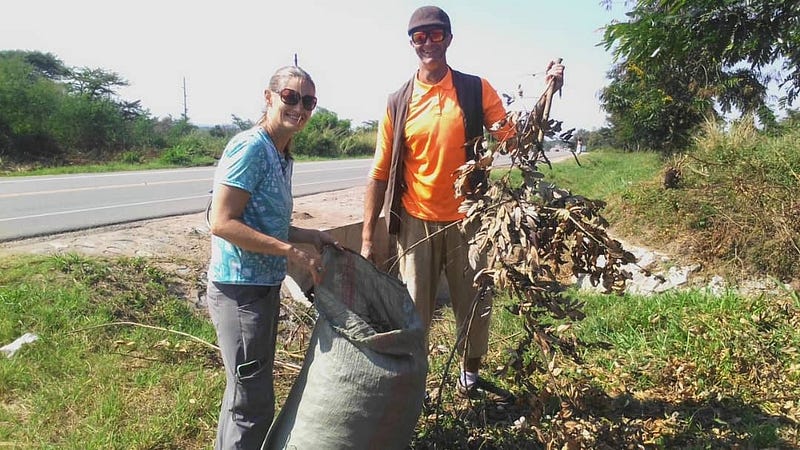
The author and her partner Chris collected dried leaves from the side of the road for building another compost pile for the village. Photo Credit: Masareka Yasoni, Kikorongo Resident

We are so grateful to be able to do this important work. We never set out to do it, but the universe has shown us our true purpose in this life, and we simply can not turn our back on it.

Slowly but surely the seeds of change have been planted, and now they can do nothing but grow!

If you are wishing to donate to our ongoing campaign to raise funds for the villagers of Kikorongo, please visit our GoFundMe page at https://gofund.me/190cfdbd. We have numerous updates there on the projects that we have already done.

Thank you!

Together We Are Stronger!

If you enjoy my writing, why not consider subscribing to the Medium platform? For just $5/month you will have unlimited access to millions of articles on the platform on every subject. Plus, if you sign up through my affiliate link below, I will get a small commission for your patronage. Thank you so much for your support and happy reading! :)

Hi there, we are 2 Canadians, Jill and Chris from Artistic Voyages. We have been nomadic since 2017 living in numerous different countries, and experiencing the life and diversity of our planet on the ground and firsthand. We have now been on the African continent for 2 years! Join our adventure by hitting the links below!

Website: www.artisticvoyages.com

Patreon: www.patreon.com/artisticvoyages

Facebook: www.facebook.com/artisticvoyages

Instagram: www.instagram.com/artisticvoyages

Twitter: www.twitter.com/artisticvoyages

YouTube: www.youtube.com/c/artisticvoyages

Mother Natures Hero
Gardening
Composting
Environment
Permaculture
Recommended from ReadMedium