
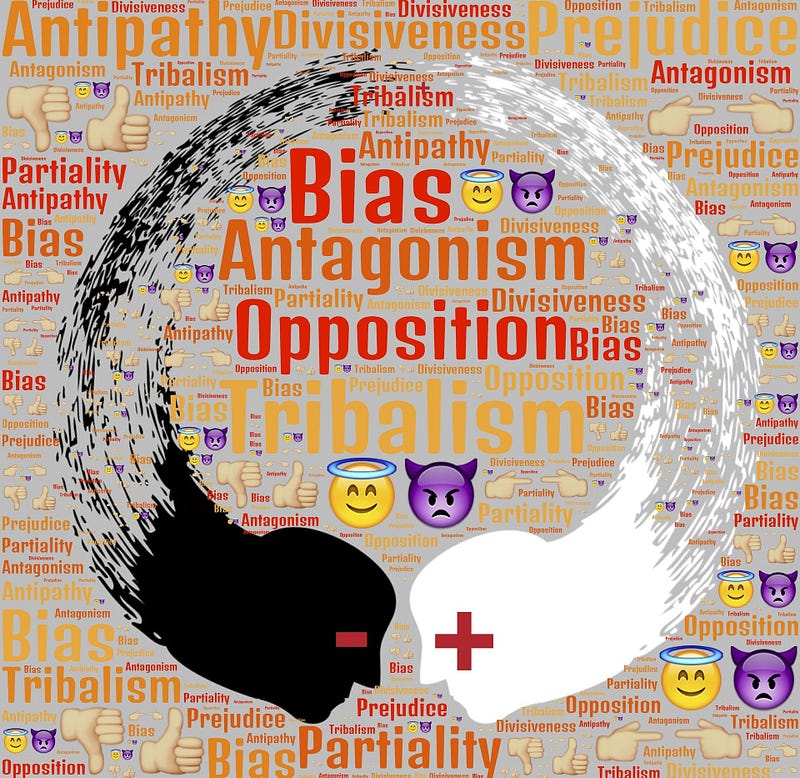
Source of Social Divisiveness and Dysfunction
People-Appraisal Judgments and the “True Nature” Myth
Over the past 40 years I have, as a clinical psychologist and researcher, been studying human nature, the judgments we make about each other, and the consequences of those judgments on our emotions and relationships. I’ve gained deep insights about a very common psychological phenomenon I call “people-appraisal,” which occurs when we make judgments, typically without conscious awareness, about the intrinsic worth and goodness of people. In doing so, we are assigning a value to what we believe is a person’s true nature.
This judgmental tendency is a root cause of divisiveness among people which manifests in problems at many levels in our lives — fractured families, personnel problems in organizations, and inequities that create many other serious issues across the world today. The rising political polarization in the Western world is a sign that our divisions are deepening. This “canary in the coalmine” ought to be catalyzing deeper conversations among us all. To that end, this article offers a collaborative approach to addressing the problem of people-appraisal.
People-Appraisal Concepts
People-appraisal is a process that is used to judge people often in simple dichotomous ways such as good or bad and worthwhile or unworthy. We use information about what a person has and what a person does, and with it we mistakenly infer something about who a person is at their core — their true self. From this conclusion about a person’s true nature we feel entitled to make decisions about whether or not someone is deserving of fair treatment and respect.
Although it’s possible to objectively judge a person’s individual and group identities (who the person is) and the person’s physical form and function (the observable parts of what a person is), it is impossible to judge the intrinsic goodness and worthiness of a person. Arriving at a conclusion about a person’s true nature, is to perpetuate a myth.
The Effect of Believing in the Myth of True Nature
When people come to believe they are wonderful and deserving, they may become extremely egotistical and lead them to look down upon others and treat them with contempt.
When people are continually told they are devoid of goodness, they learn that others are likely to reject and punish them. As a result, they’re unlikely to feel empathy, and tend to act without respect for rules and regard for the feelings of others.
When people are continually told that they have little or no value, that they don’t matter, it’s easy to convince them that the rules of society are against them. They learn to hate themselves and act in ways that enable others to gain power and control over them.
These people-appraisal myths are promoted by different cultures and reinforced by the stories told to us by our families, friends, institutions (schools, governments, religious organizations, etc.), and all types of media beginning in childhood.
All of this means that people-appraisal judgments — which logically can only be made by evaluating observable things and errantly believed to reflect one’s true nature — are not only a waste of time, but damaging and dangerous.
Purging People-Appraisal
One thing that would help humanity evolve adaptively is to purge the process of people-appraisal from the planet. In its place, humans would adopt a unifying purpose to eliminate such divisive and demeaning judgments. To achieve this goal requires that we raise awareness about people-appraisal and then teach people how not to do it. Children are easier to influence but adult behavior must also change if we are to make enough progress to stave off more severe consequences.
Teach Our Children Not to People-Appraise
The most powerful way to crush people-appraisal is to teach our children about it. That is, change the stories we tell them about the fallacy of appraising the worth and goodness of any person. These new stories would dispute the notion that a person’s true nature is able to be measured because “true nature” is only an imaginary idea, not an observable thing.
The power of storytelling transcends culture and time. There is ample evidence that stories are processed by the human brain more effectively than other forms of informational input. We have been described as “primates who tell stories”, and that they are “primates whose cognitive capacity shuts down in the absence of a story.” Stories are essential in the early education and development of young children; parents and teachers have used stories and metaphors for centuries (Reference).
The proposed new stories would vilify people-appraisal by raising children’s awareness and understanding that sensible and reasonable judgments of people can only be made about the things we can observe-what people have and what people do. The children would also be taught that the ratings used to make those assessments are subjective, so everyone will measure things differently and the ensuing disagreements presented as evidence that there is no universal truth about a person. The stories must be written and presented in ways children can understand and question.
Teach Adults Not to People-Appraise
There would be great benefit in helping adults realize the destructive effects of people-appraisal. Ideally it would motivate them to stop doing it. Adults who grew up in environments where stories supporting people-appraisal were prevalent — and now believe there’s nothing wrong with it — will likely continue doing it without some form of intervention. It’s even difficult for those who want to stop people-appraising because it’s an automatic, unconscious, emotionally-driven activity that they do without realizing it; and when they do it, they probably don’t recognize its damaging impact. So, again, the first step is to increase awareness by recognizing when people-appraisal is occurring. One method to help people recognize when people-appraisal occurs is to encourage them to do the following two things:
- Every time they think or say phrases similar to (a) “He/She is a ___ person” or (b) “They/We are ___ people” or (c) I am a ___ person” and fill in the blank with a judgmental term, make them aware that they are people-appraising.
- Change those phrases to (a) “He/She is a person who [has or does] ___” or (b) They/We are people who [have or do] ___” or (c) I am a person who [has or does] ___” and to stop there. It will not people-appraising, even if they fill in the blank with a judgmental phrase.
The point is that we are not or “human-havings” or “human-doings;” we are just imperfect, fallible human beings who have things and do things...and the true nature concept is only a myth!
Replacing the judgment of others with a curiosity about their own experiences in their youth that promoted their people-appraising beliefs, and how it became so deeply ingrained in them that it occurs without conscious thought or intention, would lead to new insights. It would become clear that what matters are the reasons for people’s feelings and actions, and those things can be understood by learning about each other’s values, experiences, and world views through respectful and humble discourse.
When discussions are heated and civility is in short supply, there are ways to structure conversations that can make things more productive. They include reframing situations and people in a different way by changing the meaning of certain things so the issues can be reconsidered.
For example, rather than demeaning a person for opposing environmentalism, consider defining climate change as a threat to the American way of life which could make it easier to view fighting it a patriotic act or as a moral act. In other words, a person who holds an opposing view on climate change and judged to be an idiot, now becomes a person with a different point of view who nonetheless is trying to be a good steward of the earth. Then, rather than launching into their own point of view, the person might be more inclined to express a desire to have a better understanding of the other person’s position, to ask how the person’s strategy would work, and to envision how it might be broadly beneficial.
Dealing with People-Appraisal in Companies and Other Organizations
Numerical rankings and rating scales of personnel performance might be counter-productive because they can lead to high frustration levels, excessive caution, and colleagues who work against each other. Research on the human brain suggests that the reason for this is that it triggers the fight-or-flight response. This is a survival mechanism meant to occur only when preparing to face a real physical threat. The result is feelings of chronic stress.
It also reinforces an invalid widespread view that human growth and learning depends on permanent inborn abilities, an underlying true nature. That means personnel with low scores are likely to feel judged as fundamentally incompetent based on the observation of their performance and is an outcome of people-appraisal judgement. This results in the development of a fixed mindset of incompetence, a perception that they are worthless in their job due to their low production value which cannot improve. Managers are likely to have the view that people judged worthless will always be difficult challenges and it would not worth the effort to help them improve because, by their very nature, they will always fail.
One solution is to eliminate people-appraisal by reframing performance evaluations using a highly structured or open-ended conversation approach that makes no assumption about an employee’s true nature. Managers would be given recommendations about how to discuss topics with employees in an annual review such as career growth, contribution, collaboration, innovation, and employees’ goals. Both employees and managers must be trained by HR to “recognize that anyone can learn and improve thanks to the brain’s capacity for change when primed by a workplace that recognizes the impact of human effort this growth mindset encourages people to listen to feedback set goals and put in the extra effort needed to succeed” (Reference).
Successfully re-educating and re-programing a significant number of adults and children to “overcome” people-appraisal tendencies will take time and effort. It’s uncertain how much time humanity has left and how much effort our species will make. So any complementary approach that might transform divisive people-appraisal to build unity — no matter how unconventional the approach may be — is worth consideration.
Conclusion
A person’s self is a social construct that defines a human being as someone with an identity and with physical and nonphysical aspect. Some of the physical aspects refer to what someone does, and others to what someone has. While it’s possible to occasionally measure some of these aspects using subjective rating scales, people often mistakenly use these measurements for people-appraisals. Most humans have been told nonsensical stories since childhood about false differences in the true nature of people.
Unfortunately, we grew up believing the stories even though a logical examination of reality makes it clear that the stories are foolish, absurd, senseless, irrational, ludicrous, and ultimately destructive to ourselves and others. Many of us, nevertheless, continue to erroneously believe that it’s reasonable to judge the inherent goodness and worthiness of people’s true nature. People appraising has become a social norm, so we fail to realize that these judgments not only make no sense, but also cause great harm to our species’ wellness, wellbeing, and in the worst case, our ability to adapt and survive.
It would be much to our advantage if we became aware of the falsehoods these stories perpetuate, how they adversely affect us, and how much better life would be if we reject them. We need to imagine a world without people-appraising. Only then can we begin to realize beneficial reductions in social division, psychological distress, and physical illness that such judgments foster. This mindset shift could readily lead to a unifying path toward greater peace, health, and sense of wellbeing for people in America and around the world. It would enable us to achieve “inclusive diversity.”
Despite the challenges we face, greater equity is within our grasp. What sometimes appears so complex is often rooted in a simple truth. This quote succinctly describes how people-appraisal affects us and how a simple change in focus could benefit us all…
It’s easy to judge. It’s more difficult to understand. Understanding requires compassion, patience, and a willingness to believe that good hearts sometimes choose poor methods. Through judging, we separate. Through understanding, we grow. — Doe Zantamata


