
Sorry, We Aren't Going into Space.
Is it even a good idea?
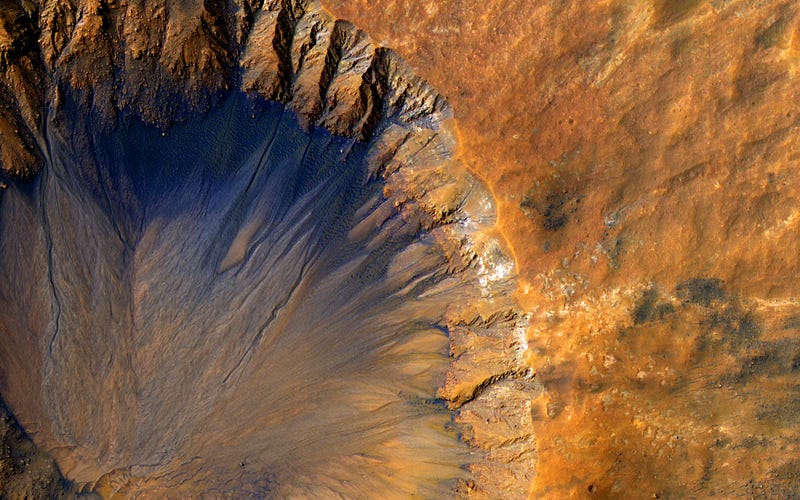
I know what you are probably thinking. What's the matter with you? The Perseverance lander just sent pictures back from Mars. We made it! We are on another planet. It's so cool! Link to NASA’s Mars Exploration Website.
"Elon Musk is a genius! We'll live to see a million-person Mars base"
The above quote is from a coworker. It is the inspiration for this article. I hate it, but he is wrong.
I get it. I love Sci-Fi. Star Wars, Star Trek, Battle Star Galactica, The Expanse... But, sorry, it's not going to happen. Do the math. We are not going very far into space anytime soon. Just to send a few people to Mars will eat up an insane amount of resources and take the rest of our lifetimes. Shouldn't we focus on the beautiful planet we have now?
Why the idea of space travel is popular. Escapism. It's romantic. We avoid the boring hard work of compromises and sacrifices to help life on Earth. We embark on a grand adventure. Leave our problems behind!
What has happened so far. We’ve been to orbit countless times. Several nations have cooperated to make the small International Space Station. The ISS is in its last few years of its operation.
We've been to the moon. Six crewed NASA missions landed on the moon between 1969 to 1972. But then nothing. Why? The moon is a huge rock. It is not worth the huge cost to send one or two people there, even for bragging rights.
Interstellar probes. Voyager 1 was launched in 1977. It reached interstellar space in 2012. It will cease to function in 2025. As of Jan. 1, 2019, it has traveled over 21 billion kilometers from the Earth. Our little chunk of now space junk will keep going indefinitely. NASA Voyager info. The closest star is 4 trillion kilometers away. Voyager 1 isn't heading to Alpha Centauri but if it was it would take over 70000 years.
What is happening now. The Perseverance Mars mission will take environmental measurements. It will look for evidence of ancient microbial life. It will test tech for making oxygen from the atmosphere and finding subsurface water. The rover will move around and take rock and soil samples. The Mars Helicopter will make its first voyage.
What will happen in the nearish future. There is a flurry of space-related activity taking place in the next 1~20 years.
- An ever-expanding number of nations and private organizations are putting satellites into the Earth's orbit.
- NASA's Artemis program will put astronauts on the moon again.
- The Voyager probes will continue into interstellar space.
- Numerous probes will look at moons, asteroids, and other in-system bodies.
- A powerful replacement to the Hubble telescope will come online.
- A lunar orbital station may be established.
- Private industry will be more involved in space programs and even space tourism.
- There may be a manned mission to Mars.
Why it won't go much farther than that for a long, long time. Distance and cost. The moon, Mars, and the other planets in our solar system are borderline reachable, but they are uninhabitable rocks. To find a truly habitable planet where human civilization can thrive, we need to go to other solar systems. Unfortunately, they are realistically out of our reach.
Alpha Centauri is the closest but, that is an impossible 4.3 light years away, over 40 trillion kilometers. Even without problems in transit, using current ion engines it would take over 80000 years. Even with the fastest engines we can realistically conceive of making, nuclear, the journey would take 1000 years. Read some discussion of the topic here.
Not. Going. To. Happen. Not in our lifetime. Not in our children’s lifetime. Not in our grandchildren’s.
Maybe sometime in the very distant future, we’ll discover wormholes or warp engines. But we need to face the fact they are pipe dreams past the horizon of time. They might even be impossible.
The Earth is in trouble NOW! Climate change and pollution are serious problems. The population is ever-increasing and straining the capacity of the planet. Wealth inequality and conflict are rampant. Most governments and large private organizations are not responsive to the needs of the common people or the wider community of humanity. And worse of all, several nations have the capability of destroying the planet with WMDs and that club is growing.
Love the one you’re with. We live on a beautiful planet and we’re screwing it up. Let’s focus here on what we can definitely do.
Collectively, in today’s dollars, we’ve spent likely over 3 trillion dollars on the space race. What if we spent that on nature preservation, education, or research?
Last year the world spent over 70 billion on space projects. Couldn’t we have found something to spend it on down here?
So to sum it up. We can’t actually get to anywhere useful to us in space, human society on Earth has enourmous problems, and we’re choosing to spend billions on this project.
Maybe we should stop space exploration until we have our house in order.