
Sorry, But Witchcraft Was a Religion Before Christianity
A short story about how Christianity demonized witchcraft.

Witchcraft. What a misunderstood concept.
For centuries we have been told horror stories where some witch is guilty of sacrificing chickens and goats, or stealing the soul of an innocent to offer it to Satan.
They also blame witches for unfaithful men, infertility, drought, hunger, misery… If something bad has happened in the last 2,000 years, a witch has been to blame.
Understanding the origins and true essence of witchcraft can be shocking to some people, especially Christians. I clarify that it is not my intention to attack Christianity (an eye for an eye and the world will end up blind), but before continuing I have to say it:
I am about to share my feelings regarding witchcraft and witches. It is not a fanatical or poorly documented perspective of reality, but a historical, biological and experiential description of the events, which means that witchcraft is my past, my heritage and my life.
Considering that the story told for centuries has been very different (the version of the “winners”), I ask discretion and maturity of those who venture to read this.
Burning the witch is out of fashion.
Common myths on witchcraft
Here are some things that most people associate with witches and covens:
- Sacrifices of animals, babies and virgins in honor of Satan: False. Witchcraft is not the same as Satanism.
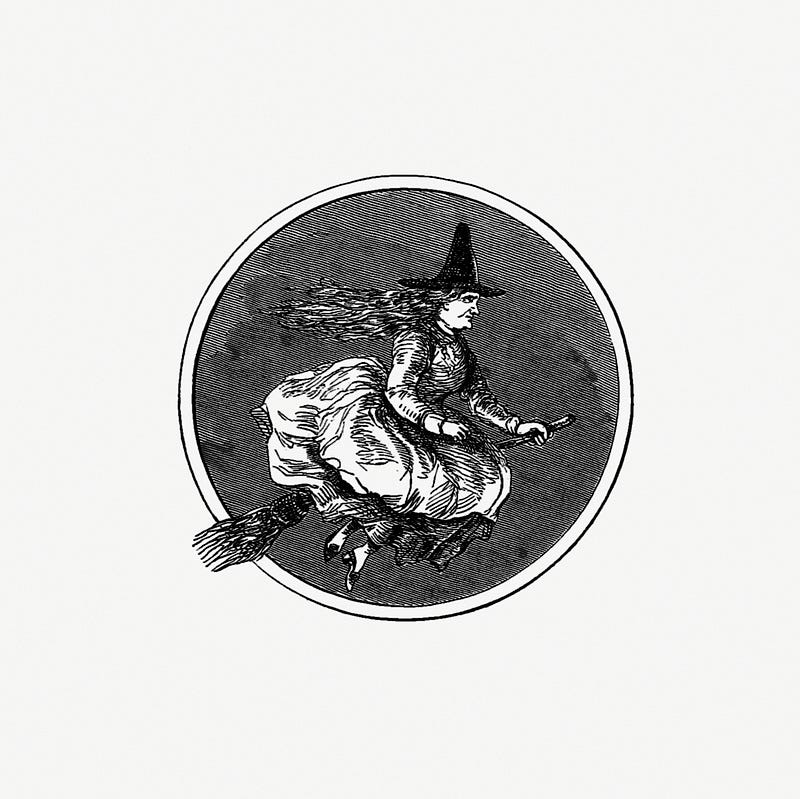
- Flying brooms and pointy hats: False. Medieval witches rode brooms during sympathetic magic rituals to tell crops how tall they should grow. Pointed hats were all the rage in 15th-century Europe, and continued to be worn by women in the country after falling out of style in the city, thus gaining fame as the garb of pagan women.
- The use of five-pointed stars to “summon the devil”: False. The five-pointed star represents the elements and the cardinal points, very important aspects in the practice of witchcraft.
- Naked women singing and dancing around bonfires in the woods: True. We will see why later.
- Altars that praise horned beings: True. I will do a brief historical review in a moment.
Witchcraft is the oldest religion ever
Many will disagree: “Witchcraft, a religion?”
But yes, it is.
Those who practice witchcraft recognize the existence of the Gods and their creator / provider role in the universe, so witchcraft has all the characteristics of any modern religion, including rituals and rites.
The prehistoric human being already believed and actively practiced witchcraft. The tribes performed ceremonies where they mimicked animals to “influence” future hunting success, a type of magic called sympathetic, which is based on the principle of the Similary-Attraction Effect.
Of course, leaders today prefers to use other names to justify the use of sympathetic magic in everyday areas of life, such as personal development, learning, weight loss … Now, they call it “visualization”, “positive thinking” or “attraction”.
Witchcraft is an ancient, prehistoric religion, which arose from the same spiritual instinct that led the Greeks to believe in Zeus or the Indians to believe in Shiva, with the difference of that witchcraft is the first religion of man, the most primitive.
Having their origin in nature, the Gods of Witchcraft represent the elements that man saw as indispensable for his survival: the Horned God and the Goddess of Fertility.

The Horned God represents hunting, provision of food, strength, masculine balance in all things. It is the equivalent of Jesus Christ (the Lamb of God) and the horned gods of India and Egypt.
In Egypt, Amun and Apis (among many other gods) were often depicted as bulls or antelopes, and nearby, in Babylon and Assyria, it was common for the deities to have bovine or sheep horns.
The Goddess of Fertility is the equivalent of the Virgin Mary and other female Goddesses of so many religions. It represents the mother, the grandmother, the girl, the young… It is the figure we turn to in search of comfort, compassion and wisdom.
In addition, the Goddess of Fertility (or Mother Nature) guarantees the reproduction of species, something essential for prehistoric man to continue hunting and feeding families for generations.
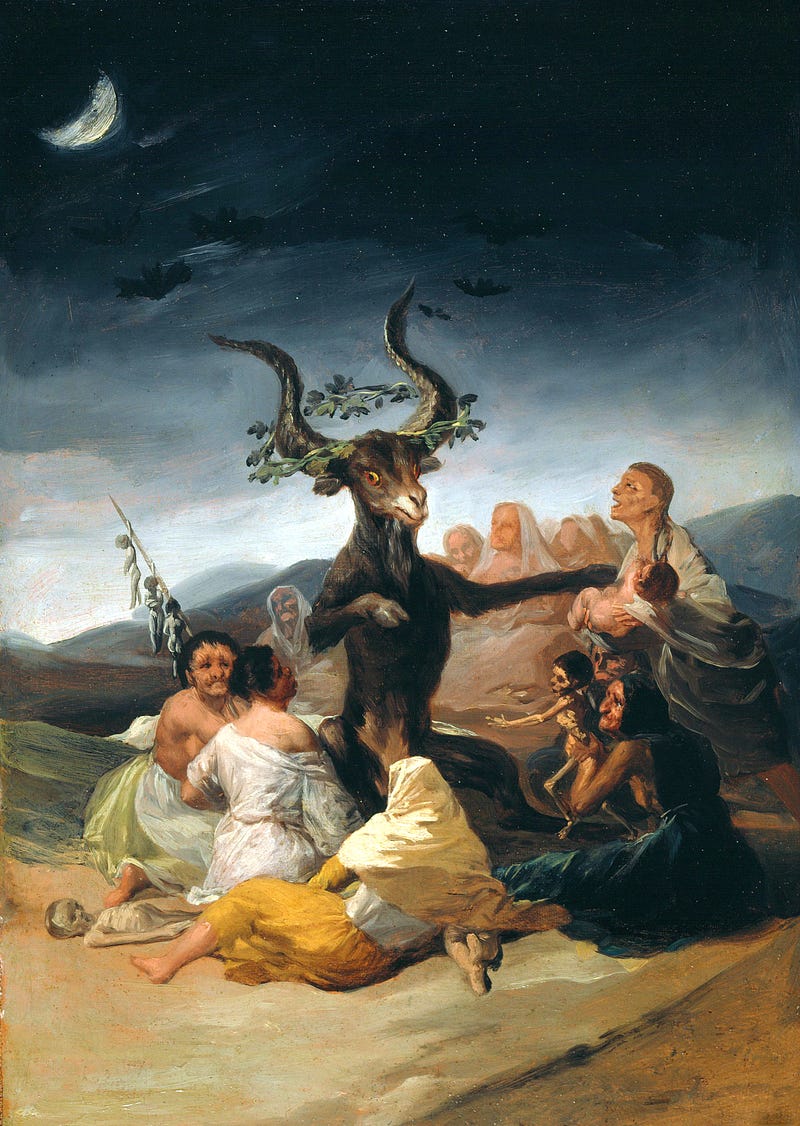
This explains the paintings (not always benevolent) showing covens surrounded by a Horned God, although it does not explain why witches are naked, does it?
Let’s get to that.
Witchcraft is a religion that is born from the earth and returns to the earth. It is a system of customs and cults that celebrate life and the balance between the ecosystem and the creatures that inhabit it.
For this reason, in a traditional witchcraft ritual, its participants prefer to go in their natural state: naked.
No, witches didn’t create Satan
The notion of a dual reality has always existed in the mind of man, because it has always existed in nature.
Sun and moon, day and night, winter and spring … That dual principle gave rise to other types of beliefs over time, such as the existence of a Devil to justify the existence of God.
Once again, this was an invention of modern forms of religion that was spread and mistakenly associated with witchcraft by the rise of occult sects that took elements of the Judeo-Christian tradition, such as Samael and Lilith, and associated them with the Old Religion.
This is the Samael and Lilith’s pentagram:
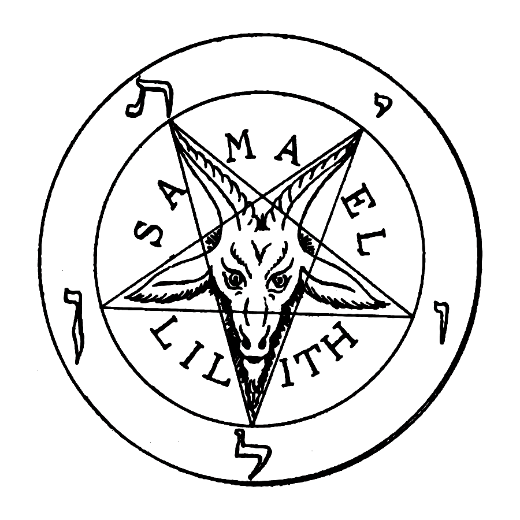
It’s very different from the pentagram that Wicca and neopaganism use:

Now, it is important to understand the political origin of Satan to understand why witchcraft was and continues to be “frowned upon” by many today.
The political origin of Satan, and why first Christians believed in reincarnation
Before continuing, let’s clarify something:
The pagan concept does not mean that a person is a worshiper of the Devil. Etymologically, pagan refers to people who live in the countryside, in the villages, far from the big cities. When Christianity began to recruit monarchs and aristocrats, paganism became the best way to make those who preferred to continue worshiping the Old Gods look bad. Only someone ignorant, a peasant, would cling to old traditions instead of accepting the New God.
Unfortunately (for them), it is very difficult to hide the similarity between the figure of Jesus (his birth, life, philosophy and death) and that of thousands of other pagan Gods that already existed hundreds of years before Christianity.
The gospels also contain an interesting mystery that Joseph Atwill masterfully exposes in his documentary Caesar’s Messiah (Caesar’s Messiah). Atwill presents sensible and logical arguments to believe that the Christian religion and the Catholic Church were an invention of the Romans to ensure the hegemony of the Empire:
I do not want to delve into the similarity that exists between Jesus, Mithras and other pagan deities, nor in the similarities that exist between the gospels and the accounts that Flavius Josephus made of the Roman victory during the messianic wars.
Everyone is free to find their own truth, as long as they do not harm anyone, but there is a very important element that I do have to delve into:
The “first Christians” believed in reincarnation. Not because they were “first Christians,” but because they were pagans at heart, pagans forced to convert to Christianity.
The Old Religion was still alive inside him. They knew that the soul exists before birth, and that the natural order in the universe is to live more than once.
Of course, it eventually became notable that the belief in reincarnation did not benefit the New Religion at all, and although the church continues to deny its participation in repressive acts related to the subject, there are records of anathemas (accusations or charges) against Origen of Alexandria, a Christian writer of the late first century AD who believed that souls exist in heaven before incarnation.
It must have been important to suppress the belief in the pre-existence of souls, considering the first anathema on the list:
If anyone asserts the fabulous pre-existence of souls, and shall assert the monstrous restoration which follows from it: let him be anathema.
Logically, it was not good for people to believe in second, third or fourth chances. It robbed the priests of their power and credibility.
With the eradication of life after death as a pagan heritage, the idea of hell took on more importance. No one wanted to burn and mourn for eternity, so obeying the priesthood became the only way to avoid the clutches of Satan.
You could even pay to have your sins forgiven, a holy (and lucrative) remedy. Thus, the Church created the Devil. They energized him, empowered him, and gave people reason to fear the idea of something monstrous completely opposed to God’s grace (conveniently, a monster with antlers, like the Horned God).
Now I go to a vital point, and with this I end for today:
A witch who claims to worship Satan not only completely departs from true witchcraft and traditions, but also pursues a Christian interest, and even a way of life based on Christian beliefs.
Satan or the Anti-Christ were not part of the tradition of the pagan peoples BEFORE the arrival of Christianity, and the appearance of cults that go completely against the principles and beliefs of the first witches has not helped to clean the image of the Witchery.
I would even dare to say that the Church made the Devil fashionable and then it went viral.
References:
Buckland’s Complete Book of Witchcraft, by Raymond Buckland.


