
Sons of Darkness, by Gourav Mohanty
A review of the first Indian epic grimdark fantasy
I had been seeing this book around on bookstagram but because of its thick size, I was hesitant to pick it up. Coupled with the fact that my reading had been going downhill at the time, I had no desire to even start a new book. But fast forward to my reading slump healing era, I was definitely ready for something serious and so when the author reached out to me, I responded with a resounding yes!
Sons of Darkness is the first Indian Epic Grimdark Fantasy novel to be published in India, and it is the first installment in The Raag of Rta series.
Disclaimer: I recevied a free review copy of the book from the author. However, all opinions expressed are my own and in no way influenced by external forces.
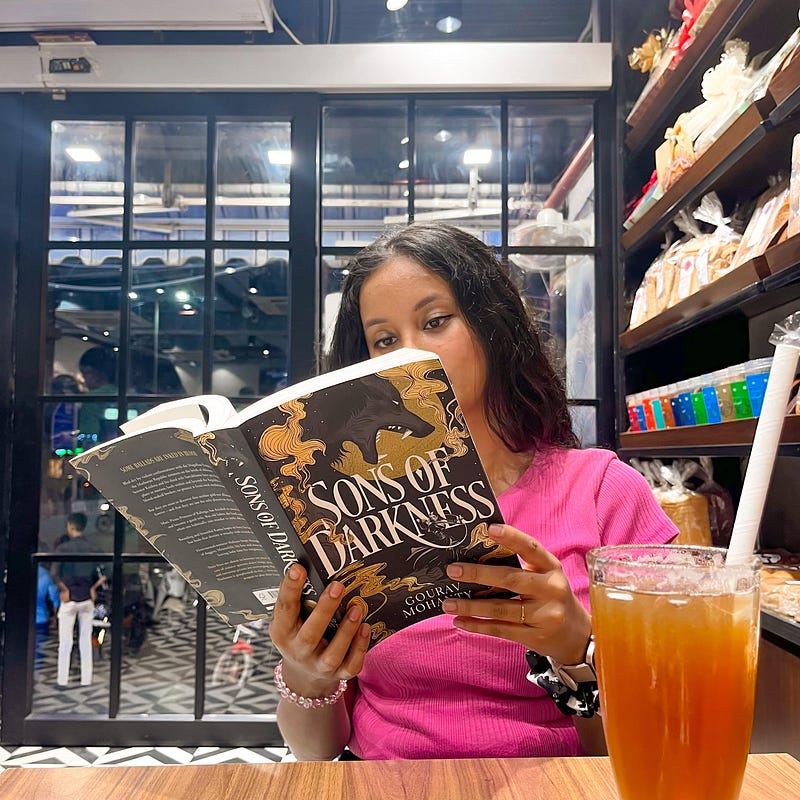
What is the book about?
Here is a brief description from Goodreads:
Bled dry by violent confrontations with the Magadhan Empire, the Mathuran Republic simmers on the brink of oblivion. Krishna and Satyabhama have put their plans in motion within and beyond the Republic’s blood-soaked borders to protect it from annihilation. But they will soon discover that neither gold nor alliances last forever.
They are however not alone in this game.
Mati, Pirate-Princess of Kalinga, has decided to mend her ways to be a good wife. But old habits die hard, especially when one habitually uses murder to settle old scores. Brooding but beautiful Karna hopes to bury his brutal past but finds that destiny is a miser when it comes to giving second chances. The crippled hero-turned-torturer Shakuni limps through the path of daggers that is politics only to find his foes multiply, leaving little time for vengeance.
Their lives are about to become very difficult for a cast of sinister queens, naive kings, pious assassins and ravenous priests are converging where the Son of Darkness is prophesied to rise, even as forgotten Gods prepare to play their hand.
First impressions
At the first go, I knew that it was inspired and to a certain extent, a retelling of the Mahabharata, the famous Indian epic of the Dvapara Yuga, compiled by the sage Ved Vyasa.
However, what I was not expecting was the extent to which the author had made it his own. The characters are ones we know of, but Mohanty has imbubed them with multiple layers, making each a more realistic version than the legends of yore we have read about.
The author has also added a lot of political elements to the story, such that it is no longer just a mythological work, but rather a high fantasy in its own rights. There are different ‘houses’ and groups with their own sigils and mottoes, much like that in any other fantasy work.
One might also argue that the Mahabharata came with its own setting and background and so that aspect might be stagnant in this retelling. However, Mohanty has built a lot upon that, drawing from Indian history; the existence of great Magadh that we know of as a mahajanapada is portrayed as an empire in the book; there are republics, and unions and of course kingdoms, some happy and some on the cusp of an end; there are allies formed on account of marriages, educational centers, and so on.
There is so much detail in this book and I loved the author’s minute attention to every single one. It is difficult to believe that this is a debut work because of the vision for the scope of the book that the author had, and especially his brilliant execution of it.
I really loved the references made to Pragjyotishpur (erstwhile Assam) in this book, especially through the couple of characters and their roles in the story. I am excited to see more of them, considering King Bhagadatta did participate in the Kurukshetra war in the Kaurava side, atleast according to what we know. I am eager to see the direction that Mohanty is going to take this in though. Knowing his writing, what twist can I expect?
The cover
I have seen other readers also say that the cover was what attracted them to this book in the first place, and I am no different. It is definitely a brilliant cover by Micaela Alcaino and by the end of the story, you understand the resemblance.
Characterization
I have to applaud Mohanty’s characterizations. Be it Krishna, Duryodhan, Karna, Shakuni or Mati, each one of them is so very layered. Growing up, based on what I have heard of the Mahabharata from my parents and grandmother, I did not really like the Kauravas (in fact, I hated them), as well as Shakuni. But after reading this book, and seeing Mohanty’s version of their side, it is a lost battle.
I feel for these characters and am quite invested in their journey so far, while also eager to see where the story leads them. Perhaps, it is only Karna towards whom my feelings remain the same — I admire him, but I also still feel sad for him and his destiny. Fate has not dealt him a good hand.
Krishna on the other hand, is finally portrayed as the master schemer he is. We have always known he is clever and very cunning. It is interesting to finally see that side of him as a mere human, no longer an elusive god hidden behind a veil.
Satyabhama as the war mistress is also a formidable woman and I did admire her, although I did not find her very likeable. But I suppose that is the whole point. Her Silver Wolves were also a fabulous bunch of women — loyal and brave until the very end.
Shakuni too seems like a mere mortal who is calculative, yes, but still not completely overtaken by his desire for vengence, making him evil (but the desire of revenge is still there nonetheless).
There are a host of other characters as well, whose roles I am eager to see pan out in the next book(s). Masha, Nala, Parashuram, Shishupal were also introduced in this book, and I wish there was more of them. Draupadi is a character who has been so manipulated by the people around her; she is very naive and I am eager to see her character arc in the next book.
Fantasy
The fantasy element with regards to the prophecy and Muchuk Und are what I definitely did not expect. The interstellar aspect of it, with daevas (like alien beings in the narrative) is also something really unexpected that the author played with.
Combining it with the myth of the Syamantaka jewel was also a clever move, thus weaving together the threads of mythology and fantasy. But then, you might ask, how different are they really?
The whole magic system, with regards to the Elementals, the Matrons and the Saptarshis was also really creative and I think the author has done a brilliant job.
Verdict
The only issue I feel was that the book was a bit slow until after the mid point, after which it picked up considerable speed. Then, the battle towards the end was a tiny bit stretched out with the author trying to give the perspectives of all the different players in the field. There was a point when I had to wonder — how long is this going to be.
Overall, apart from that aspect, the book is written well and I had a really good time reading it. In fact, I read it in about 4 days, which should really tell you how invested I was in the story.
I would definitely recommend you this book and hope that you have a good time with it as I did.
Nayanika Saikia recently graduated with a First Class Master’s Degree in English Literature, and is currently working as an editor at a publishing house. She is also a Booktuber and Bookstagrammer. She can often be found on her Instagram account Pretty Little Bibliophile.
You can support her by Buying Her a Coffee or by using her Referral Link while getting a Medium membership!