
Songs of the Tree Frogs
Nature’s hearing test
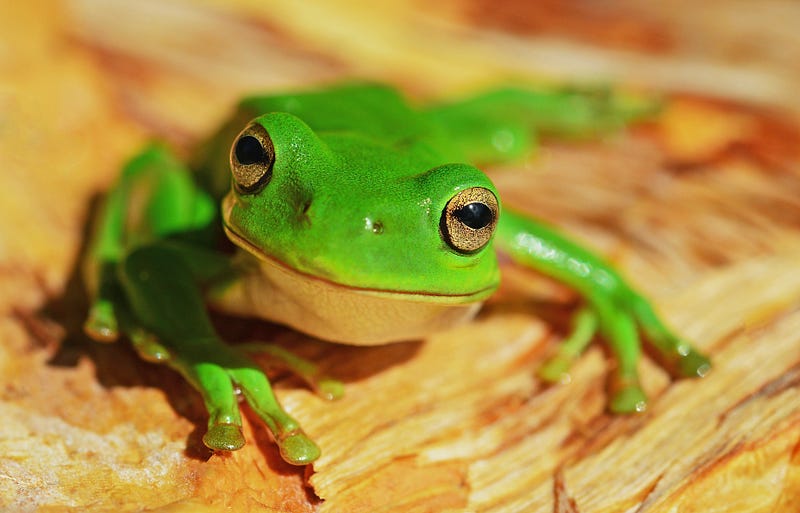
Our house is surrounded on three sides by trees. Those trees are filled with tree frogs. And, as of this week, they are also being filled by songbirds, returning from wherever they went during the winter.
Let’s leave aside the question of where songbirds would go to avoid the temperatures in the (*gasp*) low 70s. Perhaps there was another reason they left. Maybe they didn’t like the construction nearby. Or felt that we needed to be vetted by the monkeys before we could be considered suitable neighbors.
The point is, that our trees are now filled with songbirds. And, just as they inexplicably were gone during the mild Caribbean winter, they inexplicably sing at all hours of the day. I’m used to Northern birds, that are very active just before dawn, on and off during the day, and then again around dusk. Songbirds singing at midnight confuse me.
One of the new songbirds has a distinctive coo-whee! tchoo call. Lying in bed, my husband complained that it was keeping him awake. The single note tchoo was a pleasant sound. But the coo-whee! was distinctly unmelodious.
I thought it harmonized well with the background chorus of tree frogs, with their incessant peep-peep and churruh.
There was a loud silence from my husband’s side of the bed, eventually broken by, “What chorus of tree frogs?”
Not the first time
I was reminded of my last visit home to see my dad, in New York. He lamented that he missed the sound of tree frogs, and wondered if it was a sign of urban development or too much pesticide use that they were gone.
We opened the window at night to offset the 90-degree temperature in the house, even though it was December. And clearly heard the peep-peep of tree frogs.
Admittedly, they weren’t as numerous as I remembered them being in childhood. So we asked Dad if that’s what he was talking about. No, he couldn’t hear them at all.
We reassured him that the tree frogs were still there. It was his hearing that was going, not the tree frogs.
At the time, my husband could hear the tree frogs.
The current tree frog dilemma
My husband has a curious kind of hearing difficulty. (One shared by my father, oddly enough.) He has trouble switching focus. So if there is a loud noise nearby him, he can’t NOT listen to it, to focus on a quieter sound.
So, the song of the tree frogs was literally being drowned out by the annoying song of the mystery songbird who was closer and louder.
He was somewhat concerned that his inability to hear the tree frogs might have been a sign that his hearing was also going. After all, he’s been wearing over-the-counter hearing aids for a few months now. They help him greatly when he’s watching TV, or trying to have a phone conversation.
Could he have become dependent on the hearing aids? Was he no longer able to hear the high peep-peep of the tree frogs without them? After all, the main difference he noticed with the hearing aids was that he could hear more high notes in voices than without them.
Fortunately, once the annoying songbird shut up, he could hear the tree frogs’ chorus, muted in the distance.
For now, at least, he had passed Nature’s hearing test.
This stream-of-consciousness story was written in response to Linda Caroll’s challenge:
In keeping with the rules, I did not go back and edit anything after the story was finished. (Although I did fix typos as I made them — I tried to make my stream of consciousness clear and free-flowing, rather than murky.) And, just so you know, yes, I’m aware of the grammar error in the story and I’m leaving it that way on purpose! Because of rules!
Also, a fun fact that I wanted to work into the story but didn’t get a chance to (15 minutes of writing is just not that long!) is that, in college, my boyfriend at the time worked at the college radio station. He found, among the many stacks of vinyl albums in the radio station’s library, an album called something sort of like “Songs of the Tree Frogs”. (This was back in the mid-80s, so I’m a little fuzzy on the exact name.) A scientist and his team had gone into the woods with musical instruments that could make sounds in the same range as the tree frogs. When the tree frogs started singing, the scientists attempted to repeat their songs back to them. The frogs soon changed their tunes, responding to the scientists. This bizarre duet between scientists and tree frogs was recorded and pressed into an album. The record was 20 minutes per side, with no breaks.
If you also take the 15-minute stream-of-consciousness writing challenge, please tag me so I can see your thoughts, too!


