
Songs of Summer: “Hot Fun in the Summertime”
Sly & the Family Stone’s classic embodies the season’s elusiveness
It’s the elusiveness that makes summer so magical.
Summer is really more of an idea than a season; tangible in fleeting grasps.
- An immaculately architected sandcastle.
- A sloppy boardwalk make-out session.
- The refreshing splash of swimming pool water washing away the sticky sweat on a 98-degree afternoon.
But those moments live mostly in the mind as aspirations and memories. They ebb and flow into an ethereal abstraction, like heaven or namaste.
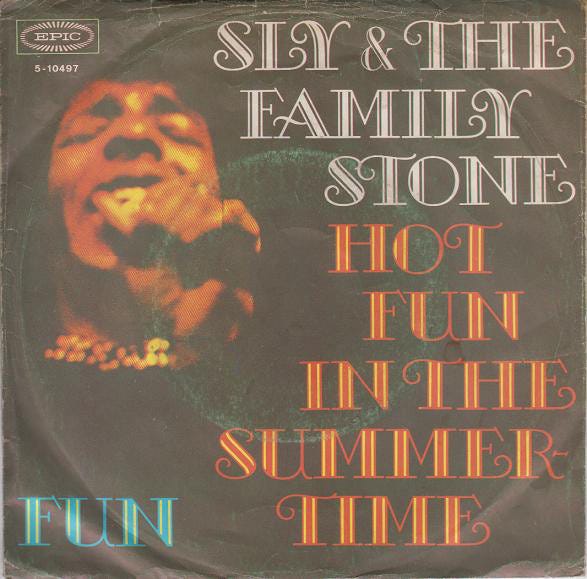
Sly & the Family Stone’s 1969 hit “Hot Fun in the Summertime” captures that elusiveness like no other song, largely unfolding in prologue and epilogue.
Memory and Anticipation
“Hot Fun in the Summertime” opens with wistful keys that bring to mind those sunny afternoons on the last week of school. You know, the ones when you can’t help but stare out the window, vibrant fantasies of adventures to come overpowering the dronings of a teacher who is probably equally checked out.
It’s the seductive allure of anticipation that makes those moments so rapturous, and the keys capture it masterfully, steadily building as the track settles into our psyche. Greg Errico’s drums sneak in with an uncharacteristic looseness, leaving plenty of room for Larry Graham’s strolling bassline and an ethereal string section.
Sly’s leisurely vocals cut through the sonic haze, subtly situating us in those breezy final days of spring in which the magic of summer awaits on the horizon.
End of the spring And here she comes back Hi, hi, hi, hi there Them summer days Those summer days
That’s when I had Most of my fun, back Hi, hi, hi, hi there Them summer days Those summer days
Sly’s tense shifts between future (“here she comes”) and past (“that’s when I had”), give the ensuing pre-chorus a disorienting ambiguity. Are the band’s exultations of “I cloud nine when I want to” and “county fair in the sun” plans or memories? Is it really all one and the same in the dizzying orbit of summer’s slippery circularity?
“Hot Fun in the Summertime” is only truly “in the moment” of summer during its gospel-delic chorus, a euphoric repetition of the song’s title backed by celebratory horns. It’s cathartic. It’s explosive. It’s transcendent. And then it’s gone, whisked away by the autumn breeze of the second verse.
First of the fall And then she goes back Bye, bye, bye, bye there Them summer days Those summer days
The pre-chorus reprises one more time before a jarringly quick fade begins in tandem with the second chorus.
Gone too Soon
For years I scoured the internet for an extended version. I wanted to bask in the contours of the groove like the summer sun itself, while the band worked through every conceivable machination and instrumental flourish. Surely a funk outfit as ingenious and virtuosic as Sly & the Family Stone wouldn’t simply let a sonic confection this enveloping fade into oblivion after a mere two minutes and thirty-seven seconds.
No such 12” “Indian Summer” mix exists, and now I wouldn’t have it any other way. Like the season itself, “Hot Fun in the Summertime” goes by way too fast, disappearing even more abruptly than it arrived. We’re left to luxuriate in the memories made, and escape the winter cold with furtive fantasies of summers to come.
Maybe the mystique of summer lies in what it represents. It’s at once the peak of the planet’s annual rotation, and a moment of transition from the growth and maturation of the spring to autumn’s slow fade, paralleling the fleeting prime years of life itself.
The Summer of Sly (Nostalgia for the Present)
In that analogy, 1969 was “summer” for Sly & the Family Stone as a band. After several years of steady progression artistically and commercially, ’69 saw the band notch its first number-one single (“Everyday People”), release an album that captured the counter culture zeitgeist of the time (Stand!) and finally reach the previously elusive rock audience with their electric performance at Woodstock.
If Stand! was late June and Woodstock July, “Hot Fun in the Summertime,” was their August. Released as a single in August of ’69, it showcases the band at the height of its genre-bending prowess. Every member shines on the track, but it all blends seamlessly into a whole that’s even greater than the sum of its mighty parts.
The track was initially imagined as the lead single to a follow-up album to Stand! that was to include the inclusive-minded “Everybody is a Star” and the anthemic “Thank You (Falettinme Be Mice Elf Agin).” The trifecta represents three of the band’s very best songs.
The album never happened. Sly’s addictions spiraled, the band began to splinter, and the flower power optimism of the ’60s gave way to the tension and despair of the ’70s. The three tracks were jettisoned to the label-mandated Greatest Hits album of 1970 album that represented the end of Sly & the Family Stone as originally constituted.
The Sly who emerged on 1971’s There’s a Riot Goin’ On was a different man and a different artist. Riot is every bit as masterful as Stand!, but it’s very much a fall album: cynical, moody, and darkly ruminative.
Despite carrying the band’s name, it’s also a quasi-solo project. Sly recorded mostly alone, enlisting individual band members as needed rather than holding group studio sessions. Errico’s pulsating drums were replaced by the mechanical kicks and snares of an early model drum machine. Riot is a captivating listen, but it’s clearly the work of a man past his summer years, his once infectious spirit faded like fabric left in the sun for too long.
In the context of Sly’s full discography, “Hot Fun in the Summertime” carries an eery awareness that the future will soon be the past, creating nostalgia for the present that embodies the magic of summer perfectly.
What songs best capture summer for you? Drop them in a reply, or better yet an article of your own. Let’s keep the Songs of Summer grooving!