
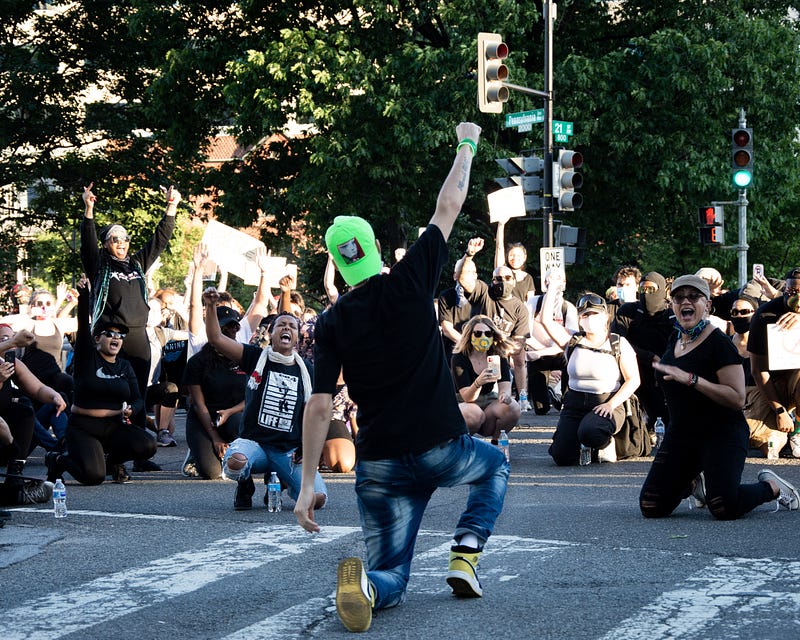
Sometimes We Kneel
What kneeling means, and why sometimes we kneel because we have to.
Many people are kneeling these days, for many different reasons.
Sometimes we kneel in reverence.
Bending the knee is a sign of respect. A posture of humility. To kneel is to humble oneself quietly before another, to honor them.
The most popular show on television just spent an entire season wondering if Jon Snow would bend the knee in submission to Daenerys. In an epic filled with dragons, swords, and battles at every turn, the most powerful moment of the Game of Thrones season may have been when Jon finally bent the knee to Dany (at least figuratively).
A knight kneels before a king in respect and submission. Both Christians and Muslims kneel as part of their religious practice. Kneeling has long been understood as the appropriate way to come before a king or ruler in humble submission, a way to honor them. At my Anglican church, the priest instructs us every week to kneel before God during a time of prayer and confession. The Bible tells us that Jesus himself sometimes knelt when he prayed.
Sometimes we kneel for other reasons. A lover may kneel to propose marriage. A team may take a knee around a coach or motivational speaker. Kneeling can be symbolic. It can be a representation of unity.
Kneeling is never about the one doing the kneeling.
Kneeling can also be cynical. Dallas Cowboys owner Jerry Jones showed that yesterday. On a day in which the vice president upstaged an NFL game by walking out on a peaceful protest everyone knew was coming, Jones made a demonstration of his own. Less than two weeks after taking a symbolic knee with his players in a show of apparently false solidarity, Jones called out the same players with a promise to bench anyone who “disrespects” the flag.
Like the president, Jones made kneeling into something it is not. He made it about himself.
Kneeling can mean many things to many people.
Sometimes we kneel because we simply cannot stand anymore.
The worst phone call of my life was one I never took.
My parents woke me up in the middle of the night one cold January morning. My grandmother was on the phone.
“Get on your knees,” she told them. “There’s been an accident.”
My parents rushed to the hospital where my brother was being helicoptered in. My sister and I joined them later that morning. I got there just in time to say goodbye. I was 17. I’m twice that age now, but it remains the worst night of my life.
I spent that night on my knees, both literally and figuratively, praying for a miracle that did not come. I spent that semester doing the same, and much of the next few years. I cried. I mourned. I didn’t understand.
It was all so unexpected. Why him? Why me? This wasn’t supposed to happen.
Sometimes I think about others that get a call like that. A call like that, but different.
“Get on your knees... There’s been a shooting.”
Tamir Rice’s family probably got a call like that.
So did Michael Brown’s.
Alton Sterling’s.
Oscar Grant’s.
Laquan McDonald’s.
Philando Castile’s girlfriend Diamond Reynolds never got that call. She didn’t need it. She watched it happen right in front of her.
Young Black men, all of them. All dead. All of them at the hands of the police.
The Washington Post reports at least 168 Black Americans shot and killed by police already in 2017. Another 492 in 2015 and 2016. Around 13% of Americans identify as Black or African-American, but almost double that percentage of men and women shot and killed by police in America each year are Black. Those numbers are undeniable. They’re inexcusable.
“Get on your knees… There’s been a shooting.”
It’s a call I would never expect to get.
But I’m white.
I wonder if I would be as shocked, if I weren’t white. If that call would be completely out of the blue, something I’d never imagined. Or if that call was actually one that’d run through my mind a million times before, every day, every night, every police siren. The call I’d been dreading my whole life.
I don’t dread calls like that. I don’t think about them. I don’t hear a siren and wonder if it’s for a loved one. I don’t feel my heart race in the presence of a police officer. If I’m being honest, I usually feel comforted. I smile and wave, tip my cap. My privilege allows it.
I’ve never lived in a nation where the sight of an officer or the sound of a siren strike fear into the very core of my being. Where the ones who are supposed to protect me are the very ones that make me tremble.
Except that I do live in that nation. I share it with millions of others who don’t share my privilege. I share it with Michael Brown’s family and Alton Sterling’s and Philando Castile’s.
Sometimes we kneel because it is no longer possible to stand.
Because we have been literally and figuratively brought to our knees. By injustice. By police brutality. Because Black men do not have the same privilege and rights as white men. Because another Black man has died for no reason. Because we are weary and cannot stand any longer.
Colin Kaepernick knelt last August at a football game. He didn’t kneel to protest a song or a piece of cloth. He knelt because he was fed up with the men he saw dying in vain, the ones without a platform or a voice. He knelt because that song and that piece of cloth did not represent a country that had carried through on its promise of “liberty and justice for all.” Because all is supposed to mean all, not all who have the right shade of melanin.
Colin Kaepernick did not kneel because of the flag or the anthem or the troops or the president. He knelt for Michael. He knelt for Philando. He knelt for Laquon and Alton and Tamir and for all the others who have suffered unjustly at the hands of police brutality, too many names to name.
Maybe Colin Kaepernick knelt because he simply could not stand anymore.
Maybe it’s time we kneel, too.

If you appreciated this piece, give it a few claps 👏 👏 so others see it too. Follow Brandon on Medium or @wheatonbrando for more sports and culture. Visit the rest of Brandon’s writing archives here.


