
“Sometimes” shouldn’t be “never”
I went into my favorite cafe the other day, and some of the furniture was out of place.
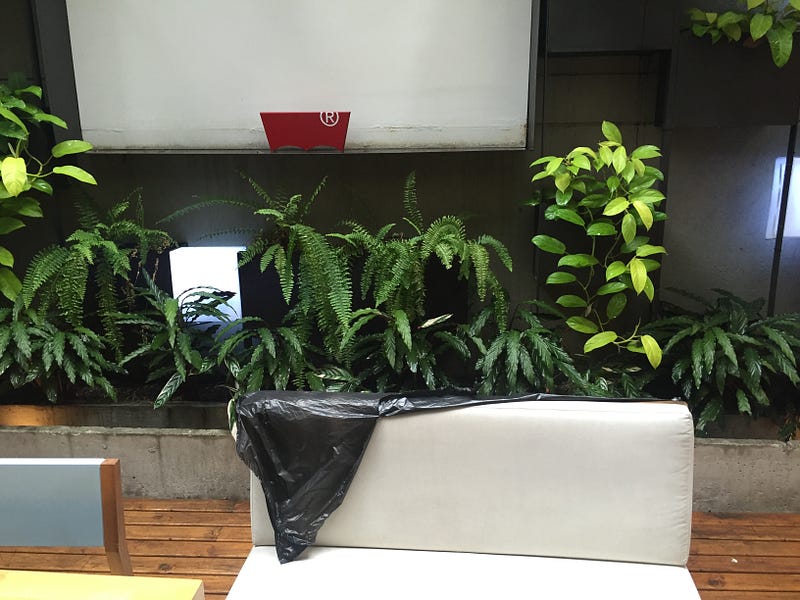
It was pretty obvious what the problem was.
It had rained REALLY HARD.
That back wall you see has plants growing on it, all the way up to the skylight above. Where that skylight would meet the wall, there’s a big gap. When it rains, the rain just comes in through the gap, effectively watering the plants.
If it rains REALLY HARD, sometimes the rain gets all over the furniture, too.
So, they move the furniture.
When they designed this place, they could have just had a regular roof on it. That means that they would never have to worry about their furniture getting wet.
But, in making that decision, they would also never have the other benefits of the open roof.
They would never have the beautiful wall of plants. Or, if they did, they would have to water it by hand.
They would never have a cool breeze go through the cafe, as all of the warm air escaped through the gap in the skylight. Instead, they would need air conditioning.
It’s not that it never rains REALLY HARD where this cafe is. It in fact rains that hard sometimes.
When it does, it’s kind of not convenient for awhile. It’s sub-optimal. They have to move furniture around, and clean things, and it’s a minor inconvenience.
Some people would think about those consequences, and decide that they don’t want a gap in their skylight. They’d rather not have the plant wall, and they’d rather spend the money on air conditioning than to sometimes deal with this minor inconvenience.
Our dumb human brains have a negativity bias. Negative consequences register to us mentally at a much higher rate than do positive benefits.
It’s all our ancestors’ faults. If they heard some rustling in the bushes, it cost them little to flee frantically when was just the wind. It cost them their life if they stayed, and it turned out it was a hungry lion.
The people who are running this cafe don’t run the risk of being eaten by lions. They run the risk that sometimes, they have to move the furniture. Some people would choose to never deal with that, so they would just not have the open skylight. They’d miss out on a lot of other benefits.
The best day of the week to release a business podcast is Tuesday mornings. People have had Monday to get up to speed on their week, and they’re ready for a little info-nourishment to get them motivated.
I can’t release my podcast on Tuesday mornings. Rather, if I did, I would have to compromise other important parts of my business. Mondays and Tuesdays are prime creative work time for me.
So, I release my podcast on Thursdays. I get Wednesday to get everything lined up then it goes live on Thursday mornings.
It’s sub-optimal. Sometimes, a potential listener probably misses out on my podcast because it’s not released on a Tuesday morning. Tuesday morning would be a better time to release new episodes.
But it’s INFINITELY better than not doing a podcast.
Additionally, the consequences I suffer for not releasing my podcast on Tuesdays are probably minimal. Maybe it’s a couple percentage points fewer listens. I can live with that, because having Mondays and Tuesdays free to do my best thinking is a benefit that far outweighs those consequences. I’ve overcome my dumb-brain-negativity-bias to see that just because sometimes I miss out on a listener doesn’t mean I should never release my podcast.
So, my podcast episodes are released on Thursdays. That’s sub-optimal, but it’s infinitely better than never.
Is there something sub-optimal you do that is infinitely better than not doing it at all? Comment below (& I always appreciate ♥’s)
New episodes of my podcast, Love Your Work go live, sub-optimally, on Thursdays. Listen to interview with Jason Fried, or subscribe on iTunes.


