
CULTURE
Sometimes Happiness Means Spontaneously Crying in the Middle of the Street
On living in a world that has normalized emotional suppression
My hands shake as I grip the scissors. I try hard to steady them, not wanting to injure myself any more than I already have today. I take a deep breath and position the blades on either side of the cheap polyester work-issue trousers that cling to my swollen and bloody legs. Slowly, I cut along the fabric, while the incident that has put me in this situation plays out in my mind for the hundredth time. As the sharp, cold metal presses against my broken skin, my resolve to be strong wavers, and I can’t help but cry.
Earlier that day, a cyclist had ridden into the back of me and knocked me down on the footpath. It was early in the morning, the streets were empty except for us. He’d shouted that I should have been looking where I was going. Shouldn’t that be the other way around?
As he cycled away, I picked myself up off the ground, my palms, knees, and back throbbing in pain. I limped along the dark and deserted streets to the department store where I worked. When I arrived, my manager took one look at my tear-streaked face, bloody hands, and dirty trousers, and called the on-duty first-aider.
“It's better if you do it,” he said, passing me an antiseptic wipe.
We were sitting in the staff room, my trousers rolled up over my knees, digging into my thighs. I took the wipe and patted my grazed skin gently. I looked up to check I was doing it right, he was the expert after all. But he wasn’t looking, and I watched as he rolled his eyes and shook his head as he caught the gaze of another staff member who was making tea across the room. To him, I was clearly just a silly teenage girl making a fuss about nothing.
The next day he approached me with a smirk on his face. “You must be feeling embarrassed after yesterday.” And when I didn’t reply he added, “You know, crying in front of everyone.”
Even then I knew it was wrong for someone to invalidate my emotional response to something that had caused me pain. But like many people my age, I was impressionable, and you can never underestimate the power of words to change the trajectory of another person’s life.
Several years later, I was working as a waitress at an Italian restaurant in London. It was just another job in a long line of low-paid, low-prestige, high-stress, dead-end jobs I’d had over the years.
Within a few months of being there, the assistant manager quit; turnover in hospitality is very high.
“I want you to be my new assistant,” my manager said. “I like you, you just get on with things.”
It wasn’t the first time I’d heard words along these lines. Whether it was from a manager or a boyfriend, what they all really meant was, you never complain and that makes my life easy.
You see, I’d perfected the art of emotional suppression over the years, learning that an emotionless state seemed to make everyone happy, everyone but me.
I took the job because it was a meager attempt at some form of career progression, but it wasn’t long before things went wrong.
One night, when everyone else had gone home, and my manager and I were cashing up, he made a move on me. We were in the small office in the basement which could barely fit two chairs in next to the tiny desk and filing cabinets. As we sat next to each other, his hand crept between my thighs. I grabbed it and shoved it back at him. “What the fuck do you think you’re doing?” I shouted.
His eyes widened in shock, then his face fell in disappointment. “Why are you being so emotional?” he said. “I thought you were different, but you’re just like the rest.”
He’d expected me to be easy. To just sit there and accept it, accept him. That on the basis I was emotionless in all other situations, I’d be less likely to protest to his sexual advances. But he was wrong. I reported him to HR. He was disciplined.
I moved to the coast, over 150 miles away. A fresh start.
Katie and I were the two youngest employees at the conveyancing firm where we worked. Apart from this fact, we were different in every way possible. Yet, we’d found a shared passion for a darkly humorous TV show that had only run for one season many years ago and which we couldn’t actually remember the name of. We’d often quote from the show and burst out laughing only to be shushed by our office manager like we were two naughty children.
The daycare where Katie took her two boys was on the same street as where I lived. She’d drop them off in the morning then pick me up and we’d ride into work together. She always had a big grin on her face and her laugh was infectious. I liked being around her, but apart from the TV show, we didn’t have much to talk about. We were both aware of this and neither of us had ever suggested meeting up socially, so it surprised me when she turned up at my house late one evening and asked if we could talk.
We sat on my couch and she told me about her struggles as a mother and how she felt unfulfilled and resentful most days. That she hadn’t ever really been sure she’d wanted kids in the first place, it had just, well, happened. Work gave her some relief from her obligations but working in an office wasn’t the life she’d pictured for herself either. She hadn’t told anyone this before because she knew that, as a mother, she’d only be judged, but things had all got a bit too much for her lately and she needed to talk to someone — me.
I’d clearly gotten Katie all wrong. Just like me, what she showed outwardly to the world didn’t reflect what she really felt inside. I felt at a loss for what to say; I was hardly the best person to offer advice on living a happy life. Eventually, I told her what I’d want someone to tell me — that everything she felt was valid and that didn’t make her a bad person.
She didn’t show up at work the next day but the following Monday, she was outside my house as normal, with a big smile on her face.
“Everything okay?” I asked, knowing now that her bright smile, just like mine, did not necessarily reflect her inner state of mind.
She told me she was going to train to be a beauty therapist. It would take two years to qualify if she took classes at the night school, so we’d still be working together for a while yet. And yes, she was still a mother, that would never change, and she loved her boys, but she also needed to do something for herself.
“We all have to find our own slice of happiness,” she said. It was a line from a Marie Antoinette-inspired skit from our favorite tv show. A woman sits on top of a giant cake grinning and saying to those who walk by “Who wants a slice of happiness?”
I laugh. “I know,” I say, “I know.”
I found happiness or should I say happiness found me when I met Mike a few years later. He was open and kind and honest and we shared our wants and needs and hopes and dreams with each other.
We’d been dating for two years when his grandad died. Mike’s dad, while still in the picture had made it abundantly clear that while he tolerated having a son he didn’t like being a father. So, Mike’s grandad (his mum’s dad) had stepped in as a far more capable substitute.
His death was understandably devastating to Mike, but more so due to the circumstances in which he’d died.
Every Sunday, Mike and his mum would visit his grandad, and on the most recent occasion, there’d been no answer when they’d knocked repeatedly at the door. It was unusual for him not to be there because he knew it was always the day his daughter and grandson visited.
The next day after work, Mike and his mum went back, having not heard from him and worried something serious had happened. This time, after receiving no reply when knocking, with the help of neighbors they broke down the door.
Mike’s grandad lay in the bath, dead.
Later at the hospital, they confirmed that he’d passed within the last twelve to twenty-four hours. If Mike and his mum had broken the door down on Sunday afternoon, instead of Monday evening, they could have potentially saved his life.
At the funeral, Mike’s dad, clearly reluctant to be there, said only one sentence to his son before quickly departing.
“Be strong for your mum.”
From then on the Mike I knew and loved was gone. If we watched an emotional film, he’d just sit there with a blank expression on his face. And when I was upset about something, he’d nod as if he were listening but the words of support and encouragement I normally received back were now absent.
After several months, I realized things couldn’t continue in this way and I suggested therapy.
“I don’t want to be here,” were his only words in our 55-minute session.
Soon his bottled-up emotions started to come out in other ways — an object hurled across the room narrowly or not so narrowly missing my head; a punch-up in a nightclub; and then long weekends spent staring at walls; refusal to leave the house or do anything other than what he wanted to do.
I struggled to cope, and when I told him it was over, he didn’t even acknowledge the fact.
“Be strong for your mum.”
Never underestimate the power of words to change the trajectory of another person’s life.
These are just a few of the many experiences I’ve had over the years that have shown me how much we all suffer as a society due to the normalization of emotional suppression. Indeed, the British saying “maintain a stiff upper lip” perfectly encapsulates the worrying culture we’ve cultivated for not showing our emotions during difficult situations.
The word emotional itself is marred with myriad negative connotations. To say someone is emotional is often used as a way to accuse them of seemingly overreacting to a situation when their response may well be completely natural, thereby invalidating their feelings and making them appear unreasonable.
This only further serves to keep us in a state of outward neutrality to avoid any potential tarnishing of our character. No one wants to upset the status quo or have the word emotional attached to them, after all.
And, if you’ve ever heard someone apologizing for crying then you can further see how we’ve come to view emotional expression as something that is negative for which we should be sorry for.
But we’ve been sold a lie.
We are emotional creatures, and that’s a good thing. To be functioning members of society we need to be able to express our emotions, not bottle them up. Outwardly showing we are not suffering doesn’t mean we’re not inwardly suffering. To suppress our emotions for the sake of decorum only makes things worse in the long run because if we don’t deal with our emotions in the present, one day they will explode out of us in a far more uncontrollable manner.
Recently, while walking down a street in Sydney, Australia, I watched as a cyclist narrowly missed a pedestrian crossing the road. It reminded me of my own traumatic experience all those years ago. But I’ve long since acknowledged and processed the many suppressed and repressed emotions from my past that I wasn’t able to or wasn’t allowed to deal with at the time. It hasn’t been easy, but it has been necessary.
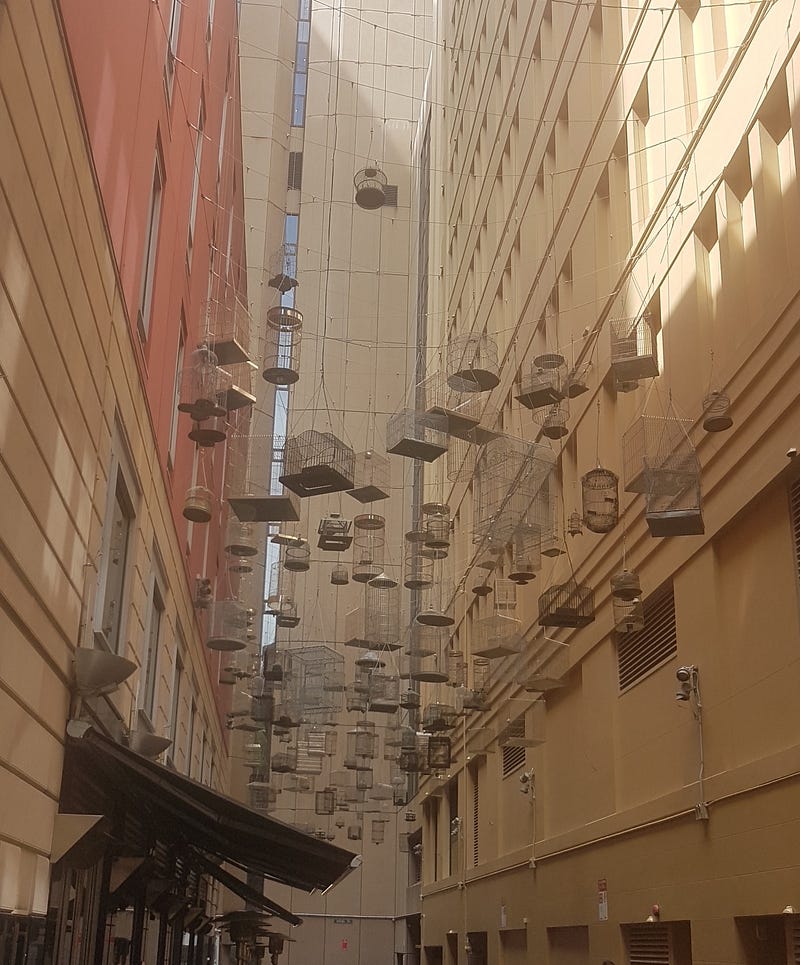
I turn a corner and walk down an alleyway, and my eye catches sight of a huge installation of birdcages hanging high above me. They are all empty. It feels very symbolic.
And so, right there in that alleyway, I cry. I cry because I am happy. I cry because I am not caged anymore; I am free to live and feel however I like. And even when I see the reactions of others — a man quickening his pace to get away from me, a woman looking surprised and then tilting her head down to avoid eye contact — I don’t, and I won’t feel embarrassed, ashamed, or any other negative emotion that comes from showing what I truly feel because if feeling isn’t the most perfect definition of living, then I don’t know what is.
After a while, two young girls stop and ask if I’m okay. “Thanks for asking,” I say, “I’m better than I’ve ever been.”
If you like my writing, why not consider buying me a coffee? In return, you’ll get lots of good karma and virtual hugs from me 🤗 🙏 💗


