
Something Incredible Awakens When You Stop Thinking Mindfulness is a State of Being
This “secret” of the Buddhist tradition is said to be the simplest method for actualizing your mind’s potential power.
“An arhat’s mindfulness is undiminishable.”
This one comment from a modern-day monk in Sri Lanka changed my whole perspective on what mindfulness can do to us.
The Sanskrit word arhat means foe-destroyer, one who has totally rid their mindstream of the obstacles to awareness: sensual desire, ill will, over-excitation, and laxity of attention.
It’s almost unimaginable, unless you’ve met someone who’s reached such a high level.
To be an arhat is to reach the end of the Buddhist path and so thoroughly master one’s mind that you can actually see the subtle elements of causation.
The notion that our awareness can be trained to such an extent was revolutionary for me, a Westerner who had gotten used to a culture of learning things quickly and then proclaiming myself an expert.
Some skills take months to develop. Some years. Other areas of human endeavor ask for whole lifetimes.
The lesson to be learned here is that mindfulness isn’t a state of being to be switched on and off. It’s a spectrum of potential that can be pursued deeper than we can currently imagine.
The tragedy is we’re either not tapping into its depths, or simply unable to do so.
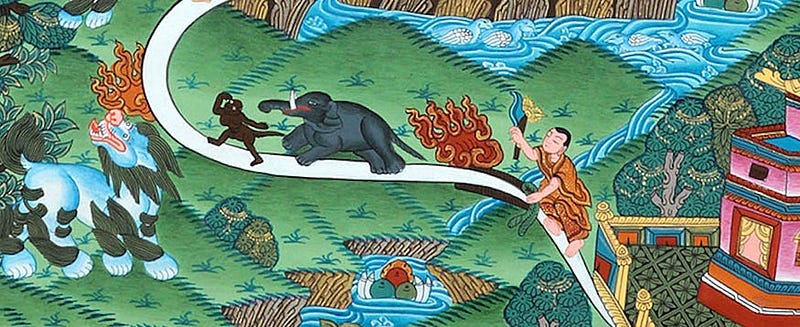
How do we actually deepen mindfulness?
To McMindfulness enthusiasts, this painting fragment might seem like a bunch of silly cultural fluff. Decor.
But it contains profound instructions, important enough that it’s painted on the walls of nearly every Tibetan temple.
The monk is starting out on the path to master his mind, which is symbolized by animals:
- The elephant represents the stubbornness, and power of the mind.
- The monkey represents its tendencies for distraction.
- The rabbit represents lethargy, subtle laziness and sinking.
And his strategies for success, symbolized by tools:
- A stick/goad, symbolizing full alertness, which is used to whack the elephant to keep going.
- A lasso in his left hand, symbolizing mindfulness, which tethers the elephant and allows continuous control over it.
- Flames representing the large amount of effort required at first. We struggle to remain seated, and must fight the urge to move. Yet as our systems condition themselves, raw effort becomes less important, and skillful maneuvering and harmonious use of energy becomes the focus.
All of these aspects are calibrated during the process of shamatha, or calm-establishing meditation, which is what trains our mindfulness to be useful enough to spiritually liberate us forever.
This requires setting our attention on one object, such as the breath or a mental image, and learning to sustain it with a relaxed, stable, & vivid dispensation.
Just ten minutes of meditation practice a day can improve our leadership abilities. Thirty minutes a day changes the physical structure of your brain for the better.
But what if we were to carry the process through, and commit more of our time to fully gaining control over our attention?
We might end up gaining the same results that successful practitioners of the last 2,500 years of Buddhist contemplative inquiry got.
This is what makes it an empirically testable tradition, not a set of “silly superstitions” or cultural frills.
Unfortunately, we probably don’t even have what it takes to follow what the tradition demands of us, let alone carry through to its intended results!
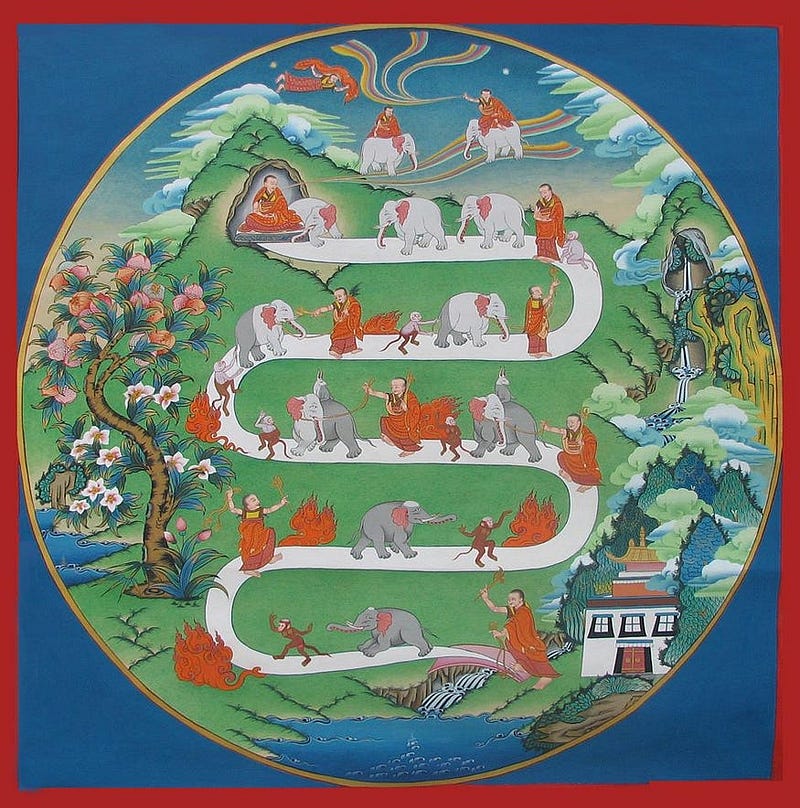
The “calm” revolution is not something we’re ready for.
The details of this painting overwhelm me, every time.
Each stage on the path requires a very specific set of strategies for progress. What’s not shown is how we might get in our own way — and hence make further progress impossible:
- Huge upheavals of emotional baggage almost too intense to process, whenever seriously and continuously practicing for more than two hours a day.
- Ingrained habits preventing you from stepping forward — like inability to relax enough to sustain awareness in a way that conserved my energy.
When these happened to me, I asked— am I even giving myself permission to be calm enough to continue this training? Is the culture surrounding me giving me permission to do so?
In a traditional environment, social support and guidance from a teacher would aid the process of overcoming these obstacles. Yet even the acknowledgement that mental cultivation is a worthy pursuit is hard to find in the West. We’re still enamored by hustle culture and materialism.
This isn’t to say we should give up, and slip back into marketed McMindful strategies to increase productivity under capitalism. We don’t need to throw away mindfulness’ potential as a spiritual tool.
There is a balance to be struck.
Can we treat mindfulness as something to be perfected, bit by bit? Can we learn to overcome our emotional baggage both on and off the mediation cushion?
Can we stop blaming our external circumstances and just take full responsibility?
It all depends on our mindset.
The future of mindfulness training
One of the craziest findings of a study on meditators found that shamatha done for 6 hours a day slowed down aging by inhibiting the enzyme telomerase. This was after three months of continuous practice.
But what if scientists were to go further, creating permanent contemplative observatories to test neurological results from “olympic-level” meditators?
Scholar and teacher Alan Wallace is endeavoring to do so. What’s most exciting about his project is that he’s got the backing of the traditional East as well as the modern West!
The goal is to re-write psychology from the ground up, (or “enlightened mind” downward), since the majority of Freudian psychology’s foundations rest on the study of psychopaths.
Will it be successful? The Dalai Lama certainly hopes it will be. And if we’re lucky, perhaps this model will cause a psychology-revolution on planet earth, just as the discovery of Greek knowledge precipitated the Renaissance.
Here’s to hoping something good comes out of our endeavors, whether it’s a ten-minute daily practice that regulates our health, or a months-long retreat, that heals our shortcomings in a way that psychologists could only fantasize about!