
Essay | LGBT+ Civil Rights | Religious Liberty and Gay Rights | Title VII (Sex Discrimination)
On The Supreme Court’s Ruling In Bostock that Title VII Covers Sexual Orientation and Gender Identity as Protected Classes
“Sex” in the Clause in Title VII Prohibiting Discrimination on the Basis of Sex Means Just That. “Homo-sex-ual” and “Trans-sex-ual” Are Necessarily Based on Sex
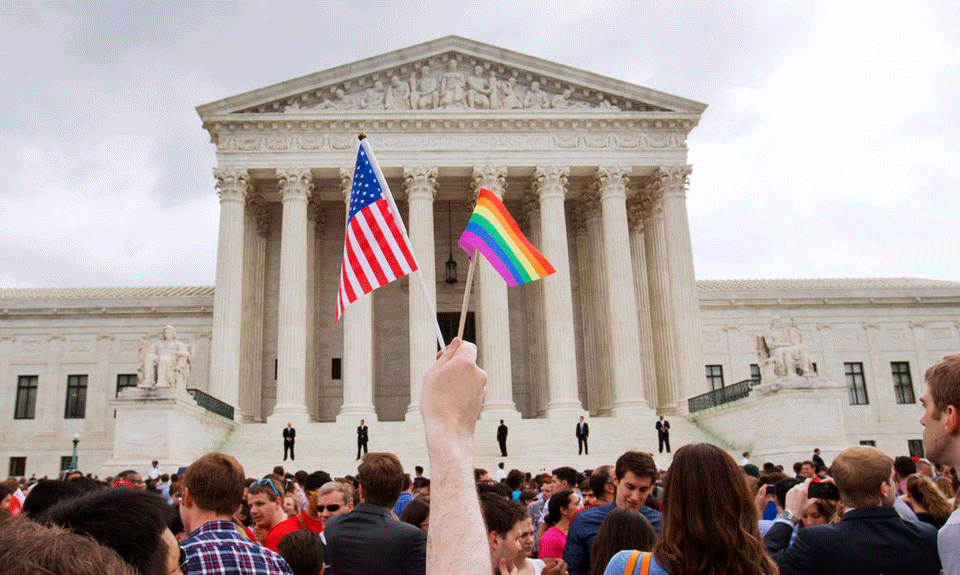
Bostock v. Clayton County, Georgia, 390 U.S. ___ (2020) (sexual orientation and transgender status protected by prohibition in 1964 Civil Rights Act, Title VII against discrimination in the workplace on the basis of sex)
Bostock is a result too long in the coming
For nearly half a century, gay and lesbian people have sought the inclusion of sexual orientation as a protected class under Title VII.
In 1974, Representatives Bella Abzug (D NY) and Ed Koch (D NY), from districts in New York City, introduced a bill in the House, the Equality Act, that would have added sexual orientation as a protected class under Title VII’s prohibition against discrimination “on the basis of … sex.” But, the bill went nowhere.
Then, in De Santis v. Pac. Tel. & Tel. Co., 608 F.2d 327, 329 (9th Cir. 1979), the Ninth Circuit rejected an argument that “sex” as used in Title VII should be read to include sexual orientation. The plaintiff argued that he would have been treated differently were he a woman attracted to men rather than a man attracted to men, and that, therefore, the discrimination necessarily turned on the basis of sex. The Ninth Circuit held invalid plaintiff’s claim that sexual-orientation discrimination violated Title VII.
That same year, the Fifth Circuit held that “[d]ischarge for homosexuality is not prohibited by Title VII.” Blum v. Gulf Oil Corp., 597 F.2d 936, 938 (5th Cir. 1979).
In the 46 years since 1974, LGBT+ people have been attempting in Congress and then in the federal courts to have sexual orientation included as a Title VII protected class. That it took nearly half a century for that very same argument to be upheld is a result too long in the coming.
Bostock is a result right on the law
Respondents in Bostock argued, inter alia, that were the Court to find in Bostock’s favor, it would have engaged in making law not intended by the original authors, and that it would have substituted its preferred policy for the legislature’s original intent. These objections are wrong on the law.
It’s well settled law that the courts will interpret a statute as applied to novel facts on the basis of its plain text. Only if the statutory text is vague, obscure, ambiguous, or seemingly self-contradictory will the courts look behind the text to legislative intent. But, if the statutory text is clear according to the plain meaning of the words, the courts will not look to extra-textual concerns to interpret its application to new facts.
In Bostock, the Court applied the statute according to the plain meaning of its words. Title VII prohibits employment discrimination on the basis of sex. One can not discriminate against homosexual or transgender/transsexual people without necessarily discriminating on the basis of sex. (Homo-sex-ual and trans-sex-ual are based in sex by the very words themselves.)
An employer who fires an individual for being homosexual or transgender fires that person for traits or actions it would not have questioned in members of a different sex. Sex plays a necessary and undisguisable role in the decision, exactly what Title VII forbids.
Those who adopted the Civil Rights Act might not have anticipated their work would lead to this particular result. Likely, they weren’t thinking about many of the Act’s consequences that have become apparent over the years, including its prohibition against discrimination on the basis of motherhood or its ban on the sexual harassment of male employees. But the limits of the drafters’ imagination sup- ply no reason to ignore the law’s demands. When the express terms of a statute give us one answer and extratextual [sic] considerations suggest another, it’s no contest. Only the written word is the law, and all persons are entitled to its benefit.
Bostock, id. (PDF copy from SupremeCourt.gov), Opinion of the Court, p. 2, 15 June 2020, retrieved 2020.06.17.
It is a result right in logic
The principle underlying Title VII is, in part, that people should not be discriminated against on the basis of characteristics over which they have no control, no choice. Black people do not get to choose their race. It is determined for them by genetics, a thing out of their control. Latinos do not get the choose their national origin. It is determined for them by the happenstance of their birth. Women (and men) do not choose their birth-gender. It is determined by genetics.
Similarly, it is more and more becoming recognized and agreed that same-sex sexual orientation is not a matter of choice but rather a matter of genetics. Sexual orientation is a heritable trait, set at birth, innate, and immutable. Further, it is increasingly becoming recognized that a person’s conviction that s/he was born into the wrong sex is not a matter of choice but of compulsion.
The logic that makes race, national origin, and sex protected classes necessarily makes sexual orientation and transgender/transsexual status also protected classes.
It is a result necessary to maintain the validity of Obergefell
Obergefell v. Hodges, 576 U.S. 644 (2015) (marriage equality), recognized a constitutional right of marriage, then held that LGBT+ people were guaranteed that right by the 14th Amendment’s Equal Protection and Due Process Clauses.
It was a 5:4 decision in which Justice Anthony Kennedy, a swing member of the Court, joined the 4 liberal justices and wrote the Court’s opinion. The four-person conservative wing, including Chief Justice John Roberts, dissented.
But, Justice Roberts is a firm adherent to the legal precept of stare decisis (Latin: ‘stand by a thing decided’), the doctrine that a thing once decided stays decided.
Even though he originally opposed Obergefell, Justice Roberts’ belief in the sanctity of precedent strongly indicates that in any subsequent challenge to Obergefell, he would vote to uphold Obergefell.
The challenge in Bostock was an implicit attack on Obergefell. To have held otherwise than the Court did would have signaled its openness to overruling Obergefell despite the stare decisis doctrine. Instead, the Court evinced its determination to uphold Obergefell in any subsequent challenge. By joining the liberal wing, Justice Roberts indicated his agreement with that determination.
The composition of the six-person majority is a bit surprising
As was said, Justice Roberts’ joining with the liberal wing was not a thing entirely surprising. But, Justice Neil Gorsuch’ (appointed by Trump) joining the liberals was surprising. It seems probable that scarcely anyone thought it likely, much less that he would author the Court’s opinion.
Justice Gorsuch minced no words. For him, on the plain language of the statute, it was “no contest.”
One might suspect that Justice Gorsuch’ personally-preferred result was the opposite of the way he held. But, his so holding indicates his preference to uphold the law even if it transgresses his personal inclination. It also indicates his disinclination to overrule Obergefell.
In any future challenge to the equality of LGBT+ civil rights, it would not be surprising to find him aligned with the liberal wing once again.