
Some Principles of Regenerative, Thriveable Transformation- Part 1
This article is in two parts. It also follows the two previous articles which start with the basics of change and transformation- why change is so hard, and what enables transformation. In this article and its twin in Part 2, we dig deeper into some of the basic principles of regenerative, thriveable transformation. I know, that’s a lot of new big words, but we’ll dig into their meaning and purpose, and how they encapsulate some of the most important principles of how effective containers for transformation can be designed, built, and implemented.
The Future Potential of the Present Moment
How can we re-perceive our world, lives and work in the shadow of climate, racial, gender, economic and political trauma, so as to be able to fully experience coherence and meaning? And what can we do to become more effective in making our world a better place for ourselves while helping heal the wounds on our planet?
Transitions always involve periods of social chaos and heightened violence due to disorientation and the breakdown of the old system. Corruption, moral decline, and inefficiency appear to be signal features of the final stages of a system. The growing importance of technology in shaping the evolutionary logic of power/action and love/care has led to history accelerating, where each transition happens faster than the last. The chaordic zone in the exit turbulence of modernism is a crucible in which hundreds of millions are making a momentous leap into worldcentric and kosmocentric levels of mindsets, paradigms, and consciousness.
Being a leader of change and transformation right now is a seriously tough job. Stress levels and personal sacrifices have never been higher. We’re here to help resolve some of those difficulties to ensure you can master those challenges and feel energized, fresh, and ready for action.
The goal of this article and its twin in Part 2 (forthcoming), is to help you develop and enhance your own skills in leading, facilitating, and designing change and transformation in your own life and work, using simple, bite-sized models that help you recognize the complex patterns in the world around you. Being able to recognize and then respond to such complex patterns with appropriate strategies and moves will enable you to convert “VUCA” (Volatility, Uncertainty, Complexity, and Ambiguity) into Stability, Predictability, Simplicity, and Clarity or “SPSC”- at least some of the time!
Transformation can be easy or hard, simple or really complex- it all depends on the maps, models, and perspectives you apply to arrive at the simplicity the other side of complexity. It’s all about timing, tipping points, acupuncture points, and sweet spots- finding the right spot by diagnosing the context precisely enough to know where the energy for a shift is, and how to liberate it in beneficial ways. Many “natural” leaders do this intuitively, but they are the rare exception, and their talents and skills are hard to transfer to those who are still learning the ropes. Most of us need to learn the hard way, through trial and error.
Becoming reflexive practitioners of the art and science of re-patterning and co-creating an uncertain future through a deeper appreciation of the qualities inherent in the future potential of the present moment is key to embracing uncertainty in a complex world. Finding constructive ways to collaborate with others ready to chart our collective path into a future that will surprise us while also taking seriously our co-creative agency to affect that future is both an art and a science.
What is Conscious Living Systems Design?
The regenerative, thriveable transformation approach is based on a profound understanding of the bottom-up principles of “Natural Emergence”, while applying the principles of “Designed Emergence” to realise some or all of the following benefits:
· Synergy — create synergistic pathways for energy flows to generate beneficial outcomes with less effort and greater chances of success;
· Unblocking the System — transform blocked energies into thriveable learning and outcomes, thereby avoiding the “blow-ups” that occur when blocked energies find no natural release valve;
· Effective Change — encourages the emergence of suitable systems and structures to minimize inputs of matter and energy and maximize outputs of useful information and thriveable activity;
· Structures Developmental Processes — provides the scaffolding inside which developmental processes can flourish and generate thriving for all life;
· Aligns Bottom-Up and Top-Down Processes- architects human activity systems to incorporate appropriate bio-psycho-socio-techno capacities that enhance the thriveability of the systems in focus and all life.
All of these benefits depend on the ability to consciously reflect on the cycles of integral change in ourselves and the world around us. As we dig deeper into the change dynamics of these shifts, we begin to see the cycles of emergence and dissipation.
Our pattern recognizing abilities will depend on our levels of physical, emotional, mental, and spiritual development, which determine how much complexity we can perceive across how wide a span of space and time, from egocentric and ethnocentric perspectives to worldcentric and kosmocentric perspectives.
Unlike existing design approaches, conscious living systems design focuses its lenses on the predictable cycle of interactions between mindshifts, cultureshifts, capability shifts, and worldshifts. This integral change cycle applies to all living systems, from single-celled amoeba to the global web of living civilizations. They are what scientists call self-similar at all scales, or “fractal”. It turns out that life looks essentially the same at all the scales that we’re aware of — it is “self-similar” no matter how close we focus in on it.
With conscious living systems design practices, we can cut through the complexity of our world to the nuggets of beautiful simplicity the other side of that complexity. Life is a “meta-process”, a collection of processes of various scales from the very minute and “short-cycled” to the grand, “long(er) cycled”. This appears to be true of all living systems, with only the scale of time changing concerning these collections of processes, according to the lifespan of individual entities or the size of homogeneous collections of these entities.
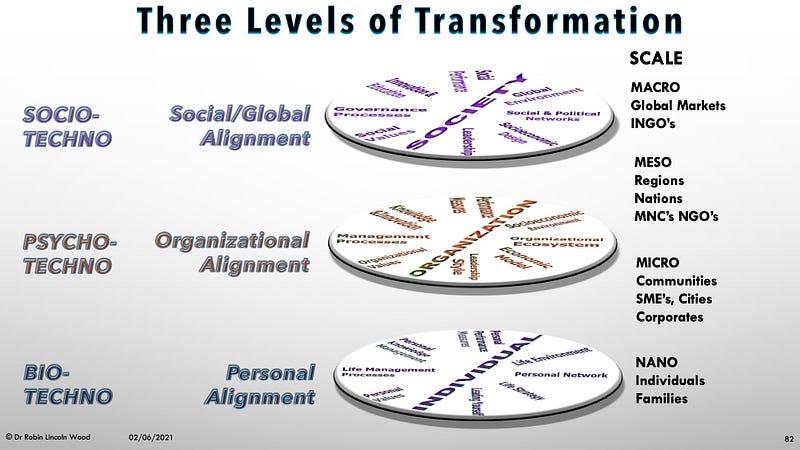
To be effective, conscious living systems designers, we need to be skilled in pattern recognition, living process design, and structure formation at three levels: energetic, informatic, and memetic. Recurring energetic, informatic, and memetic patterns become obvious when we can distinguish between the three key zones which interact to make conscious living systems come alive and thrive:
These three levels in living systems are inside, between, and around us simultaneously, interpenetrating each other to create dynamically stable layers of meta-processes and forms that enable human civilization to emerge and prosper. Dysfunctions in and misalignments between these three levels cause breakdowns and collapses in the entire fabric of civilization.
• BioTechno — Energetic: biophysical processes and innovations that operate and heal our Anthropocene ecosystems which integrate human and natural capitals with infrastructure and manufactured capital;
• PsychoTechno — Informatic: processes and innovations in the fields of body-mind and spirit that develop and heal individuals and organizations, through relationship and intellectual/knowledge capitals; and
• SocioTechno — Memetic: processes and innovations in the social field that help us develop and heal our communities, cities, nations, and planet, through social capital.
Conscious, living systems design capabilities lie at the core of the practice of thriveable transformation- literally a fresh new way to see and engage with the world to co-create the future we know is possible and desirable:
· Designers invent or conceive possible futures, including artifacts that they may be able to bring about, imaginable worlds that would not come about naturally. …
· Designers need to know how desirable these futures are to those who might inhabit them, and whether they afford diverse communities the spaces they require to make a home in them. …
· Designers experiment with what is variable or could be changed to view the opportunities that variability could open up for them and others. …
· Designers work out realistic paths, plans to proceed towards desirable futures. …
· Designers make proposals (of realistic paths) to those who could bring a design to fruition, to the stakeholders of a design.
Our purpose is to repurpose all our capitals to serve all life for a thriving future. Thriveable transformation shows the way. The purpose of the $600 trillion of financial, infrastructure, and manufactured capital on our planet (including all hard currency, broad money, real assets, equities, and other financial assets) is to act as a bridge for our transition to a regenerative, inclusive, soulful, multicapital and thriveable world. It waits for us to unleash its potential- our human genius (human, relationship, social and intellectual capitals) enables us to synergistically integrate the raw materials in our world to create true future value when we follow the principles of thriveable transformation.
Integrated « top-down » solutions can then be designed to be fractal, to liberate trapped bottom-up energy, by providing pathways of least resistance for trapped or closed first-tier systems toward thriveable outcomes — even if that means thriveable beige or purple (I’ve had the privilege of being an honorable member of a Bushman tribe in the Caprivi Strip, and beige can be thriveable too- however one cannot scale beige or purple or red to a global level as there would be no forests left on earth with 7.8 billion woodcutters using trees as their primary source of energy- which is why India has so few trees, for example).
A fractal is self-similar at all scales, and fractal spirals form the inner workings of toroidal structures that govern how energy emerges from the quantum vacuum into spacetime. Applying the regenerative, thriveable transformation principles enables the energy trapped in conscious living systems, ranging in scale from individuals, teams, organizations, and business ecosystems to nation-states and global governance entities. Energy will always flow along the pathways of least resistance, and lowering resistance to change through resonance, alignment, and coherence is the key to successful transformation.
Conscious Living Systems Design & the Global Transition We Are In
Power and care in the three levels in a conscious living system are expressed in very different ways- the BioTechno vs the PsychoTechno vs the SocioTechno. At the BioTechno system level, power and care are mainly physical, while at the PsychoTechno level power and care are derived from how information flows and is distributed in the organization, institution, or market- the design of organizations is modeled on the principle of information asymmetry, as well as the cognitive complexity that each individual in the system can process.
Currently, as Game “A” begins to slowly disintegrate, huge power is still concentrated at the SocioTechno level, through financial and political systems, where the game has always been what economists call monopoly or oligopoly- those with power seek to entrench their power, and right now they are succeeding, with very negative social consequences, though their days are numbered. The power of the social narrative is the key to doing this, which is why the media in most countries is owned by the most powerful/rich people and is then weaponized to maintain that power. The Global Transition Model explains these dynamics in much greater depth.
Though the workings of the Global Transition Model are too complex to be explained here, here are some of the key outputs from that model. The seven fractal acupuncture points are what we must all become more skilled at identifying and leveraging as we seek to transform the systems we each engage with and are capable of influencing.
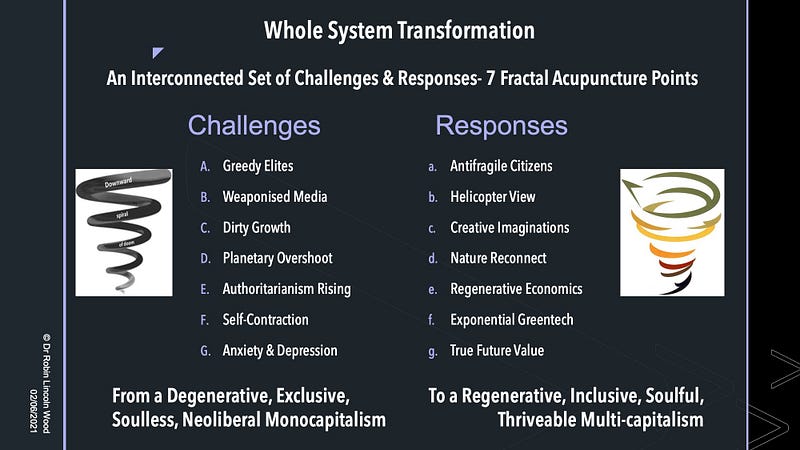
To heal ourselves & our planet in the next decade we must each become conscious living systems designers using our networks of influence, capabilities, and resources to trigger regenerative, thriveable transformations locally and globally.
Thriveability and Transformation
The purpose of conscious living systems design is to catalyze a great shift from Game “A” — degenerative, exclusive, hierarchical, monocapitalism, toward Game “B” — regenerative, thriveable, collaborative, multicapitalism. This emerging conscious living system is thriveable and displays the quality of thriveability, meaning:
“Thriveable — A living system is thriveable if it has the ability to thrive through abundant and lean times, with the ability to adapt or transform itself if its life conditions are disrupted.”
“Thriveability — In conscious living systems such as human beings, thriveability includes the sense of the flourishing of oneself and all life, together with the ability to engage purposefully in life and work through meaningful relationships, along with a sense of accomplishment for one’s positive contributions to the world.”
Each of us can thrive when we are part of a larger whole that is flourishing. When we are in a nurturing place that helps us realize our full potential, we can also make a much greater contribution to the health of the whole system we are a part of. As it is in the nature of living systems to evolve and transform, healing ourselves and the wholes we are a part of is a synergistic process that can positively transform how our world works for all life.
“Transformation — a complete change in the appearance or character of something or someone, especially so that that thing or person is improved.”
If we are to practice integrated leadership that can inspire and catalyze regenerative, thriveable transformation, we need some simple yet holistic metrics that we can use to understand the system in focus we are working with, so that we can shape trajectories and pathways (“adjacent possibles”) that will lead us from Game “A”- degenerative, exclusive, hierarchical, monocapitalism, toward Game “B”- regenerative, thriveable, collaborative, multicapitalism. The differences between Game “A” and Game “B” are both qualitative and quantitative, as explained in “A Leader’s Guide to ThriveAbility”.
We need to ask three questions of the system in focus, whether it is a team, an organization, an ecosystem, an industry, or a nation-state”
How thriveable is the system?
How much synergy is being harnessed between the six pathways to a thriving future?
How transformative is the system in question?
Taking an organization as an example, these questions then require us to examine and measure as best we can, the following three dimensions of regenerative, thriveable transformation:
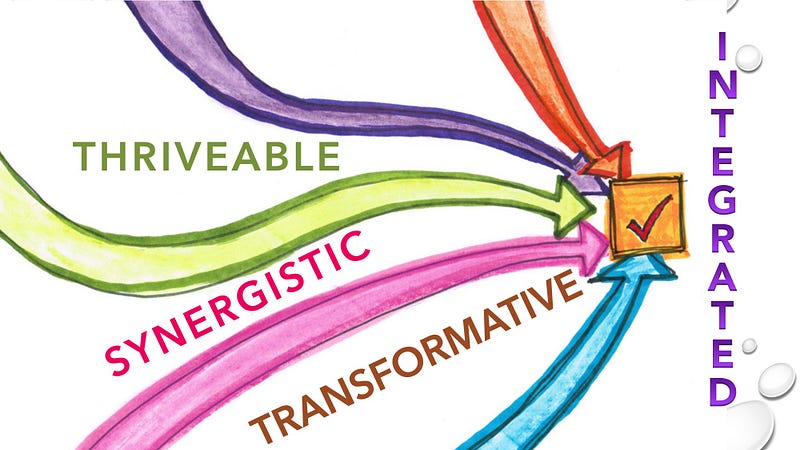
We will cover the six regenerative pathways in a future article in more detail. (You can find out more about the six regenerative pathways in the book: “Making Good Happen- Pathways to a Thriving Future” http://amzn.to/2gj3csl).
The six transformative capabilities needed in any organization are somewhat simpler in nature, as explained in the following diagram:
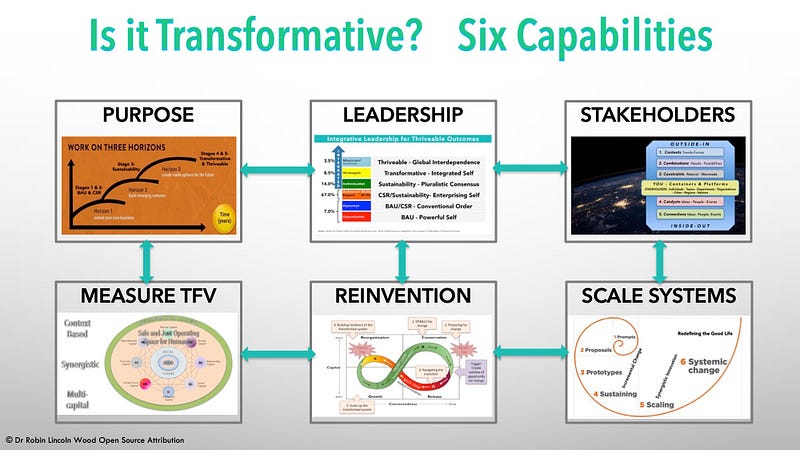
A. SEE — PURPOSE — Creative Imagination and Vision
Most of what is possible is limited by what we can “see” in our imaginations. Most of us are good at seeing in reality with our eyes, but it is only when our eyes are closed that we can explore the rich inner world that enables our inner vision to be activated. We are all familiar with the world of dreams when we sleep, and the world of daydreams when we are awake. Creative imagination and vision exist as a hybrid between these different states and can be triggered with appropriate creativity exercises and even virtual reality technologies.
Human imagination and ingenuity have been at the forefront of our evolution as a species since time immemorial. What we call creativity and innovation today could not exist without our imagination and ingenuity. “What if…”, “How might we…”, “Imagine that…” are phrases that can make a very big difference in the way we perceive and work with current reality to create previously unimaginable future states.
We can only see as far as our own horizon, without the aid of technologies that enable us to gain altitude and see further. Through remote sensing carried out on our behalf by satellites, space probes, drones in the air, on land and in the seas, we are able to see much further. But we can only see what currently exists, not what could be. This is why being able to see across three horizons is crucial to developing our imagination, foresight, and innovative capabilities.
Thinking in different horizons prompts you to go beyond the usual focus of fixing innovation just in the present. The Three Horizons Methodology connects the present with the desired future and identifies the ‘seen’ disruptions that might occur in moving towards a vision. This methodology lends itself well for mapping out the different horizons needed for synergistic innovations across the six pathways. It offers a helpful way for connecting your innovation activities over different horizons and navigating uncertainty more imaginatively.
B. FEEL — LEADERSHIP — A Passion for Beneficial Change
While seeing further into the future requires pattern recognition abilities and a degree of creative intelligence in the seer, these abilities need to be complemented by the emotional energy to drive explorations that enable the changes and transformations needed, to happen.
In other words, motivation and the emotional intelligence to know thyself and know others well enough to reach out and engage them while also learning from and with them is key. Here lie the roots of the ability to generate relationship capital, share knowledge and generate new knowledge through emergence.
A passion for beneficial change implies that you are tuned into your context, whether it be local, regional, national, or global. You have your finger on the pulse of what needs to change to make your world a better place, and the ability to reach out to people who can align with you in your cause, even if they may be very different to you in many ways.
C. TOUCH — STAKEHOLDERS — Multi-stakeholder Coalition Building
Convening and shifting a multi-stakeholder coalition in the direction of “good” is a challenge. Whether it was the civil rights or anti-apartheid movement in the last century, or the campaigns to keep greenhouse gases below 350 ppm by 350.org or to end the use of fossil fuels, building multi-stakeholder coalitions is a difficult and arduous task.
You, the teams, groups, and organizations you interact with on a daily basis, all have boundaries of some kind. When such boundaries form a physically closed system, we call them a “container”. Every cell in every living creature has a cell wall that regulates what enters and exits the cell; your body has skin and various openings and sensors/effectors that regulate what enters and exits or makes contact with your body.
Nations have borders and national identities and systems, acting as containers for their nationals both in protecting their rights and enforcing their responsibilities. Organizations, especially corporations, have both physical containers that place boundaries around their operations and processes, and brands that symbolically represent the presence and promise of their products and services.
The Container tends to live at the “Tight” end of the “Loose-Tight” continuum, acting much as its name suggests, like a boundary of a system that defines its outer skin and interfaces with the world. Containers have interests (survival instincts, beliefs, worldviews) and identities (names, brands, values). No man, woman, or system is an island, however.
To survive and thrive, containers need to be interconnected through networks. Organizing these networks is the job of “platforms”. Your cells are interconnected through your blood, nerves, and lymphatic vessels. Our bodies are interconnected through systems offering us food, shelter, the opportunity to work and socialize. Cities, businesses, nations, and corporations are interconnected through trading systems, information systems transport systems, and security systems.
D. MEASURE — Context-Based, Multi-capital, Synergistic Metrics
When you make a decision, how do you know if the outcome will be better, good or very good? Can you just trust your intuition? Or do you just go with the flow and do what everyone else does, because that is relatively “safe”.
Evidence suggests that most people take the path of least resistance in their lives, simply because it takes time and energy to gather the information to make better decisions. That might sound like a death knell for our species, given the trajectory we are currently on.
Yet there is hope. We are also a very curious species, and given the right conditions, we are social learners who will also copy good behavior with good outcomes. And with social and other media sensitizing and informing us as to “what’s up” around the world, we can begin to see a link between our actions and outcomes.
Of course, we do not have to, nor do we want to, measure everything in our lives, a fairly joyless prospect. When it comes to world-changing outcomes, however, knowing the consequences of our actions should be the norm.
The IIRC (International Integrated Reporting Council) recommends that all financial accounts and sustainability reports (known as “integrated reports”), should consider the impact of the activities of the business being reported on through the lens of six capitals: financial, natural, human, social, intellectual and manufactured. While the ins and outs of financial capital are now well established after several centuries, natural and human capitals are still being defined in more accurate ways that make it possible for those using multi-capital accounting to aim for the safe and just operating space for humanity inside the “doughnut”.
Since the first six capitals were defined, those working with multi-capital frameworks have added two additional capitals: relationship and infrastructure capitals. This is why we use eight capitals in the thriveability and synergistic innovation multi-capital frameworks and equations.
Multi-capital metrics operate as a set of constraints on human activity, that keep the impact of that activity moving toward the center of Kate Raworth’s doughnut model- the safe and just operating space for humanity. In this way, they avert the worst effects of environmental damage, bad governance, and inhumane treatment of people.
E. REINVENT — Strategic Innovation Capabilities
With the foresight that comes from being able to SEE further into the future and creatively imagine the previously unimaginable, plus the ability to FEEL a passion for beneficial change that resonates with others and is contagious, together with the ability to TOUCH key stakeholders in ways that build aligned multi-stakeholder coalitions, and the ability to MEASURE in context-based, multi-capital, synergistically innovative ways, we also need to know how to REINVENT our current ways of doing things by developing our strategic innovation capabilities.
What we learn from the tens of thousands of volumes published on change, transformation, and innovation, is that mindsets and cultures are the key enablers and constraints on the human ability to create beneficial new discoveries, technologies, products, services, business, and governance models. The larger and more successful an organization or institution becomes, the more likely it is to have an entrenched culture and leadership mindset that confirms the old adage: “Nothing fails like success”.
This is why, despite the huge amounts spent on R&D by large corporations and governments every year, many of the biggest breakthroughs originate in smaller organizations and start-up or crisis situations. Hence the famous “S-curve” describes the stages any genuinely new innovation goes through. First, the early adopters experiment with the cool new thing; if enough well connected early adopters communicate the benefits of the cool new thing to their friends, it is possible for the innovation to “cross the chasm” between the early adopters (who don’t mind that the new thing is imperfect and requires effort to master), and the early majority, who are only interested in reaping the benefits of the cool new thing if they do not have to expend too much effort, and if its price is equal to or lower than the existing technology/product/service they are currently using.
As the innovation matures it attracts the late majority, and then, finally, the laggards. Think of the mobile phone. In 1986 there were a few brave early adopters lugging large battery-sized “portables” around with them, attracting the scorn of their fellow diners and colleagues. By 1996 the early majority was buying the world’s most popular Nokia and Motorola phones, and it was considered “cool” to have a mobile phone that could fit easily into your pocket. By 2006, the iPhone changed all that, leading to the smartphone now becoming the “cool new thing”. Now, in 2017, half the planet has a smartphone or mobile phone. There were several “S-curves” along the way, with the older technologies going extinct as the newer S-curves rode the next upwave.
F. SCALE- Organization & Leadership
How can we scale healthy growth? There are two very different kinds of growth in our world, following two very distinct kinds of laws:
· Bio-physical Growth- natural laws both enable and constrain what kinds of growth are possible in biophysical systems. Although we are still discovering new laws of how nature operates and tweaking those laws with our scientific and technological discoveries and inventions, the state-of-the-art of our knowledge and capabilities accumulate steadily. We embed our capabilities to grow crops, aquaculture, forests, farm animals and build habitats in infrastructure and manufactured capitals;
· Social and Knowledge Growth — for the most part, in healthy societies, we structure our communities, cities, organizations, and nations according to human-made laws, based on what has worked well for us historically. Human-made laws can be changed quickly as situations change and the need arises, especially when it is clear that our current way of doing things is failing. Yet changing human institutions, as anyone who has attempted to do so can attest, is a slippery and difficult affair- something Machiavelli knew very well from first-hand experience.
The concept of SCALE is one of the more popular topics in any conversation involving how we can make good happen. Whatever the topic, it can be sure to end with a remark such as: “And of course, we need to scale this as quickly as possible!”
This leads us to some principles to begin this urgent conversation:
· Conscious Collaboration, Consent, and Choice — as far as possible (which is very far these days with ubiquitous communications, networks, and multi-stakeholder consultations), individuals and their representatives need to be trusted to define their real needs and offered an appropriate range of choices before they consent to collaborate with anyone who stands to benefit from their consent. (The 21st century equivalent of “No taxation without representation”).
· Scale-up Good Things — We need to scale up the good, scale down the bad. For example, renewable energy and resources, regenerative agriculture, forestry, and fisheries, free/affordable medical care all need to be scaled up. Fossil fuels, degenerative agriculture, forestry, and fisheries, need to be scaled down, to zero as soon as possible. (This is simply common sense if we wish to survive).
· What Scale is Needed for this Function? For example, how many solar and wind farms does the world need to thrive? Where? Run and owned by whom? Relative to what other sources of renewable energy? Is this something that is better done locally, city-wide, nationally, globally? (The equivalent of the principle of subsidiarity deployed by the EU, which states that whatever matters can be dealt with at a local level, should be. If higher levels of coordination are required then deal with matters at that level).
· What is the Right Size for You? Given your own priorities, how big a role do you want to play in scaling up whatever you are involved in? Given your skills and ability to contribute positively, what size fits you best? Avoid getting too quickly out of your depth as much as possible, while still aiming high.
· Focus on the Quality of Leadership, Governance, and Culture — Whatever the decision process that ultimately gets to decide what to scale, when, for whom, and how, the quality of leadership, governance, and culture that makes those decisions is critical. Investing in better quality in these areas is vital to making good happen. Purpose, people, and process come before strategy, competencies, and systems.
· Design Organisations and Institutions from an Integral Perspective — Recognising the co-evolution of consciousness, competencies, cultures, and creations matter more than becoming fixated on one or another organizational form- one size does not fit all, generally, no matter how hard we may attempt to colonize others with our preferred way of doing things. Different functions require different forms. Go back to the first principle if in doubt.
· Empowering others to Scale-up Involves both Rights and Responsibilities — There are no rights without corresponding responsibilities. Apply the ThriveAbility Equation to determine the goodness of an outcome if in doubt. Multi-stakeholder, multi-capital, context-based metrics can help point us to what is good, true, beautiful, and just in any situation.
· Match Levels of Scale with Levels of Development — Later stages of human development can span greater horizons of time, space, and complexity, and are therefore more suitable to lead and manage larger-scale initiatives and entities.
In Summary
In conclusion, we can summarise some of the basic principles of regenerative, thriveable transformation which lay the foundations for better design of conscious living systems (us!):
· As living systems, humans in their environment convert energy into matter and information. The information in designed and built matter remains from earlier civilizations, along with the evolution of consciousness and cultures that have managed to regenerate.
· Over time human cultures and creations become layered like geological strata, with newer layers resting on older layers and expressing some of the qualities of those lower layers, but also expressing emergent new properties in response to changing life conditions.
· Self-reflective consciousness enables us to examine this fossil record of human civilization and understand ourselves better as a result. We are better able to discern adjacent possible pathways into possible futures through this insight.
· Human minds are situated in and partake of the characteristics of specific environments and life conditions. Thus, the local civilizational strata shape the nature of this “indigenous mind”, and its specific likes, tendencies, and habits.
· Energy, matter, information, and consciousness are seamlessly integrated into us and our world at a practical level, so much so that we do not notice the dynamics of this process until there is a lack of resources or a breakdown in some aspects of our world.
· In the Anthropocene we are now encountering such resource shortages and limits to growth, as usual, forcing us to examine more closely the energetic, informatic, and memetic cycles and cause-effect dynamics to redesign our lifestyles, organizations, and socio-economic systems.
So, What’s Next?
Right now, right around our planet, people are developing worldcentric, systemic perspectives and capabilities that can not only resolve most of the challenges we currently face — they will also transform our species and what it means to be human.
Imagine a world powered by renewable energy, where all human beings thrive in resilient habitats; where businesses operate in a circular economy that regenerates natural capital, without a particle of waste, led by enlightened leaders whose goal is to maximize the thriving of all stakeholders; where each individual is empowered to pursue their passion and make a living in service to others; where governance systems are transparent, effective and wise in the ways in which they deliver their services to their communities and populations; and where intercultural appreciation and insight enriches the exchanges between the diverse worldviews and cultures embraced by humankind.
Does that sound like an impossible dream? Every single one of these “pockets of the future” is currently observable in the present, right here and right now, somewhere in the world. This series of articles offers a guide for those who wish to understand and take part in this global transformation, showing us how to connect and align with the pockets of the future in the present that will become a mainstream reality for most of us by 2030. You will also discover the roots of the rapidly growing regenerative, distributive economy, along with the emerging social and political systems that can ensure a thriving future for us all, and a flourishing biosphere for all life on earth.
You will learn how to transcend and master the apparent chaos and complexity inherent in our globalized, post-modern world, so that you can not only adapt to the massive shifts underway but also help shape them. Despite the doom and gloom of many today, there are 700 million-plus people leading the way toward a thriveable future- what Peter Drucker called: “Getting into our strategic psychological helicopter and transcending the problem”, enabling challenges to be viewed from multiple perspectives and producing breakthroughs at emergent, unprecedented levels of thinking.
You will discover how enlightened mainstream leaders (many still “undercover”), are shifting their policies, businesses, and investments toward renewable energy, resilient cities, circular economies, and conscious leadership; and how those making the leap from the cultural creative world also number in the many millions, especially the activists, organizers, and civil society leaders. You will also learn of the artistic, cultural, design, and social leaders inspiring a tsunami of talent doing well by doing good, dedicated to making a better world and a positive difference, along with the younger generations now surfing this big wave, embracing a broad diversity of visionary actors of all ages that are reshaping whole social, economic, cultural and educational systems in more holistic, joined-up ways.
We are operating in a turbulent field of social transformation. The ride is guaranteed to be full of shocks and surprises, as well as amazing new opportunities. You can be a part of a thriving future that regenerates our biosphere and our global civilization to be a more peaceful, sustainable, and enjoyable place to live. The rewards of healing yourself, and healing our planet at the same time, are immense. No matter where you are on your own journey, applying the thinking and frameworks in this book to improve your own practices and skills will help you become more focused and powerful in your efforts. Your fellow travelers are already out there, waiting for you to connect up with them, and make the momentous leap together.
Together, we can do this. Come join us.
Thanks for reading this far. If you’ve learned something new or simply enjoyed reading this article, please clap and share. You can clap up to a dozen or more times to show your appreciation. Thanks again!