
Solar Power: Not So Green After All
How Solar power disrupts Biodiversity, Ecosystems, and Local Communities

Introduction
Solar power is often hailed as a clean, green, and renewable source of energy that can help us fight climate change and reduce our dependence on fossil fuels. However, like any other human activity, solar power also has a dark side that is often overlooked or ignored.
In this article, I will explore the negative impacts of solar power on the environment, society, and economy. I will focus on three main issues: waste management, land use, and political influence, along with some possible solutions and best practices to address these issues and make solar power more sustainable and equitable.
Land use
One of the main challenges of solar power is finding suitable land to install solar panels. Solar power requires a lot of space to generate electricity on a large scale.
According to a study by the International Renewable Energy Agency (IRENA), India would need about 55,000 square kilometers of land to meet its target of 175 gigawatts (GW) of renewable energy by 2022, of which 100 GW would come from solar power.
However, land is not only a scarce resource but also a contested one. Land use for solar power can have negative impacts on biodiversity, ecosystems, local communities, and so on.
Solar parks can disrupt the natural habitats of wildlife, cause soil erosion and water scarcity, and affect the livelihoods and rights of people living in or near the project areas.
- For example, the Bhadla Solar Park in Rajasthan, which is one of the largest solar parks in the world with a capacity of 2.25 GW, has faced criticism for its environmental and social impacts. The park is located in a desert area that is home to many endangered species, such as the Great Indian Bustard, the Indian Gazelle, and the Desert Fox. The park has also displaced several villages and pastoral communities that depended on the land for grazing and farming.
- Another example is the Pavagada Solar Park in Karnataka, which has a capacity of 2 GW and covers an area of 53 square kilometers. The park is built on leased land from farmers who have faced droughts and crop failures for years. While some farmers have benefited from the rental income, others have complained about the loss of access to their land, the lack of transparency and consultation in the project implementation, and the poor quality of infrastructure and services in the area.
These examples show that land use for solar power involves trade-offs and dilemmas between land conservation and renewable energy development. How can we balance these conflicting interests and ensure that solar power does not come at the cost of environmental and social justice?
Waste Management

Another challenge of solar power is the waste management of solar panels. Solar panels are made of various materials, such as silicon, metals, glass, and plastics, that can be toxic or hazardous to the environment and human health if not properly disposed of.
- According to a study by the International Renewable Energy Agency (IRENA), global solar panel waste could reach 78 million tonnes by 2050. In India, solar panel waste is estimated to be around 1.8 million tonnes by 2030. However, there is no specific policy or regulation for solar panel waste management in India, and the existing e-waste rules do not cover solar panels.
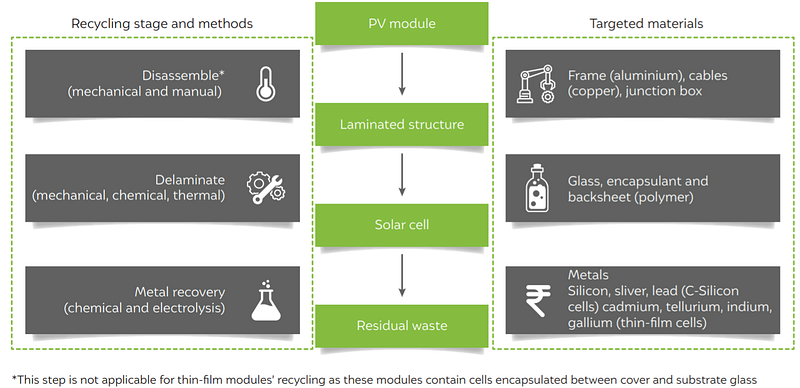
Recycling solar panels is not only an environmental necessity but also an economic opportunity. Recycling can recover valuable materials, such as silver, copper, and indium, that can be reused in the solar industry or other sectors. Recycling can also create jobs and reduce the dependence on imports of raw materials.
- However, recycling solar panels is not easy or cheap. It requires specialized technology, infrastructure, and skills that are not widely available in India. It also faces economic barriers, such as low market demand, high transportation costs, and a lack of incentives for producers and consumers.
It is important to develop and implement effective solutions and best practices for reducing and managing solar panel waste in India. Some possible ways can be are:
- Promoting innovation and research in developing more efficient, durable, and recyclable solar panels.
- Adopting a circular economy approach that minimizes waste generation and maximizes resource recovery.
- Establishing a clear and comprehensive policy framework that defines the roles and responsibilities of different stakeholders, sets standards and targets, and provides incentives and penalties for solar panel waste management.
- Enhancing awareness and education among producers, consumers, and recyclers about the benefits and challenges of solar panel waste management.
Political influence
Another big challenge of solar power is the political influence that the solar industry exerts on the public policies, regulations, and incentives that affect its development and deployment. The solar industry, like any other industry, has its own interests and agendas that may not always align with the long-term decarbonization goals or the public interest.
- For example, in India, the solar industry has lobbied for various policies and subsidies that favor its growth, such as the domestic content requirement (DCR), the safeguard duty, the basic customs duty, the production-linked incentive scheme, and the renewable purchase obligation (RPO). However, some of these policies have been criticized for being protectionist, inefficient, or ineffective in promoting a competitive and sustainable solar market.
- Another example is the influence of China, which is the world’s largest producer and exporter of solar panels, on the global solar market. China has invested heavily in its domestic solar industry, providing cheap loans, tax breaks, land grants, and other subsidies to its manufacturers. This has enabled China to dominate the global solar supply chain and drive down the prices of solar panels, making it difficult for other countries to compete.
we need to ensure that solar power is governed in a transparent, accountable, and participatory manner that reflects the diverse interests and needs of different stakeholders.
Conclusion
In this article, I have explored the dark side of solar power in terms of waste management, land use, and political influence. I have shown that solar power, despite its many benefits, also poses significant challenges and risks for the environment, society, and economy. I have also suggested some possible solutions and best practices to address these issues and make solar power more sustainable and equitable.
Solar power is not a silver bullet for solving the climate crisis. It is a complex and dynamic phenomenon that requires careful and holistic analysis and evaluation.
It is important and urgent to acknowledge and address the dark side of solar power, as it affects not only the present but also the future generations.
Feel free to connect with me on Linkedin , Medium and Topmate.


