

Software System Design: Building Efficient and Reliable Software Systems (1)
A Comprehensive Guide to build efficient and maintainable software solutions
Thank you for being a part of this journey with me, and I hope to continue providing value to you for years to come! Giving tips by supporting me.
I would be overjoyed if you could support me as a referred member. However, the income I’ve received from my contributions on this platform has not proven sufficient to sustain the frequency of updates I’d hoped for. Facing this reality, I’ve made a difficult decision — to explore new income avenues. However, this isn’t the end; rather, it’s an exciting new beginning. I am thrilled to announce my upcoming Substack newsletter, where I’ll delve into my investing system, harnessing the immense potential of IT technology and embracing a system-thinking approach to investment strategies. Rest assured, I will still be posting when inspiration strikes.
Introduction
In software development, choosing the right architecture and design principles is key to building scalable, maintainable, and high-performance systems. Whether you’re working on a large enterprise application or a small internal tool, how you structure your system will impact development speed, code quality, and long-term efficiency.
Software architecture defines how system components interact and how the system is organized. Whether it’s microservices, monolithic, or layered architecture, each style brings its own benefits and trade-offs based on factors like team size, project scope, and business needs.
Equally important are the design principles that guide how the system is built. Principles such as the Single Responsibility Principle (SRP), Open/Closed Principle (OCP), and Don’t Repeat Yourself (DRY) ensure clean, efficient, and scalable code, preventing common issues like tight coupling, redundancy, and fragile designs.
In the following sections, we’ll explore key software system design and design principles to help you build systems that are both technically robust and adaptable to changing needs.
Applicable Areas of Different Architectures
(A) Microservices Architecture
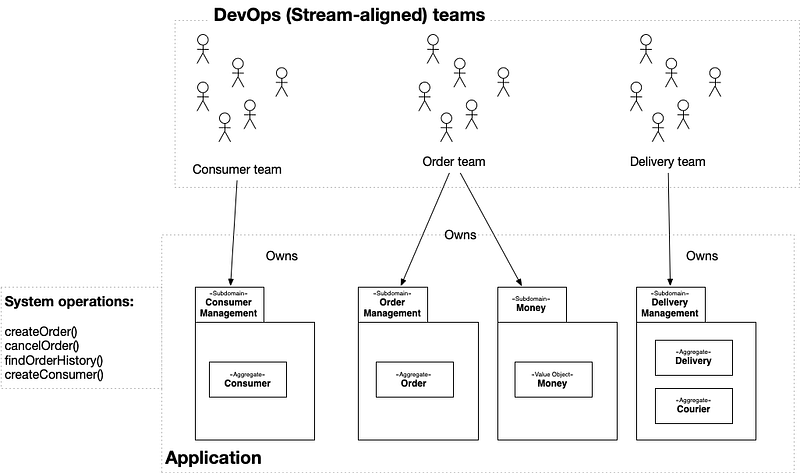
Microservices architecture has gained significant traction in recent years by breaking down applications into smaller, autonomous service units. Each service can be developed, deployed, and scaled independently, enhancing system flexibility and maintainability. This modular approach supports agile development, simplifying the management of complex projects.
For instance, in a large e-commerce platform, services such as order management, product management, and user management can be developed and deployed separately. If one service experiences high load, it can be scaled independently without affecting others. This architecture is particularly suitable for large, complex systems with substantial team sizes and long-term development needs.
Microservices are an excellent choice when team sizes exceed 10 people, the business complexity involves more than five submodules, and the project requires iterative development over six months or longer.
(B) Monolithic Architecture
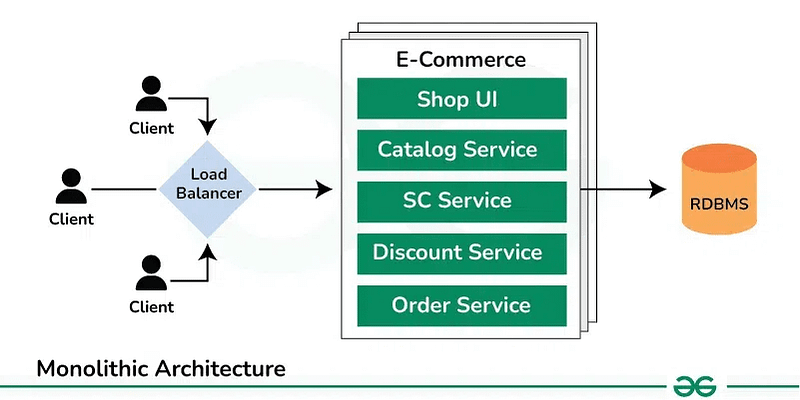
Monolithic architecture operates the entire application as a single unit, making it straightforward and ideal for small-scale projects and startups. This approach offers the benefit of a unified codebase and database, simplifying maintenance. For example, an internal management system for a small business with basic functions and low user traffic can be efficiently developed and deployed using a monolithic structure. Monolithic architecture works well for small to medium-sized projects where close team collaboration and quick iteration cycles are essential.
(3) Layered Architecture
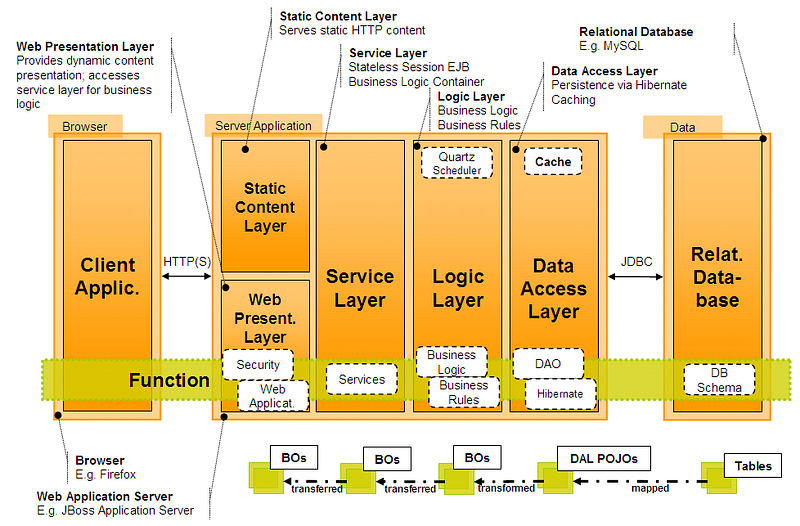
Layered architecture structures a system into distinct layers like the presentation, business logic, and data access layers. The presentation layer manages user interactions, the business logic layer applies business rules, and the data access layer interfaces with databases. This design enhances maintainability and scalability, enabling independent development and testing of each layer. It’s especially advantageous for projects needing clear modularization and strong separation of concerns.
Detailed Comparison of These 3 Architectures
(A) Microservices Architecture
Advantages:
- Modularity: Each service is independent, making the application easier to understand, develop, and test, reducing the risk of architectural erosion.
- Scalability: Microservices are independently deployed, allowing for targeted monitoring and scaling of each service, leading to more efficient resource utilization.
- Technological Heterogeneity: Different services can use different technologies and languages, providing teams with greater flexibility.
- Continuous Delivery: Microservices are ideal for Continuous Integration and Continuous Delivery (CI/CD), as each service can be independently developed, tested, and deployed.
- High Availability: Service registration and discovery mechanisms enable high availability and fault tolerance.
- Independent Development Teams: Different teams can work on different services independently, improving development efficiency and collaboration.
Disadvantages:
- Complexity: Microservices architecture increases system complexity, especially in terms of communication and coordination between services.
- Operational Costs: More infrastructure is required to support the deployment and management of independent services, raising operational costs.
- Data Consistency: Maintaining data consistency across independent services becomes more challenging.
- Performance Overhead: Network calls between services can introduce additional performance overhead.
- Testing Challenges: Testing the entire system becomes more complex, requiring extensive integration and end-to-end testing.
(B) Monolithic Architecture Advantages:
- Simplicity: The entire application is developed and deployed as a single unit, reducing system complexity.
- Development Efficiency: Developers can easily understand and modify the entire system since all the code resides in one project.
- Performance: In some cases, Monolithic architecture may have better performance since internal calls do not require network communication.
- Operational Costs: Operations are relatively simple, requiring less infrastructure to support multiple service deployments and management.
- Integration Testing: Integration testing is easier because all components are within a single process.
Disadvantages:
- Maintainability: As the system grows, Monolithic architecture becomes difficult to maintain and scale.
- Scalability: Since the entire application is deployed as one unit, it’s hard to scale specific features independently.
- Technical Debt: Over time, the code may become bloated and complex, accumulating technical debt.
- Continuous Delivery: Deploying the entire application is more frequent and complex, making continuous delivery harder.
- Team Collaboration: Multiple teams working within the same codebase can lead to conflicts and coordination issues.
(C ) Layered Architecture Advantages:
- Modularity: By dividing the application into layers, different parts of the application can be developed and tested independently, enhancing modularity.
- Maintainability: Layering organizes the code, making it more structured and easier to maintain.
- Testability: Each layer can be unit-tested independently, improving testing efficiency.
- Scalability: New layers can be added or existing ones improved to expand the system’s functionality.
- Technology Independence: Different layers can use different technologies and frameworks, increasing technological flexibility.
Disadvantages:
- Performance Overhead: Calls between layers may introduce additional performance overhead, particularly for deep calls.
- Complexity: While layering improves modularity, it can also increase system complexity, especially with inter-layer dependencies.
- Tight Coupling: Poorly designed interfaces between layers may lead to tight coupling, reducing system flexibility.
- Scalability Limits: Although new layers can be added, the dependencies between layers can sometimes limit the system’s scalability.
- Deployment Complexity: While not as complex as microservices, it still requires managing multiple layers’ deployment and configuration.
Comparing Architectures in Specific Scenarios
Small Projects
(A) Monolithic Architecture
- Simple to use, easier development and deployment, suitable for rapid iteration.
- Maintenance and scalability become challenging as the project grows.
(B) Layered Architecture
- Good modularity and maintainability, suitable for structured design.
- Requires more upfront design, increasing initial complexity.
(C ) Microservices Architecture
- Highly modular, suitable for future expansion.
- High complexity and operational costs, not ideal for small projects.
Large Projects
(A) Microservices Architecture:
- Highly modular and scalable, ideal for teams working independently in parallel.
- High operational costs and technical complexity, requiring strong team support.
(B) Layered Architecture
- Highly modular and maintainable, suitable for teams with clear divisions of responsibility.
- Layer dependencies can limit scalability, performance overhead may be significant.
(C ) Monolithic Architecture
- Can still be used with proper code management and automation tools.
- Maintenance and scalability become difficult, not suitable for large projects.
High-Performance Needs
(A) Monolithic Architecture:
- Internal calls don’t require network communication, potentially better performance.
- Difficult to optimize specific functionalities independently.
(B) Layered Architecture
- If optimized, can meet high-performance requirements.
- Deep calls may cause performance overhead.
(C ) Microservices Architecture
- Performance can be improved by optimizing service discovery and communication mechanisms.
- Network calls between services can introduce additional performance overhead.
Continuous Delivery and Agile Development
(A) Microservices Architecture
- Each service can be independently developed, tested, and deployed, supporting DevOps processes.
- Requires more integration and end-to-end testing.
(B) Layered Architecture
- Also supports continuous delivery, but requires more integration testing to ensure layer coordination.
- Inter-layer dependencies may complicate testing.
(C ) Monolithic Architecture
- Deployment complexity is higher but can be mitigated with automation tools.
- Not conducive to continuous delivery due to frequent and complex deployments.
The choice of architecture depends on the specific needs of the project, the technical skill level of the team, and available resources. In practice, hybrid architectures are sometimes used to combine the benefits of different architectures to meet the project’s requirements. For instance, a large project might use a Monolithic architecture for core business functions and Microservices for non-core functions to balance complexity and maintainability.
Key Considerations for Architecture Selection
(A) Project Scale
For large-scale and complex projects, microservices or layered architectures can enhance maintainability and scalability. For example, enterprise-level applications with multiple business modules, high user traffic, and complex data processing benefit from microservices, which divide the system into independent services focusing on specific functionalities. Conversely, monolithic architecture suits smaller projects, offering simpler development and deployment without complex management.
(B) Team Capability
The team’s expertise with a particular tech stack is important. Choose an architecture that aligns with the team’s strengths. For instance, if the team is skilled in Java, a Java-based microservices framework like Spring Cloud can optimize productivity. The team’s overall experience also matters; seasoned teams may prefer microservices for larger projects, while less experienced teams might find monolithic architecture more manageable.
(C ) Tech Stack Compatibility
Ensure the chosen architecture aligns with the current tech stack to avoid development challenges and additional costs. Microservices frameworks may support specific programming languages or databases, while layered architectures may require particular tools and technologies.
(D) Business Characteristics
Business requirements also influence architecture selection. For high scalability and rapid responsiveness, microservices may be ideal. For stable businesses with clear, defined modules, monolithic or layered architectures can suffice. For example, financial transaction systems needing high performance and scalability are well-suited to microservices. In contrast, an internal management system with stable, clearly defined modules may work effectively with a monolithic or layered structure.
Software Design Principles: Standardizing System Development
This section elaborates on various software design principles to ensure system stability and maintainability.
(A) Single Responsibility Principle (SRP)
A class should have only one reason to change, enhancing cohesion. SRP, one of the core SOLID principles, states that a class should have a single reason for modification. If a class has multiple responsibilities, they become coupled, leading to potential disruptions when one responsibility changes, potentially breaking other functionalities and creating a fragile design.
Example: Consider a UserInfo class that holds the username, email address, and a method for sending emails. Combining user data storage and email sending functions violates SRP, as the class has two responsibilities. To adhere to SRP, these responsibilities should be separated into different classes, each handling one function. This separation improves maintainability, reduces modification risks, and enhances system scalability.
Benefits
- Improved maintainability: Easier to understand and modify classes with a single function.
- Reduced modification risk: Single-responsibility classes can be changed without impacting other components.
- Enhanced scalability: SRP-compliant systems are more adaptable to future changes.
Implementation: Identify and separate distinct responsibilities within a class. The Interface Segregation Principle (ISP) complements SRP by ensuring interfaces include only necessary methods, maintaining focused interfaces.
(B) Open/Closed Principle (OCP)
Software entities should be open for extension but closed for modification, encapsulating changes and reducing coupling. By coding to abstractions rather than specifics, classes can remain stable while allowing new functionalities through inheritance and polymorphism.
Example: In a banking system, combining deposit, withdrawal, and transfer functions in one class violates both SRP and OCP. By separating business logic into extendable interfaces, new features can be added without altering existing code.
Benefits:
- Flexible design: Adapts to new requirements.
- Minimized changes to tested code: Reduces the risk of introducing new bugs.
(C) Liskov Substitution Principle (LSP)
Subtypes must be able to replace their base types without affecting the correctness of the program. LSP is essential for inheritance-based reuse. True polymorphism and reliable class reuse are possible only when derived classes can replace base classes without altering program behavior.
Example: A common LSP violation is the idea that “a square is not a rectangle.” Similarly, a design that treats all birds as flying creatures can fail when non-flying birds like kiwis are introduced. LSP ensures that overriding methods do not compromise base class functionality.
Benefits:
- Supports OCP: LSP forms the foundation of OCP.
- Prevents system-breaking extensions: Ensures new features do not affect existing functionality.
- Increases robustness and maintainability: Makes the system more reliable and easier to maintain.
(D) Interface Segregation Principle (ISP)
Use multiple specialized interfaces instead of one general-purpose interface to prevent interface bloat and promote more flexible, maintainable design.
Example: A Gun interface containing both trigger and bullet properties for real and toy guns can lead to interface pollution. Implementing unnecessary methods may mislead the system and cause incorrect behavior.
Benefits:
- Avoids interface pollution: Interfaces do not contain unnecessary methods.
- Enhances flexibility: Allows for more tailored design through specialized interfaces.
- Supports custom solutions between modules: Different modules can implement specific interfaces as needed.
(E) Dependency Inversion Principle (DIP)
High-level modules should not depend on low-level modules; both should depend on abstractions. Abstractions should not depend on details, but details should depend on abstractions.
The Dependency Inversion Principle encourages shifting dependencies from concrete implementations to abstract interfaces, improving module decoupling and flexibility.
Example: Consider a UserManager class that depends on an EmailService class to send emails. If the implementation of EmailService changes, the UserManager also needs modification. To avoid this, an EmailService interface can be defined, and the UserManager should depend on the interface rather than the specific implementation class.
Benefits:
- Improved decoupling: Dependencies between high-level and low-level modules are managed through abstract interfaces, reducing coupling.
- Enhanced flexibility: Specific implementation classes can be easily swapped via dependency injection, without modifying high-level module code.
- Better testability: Dependency injection using interfaces makes unit testing easier, allowing mock objects to be used.
(F) Don’t Repeat Yourself (DRY) Principle
The same information or logic should not be repeated in code. Each piece of knowledge or data should have a single, clear, authoritative representation. The DRY principle emphasizes code reusability and maintainability, preventing errors and maintenance difficulties caused by redundant code.
Example: If multiple places need to validate an email format, the validation logic can be extracted into a separate function or module and called where necessary.
Benefits:
- Increased reusability: Reduces duplicate code and enhances code reuse.
- Lower maintenance costs: Logic needs to be modified in just one place, reducing maintenance workload.
- Fewer errors: Avoids errors caused by duplicated code, increasing reliability.
(G) Keep It Simple, Stupid (KISS) Principle
System design should be as simple as possible, avoiding unnecessary complexity. Simple systems are easier to understand, maintain, and extend. The KISS principle emphasizes simplicity and readability, avoiding unnecessary complex logic and redundant design.
Example: When designing a user authentication system, avoid introducing too many authentication methods (e.g., multiple OAuth providers, custom authentication) unless necessary. Keep the authentication logic simple to ensure the system is easy to understand and maintain.
Benefits:
- Increased readability: Code is simpler, easier to read and understand.
- Lower maintenance costs: Simple systems are easier to maintain, reducing debugging and fixing time.
- Increased development efficiency: Avoids over-designing, making the development process more efficient.
(H) You Aren’t Gonna Need It (YAGNI) Principle
Don’t waste time and resources on functionality that is not needed at the moment. Implement only the functionality that is required now and avoid building features that might never be used. The YAGNI principle stresses demand-driven development, avoiding over-design and functionality bloat.
Example: When developing an e-commerce website, avoid implementing complex user behavior analysis features unless there is a current requirement. Start by implementing basic shopping cart and payment functionality, and then add other features gradually based on user feedback.
Benefits:
- Increased development efficiency: Focus on current requirements, avoiding time wasted on future possibilities.
- Lower maintenance costs: Reduces unnecessary code, simplifying maintenance.
- Improved system stability: Avoids introducing untested features, making the system more stable.
(I) Law of Demeter (LoD) Principle
An object should avoid directly interacting with the internal objects of other objects. It should only interact with its direct components or objects passed to it as parameters. The LoD principle stresses loose coupling between objects and reduces dependencies.
Example: Consider a User class and an Address class. If the User class contains an Address object, to get the user's street name, it should use a method of the User class instead of directly accessing the properties of the Address object.
Benefits:
- Reduced coupling: Less dependency between objects, improving system decoupling.
- Improved maintainability: Changes to one object’s internal structure do not affect other objects’ code.
- Enhanced encapsulation: Internal structure of objects is more hidden, strengthening encapsulation.
(J) Separation of Concerns (SoC) Principle
Different parts of a system should focus on different responsibilities, avoiding mixed responsibilities. Each module or component should have clear responsibility boundaries. The SoC principle stresses modularization and responsibility separation, enhancing system maintainability and scalability.
Example: In a web application, separate the frontend logic, backend logic, and database operations into different modules. The frontend module handles user interface rendering, the backend module processes business logic, and the database module manages data persistence.
Benefits:
- Improved maintainability: Clear responsibilities for each module, making it easier to maintain and debug.
- Enhanced scalability: Modular design makes the system easier to extend and upgrade.
- Improved team collaboration: Different team members can focus on different modules, increasing development efficiency.
(K) Principle of Least Knowledge (PLK) Principle
An object should know as little as possible about the internal details of other objects. It should only interact with its direct components or the objects passed to it as parameters. The PLK principle, similar to the LoD principle, emphasizes loose coupling and reducing dependencies.
Example: Consider an OrderProcessor class that needs to call a PaymentGateway class to complete payments. The OrderProcessor should only call the public methods of PaymentGateway and should not access its internal properties or methods.
Benefits:
- Reduced coupling: Fewer dependencies between objects, improving system decoupling.
- Improved maintainability: Changes to one object’s internal structure don’t affect others.
- Enhanced encapsulation: Internal structure of objects is hidden, enhancing encapsulation.
(L) Principle of Least Astonishment (PLA) Principle
Software should behave in a way that minimizes surprise for users and developers. The system should work as expected and follow familiar conventions. The PLA principle aims to make software intuitive and predictable, leading to a more pleasant user and developer experience.
Example: In a graphical user interface, when a user clicks a button to submit a form, they expect the form to be submitted and a confirmation message to appear. If the button unexpectedly resets the form, it violates the PLA principle.
Benefits:
- Increased user satisfaction: Intuitive behavior improves user experience.
- Improved developer collaboration: Predictable software behavior makes it easier for developers to collaborate.
- Fewer errors: By following common conventions, users and developers are less likely to make mistakes.
(M) Convention Over Configuration (CoC) Principle
A framework or system should provide reasonable default configurations, reducing the amount of manual configuration developers need to do. The goal is to simplify the development process through conventions rather than configurations. The CoC principle emphasizes the ease of use of the framework and development efficiency, reducing configuration complexity.
Example: When using Create React App, many configuration options are already set up by default, so developers don’t have to manually configure tools like Webpack or Babel. They can directly start writing React components.
Benefits:
- Increased development efficiency: Reduces the workload of configuration, allowing developers to start coding faster.
- Fewer errors: Default configurations are usually best practices that have been validated, minimizing the risk of mistakes in manual configurations.
- Enhanced consistency: Conventions ensure the project’s code style and structure are consistent.
(N) Fail Fast Principle
The system should detect and report errors as early as possible, rather than hiding or delaying error handling. By identifying issues early, debugging and fixing them becomes faster. The Fail Fast principle emphasizes timely and transparent error handling, improving system reliability and maintainability.
Example: When writing a function, if the input parameters do not meet expectations, an exception should be thrown immediately, rather than continuing with logic that might cause further errors.
Benefits:
- Improved debugging efficiency: Errors are detected early, making them easier to locate and fix.
- Fewer hidden errors: Prevents errors from being hidden or postponed, increasing system reliability.
- Stronger code robustness: Timely error handling makes the code more robust and reduces runtime exceptions.
(O) Composition Over Inheritance (CoI) Principle
Prefer composition over inheritance to achieve code reuse. Composition makes the code more flexible and maintainable, avoiding the complexity and coupling introduced by inheritance. The CoI principle focuses on flexibility and maintainability, steering clear of the limitations that inheritance can impose.
Example: Consider a Vehicle class and a Car class. If the Car needs to implement an Engine feature, it can incorporate Engine as a component, instead of implementing it through inheritance.
Benefits:
- Increased flexibility: Composition makes the code more flexible, allowing features to be added or removed easily.
- Reduced coupling: Avoids the tight coupling that comes with inheritance, leading to more decoupled code.
- Better maintainability: Composed code is easier to understand and maintain.
(P) Principle of Least Expressiveness (PLE)
The Principle of Least Expressiveness states that when programming a component, the simplest computational model should be chosen to express the program naturally. If ideas can be expressed using constants, lookup tables, or state machines, there is no need to use a Turing-complete language.
Example: When decoding images in different formats, a lookup table can be used to map image formats to corresponding decoders, instead of using complex conditional statements.
Benefits:
- Simplifies the code: The code becomes more concise, easier to understand, and maintain.
- Improves scalability: Simple models are easier to extend and adapt to future changes.
- Reduces errors: Complex code is more prone to errors, while simple models reduce the likelihood of mistakes.
(Q) Encapsulate What Changes (EWC)
The Encapsulate What Changes principle states that parts of the system that are likely to change should be encapsulated so that they are hidden from the outside. This reduces the system’s sensitivity to external changes and improves stability.
Example: In a system, if the database connection method might change, it can be encapsulated in a separate class, accessed via an interface, rather than directly writing the database connection code in multiple places.
Benefits:
- Improves stability: Encapsulating changing parts reduces the system’s sensitivity to external changes.
- Enhances maintainability: Managing changing parts in one place makes it easier to modify.
- Improves scalability: Interfaces make it easy to replace specific implementations.
(R) Programming to an Interface, Not an Implementation (PITI)
The principle of programming to an interface rather than an implementation states that code should be written for interfaces, not concrete implementations. This increases flexibility and scalability while reducing dependency on specific implementations.
Example: In a system that needs to handle multiple types of logging, an ILogger interface can be defined, and different logging handler classes can be implemented based on specific needs.
Benefits:
- Increases flexibility: Interfaces make it easy to swap specific implementations.
- Enhances scalability: When adding new features, simply implement the interface without affecting existing code.
- Reduces coupling: Code depends on interfaces, not on specific implementations, making it more stable.
(S) Inversion of Control (IoC)
The Inversion of Control principle states that control should be delegated to an external container or framework, rather than being managed directly by internal code. This increases the flexibility and testability of the code.
Example: In the Spring framework, dependency relationships between objects are managed via dependency injection (DI), rather than creating objects directly within the class.
Benefits:
- Increases flexibility: Dependencies can be dynamically configured, making the code more flexible.
- Enhances testability: Dependency injection makes it easier to conduct unit testing.
- Reduces coupling: Dependencies between objects are managed externally, leading to more decoupled code.
(T) Avoid Premature Optimization (APO)
The Avoid Premature Optimization principle states that optimization should not be done before sufficient testing and performance analysis. Premature optimization can make the code complex and harder to maintain.
Example: When developing a new feature, first ensure its correctness and completeness before focusing on performance optimization.
Benefits:
- Improves maintainability: Avoids the complexity introduced by premature optimizations.
- Reduces development time: Ensures functionality is correct before considering optimization.
- Improves code quality: Gradual optimization leads to higher-quality code.
(U) Postel’s Law (Robustness Principle)
Postel’s Law states that inputs should be accepted generously, but outputs should be strict. This increases the system’s robustness and compatibility.
Example: In network protocols, a server should handle requests in various formats but return responses that strictly adhere to the standard.
Benefits:
- Improves robustness: The system is better equipped to handle unexpected inputs.
- Enhances compatibility: The system is more compatible with other systems or components.
- Reduces errors: Strict outputs reduce the occurrence of errors.
If you’ve found any of my articles helpful or useful then please consider throwing a coffee my way to help support my work or give me patronage😊, by using
Last but not least, if you are not a Medium Member yet and plan to become one, I kindly ask you to do so using the following link. I will receive a portion of your membership fee at no additional cost to you.


