
Software Product Management: The Criteo Way

I have been working in Product Management for years and I am still amazed by the number of questions that a Product Manager job description can raise: Is it a strategic role? What’s the day-to-day like? How different is it from a Project Manager role?
I could go down the list for long.
It’s not surprising: Software product management is still a young discipline, especially in Europe, and each company defines the role differently from one another. The reasons here are numerous but we can think of a few impactful company factors that highly influence it: The type of industry, the company size, the footprint (global, national, local), the customer target (B2C, B2B) and the revenue model (freemium, advertising-based, subscription-based, transactional…).
What about Criteo? We are an industry leader in the advertising technology business, have built exciting assets that thousands of clients benefit from daily, operate worldwide and have the ambition to become the leading advertising platform for the open internet.

I will explain in this article what product management means at Criteo and how the product team functions. I’ll describe in detail (i) the mission of our product managers, (ii) how we are organized, (iii) what activities the product team is involved in and (iv) share some thoughts on how to grow a product team.
Product Mission
The product manager’s mission is to design high-value products for customers and prospects and manage their full-lifecycle from ideation to launch and beyond.
Even if this mission statement is fairly standard for Product Manager roles, the environment that Criteo operates in and our position in the market make it very specific: Think about the fast-pace changes in our industry, the constant technical innovations and the high competition in the marketplace and you’ll understand that our product management team always operates with a need for long-term thinking and constant adaption.
Whether we lead initiatives on analytics, UX or technology-centric products, we must be obsessed with discovering customer needs, ensuring we built the right offer and provide value. It definitely makes our job engaging!
Product Organization
In order to have a functional product practice, we made sure to translate our mission statement into our organization.
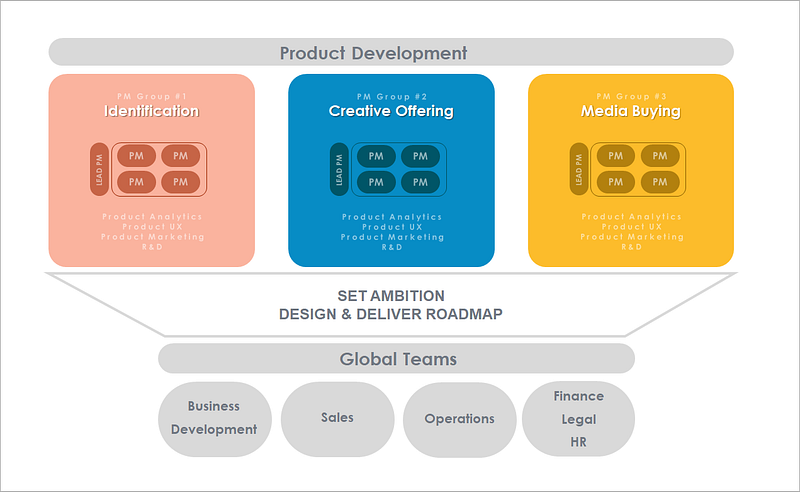
From an organizational point of view, product managers work in small groups responsible for a product offering (e.g. identity, creative offering, media buying) and are led by a senior product manager. Within each group, each product manager is responsible for setting the ambition globally on his scope, designing and delivering his roadmap. Each group collaborates closely with dedicated R&D, UX, Product Analysts and Product Marketing teams enabling them to work autonomously in a start-up-like environment.
Product Activities
All product managers are involved in the four following activities: Discovery, Planning, Design, Delivery.
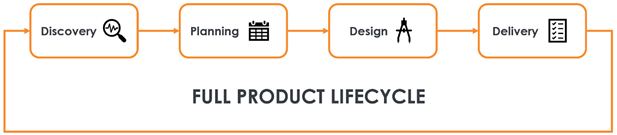
In theory, these activities are often depicted as a full product lifecycle but, in practice, they are often intertwined because product managers iterate quickly to build their products.
Discovery:
Discovery is the process of understanding who clients are, what they need, why we should help them and eventually test and validate these hypotheses. The fast-pace evolution of the advertising industry forces us to constantly spend time researching the market. With the help of product marketing managers, product managers put a lot of effort into gathering feedback from our commercial teams and speaking directly with customers and prospects.
The good news is that, with over 20,000 clients worldwide, we have plenty of opportunities to do so! Whether we jump on a client call organized by the Criteo sales team or brainstorm with them directly in one of our Criteo offices, there is always a way to gather interesting feedbacks and refine our offering.
Planning:
Product groups must plan their strategy to fit the market and position their offering in the marketplace. Concretely, they must understand the value that their offering will provide to the market, how it will differentiate Criteo from competitors and finally declining it into a multi-quarter roadmap made of key milestones.
In order to reach the latter, product managers quickly iterate their offering (see design activity next) and keep communicating about their product development efforts to (i) align R&D, UX, Analysts and Product Marketing stakeholders on next steps and (ii) share a clear direction to other departments for them to anticipate potential impacts as early as possible.
Finally, the product team collectively, along with the C-level management, ensure that all roadmaps are aligned with Criteo's business strategy and priorities.
Design:
The design activity is the most critical aspect of our job: because our mission is to deliver high-value products, our product team is deeply invested in feature specification activities. It implies tasks such as (i) driving brainstorms with R&D, UX and Analysts, (ii) drafting specification documents, (iii) gathering feedback from local stakeholders and (iv) communicating heavily to validate the final design with all parties.
Because of the nature of our offering, Criteo product managers are expected to be technically-savvy and data-driven in order to closely collaborate with R&D, UX and Analysts teams.
Delivery:
Product managers must keep the delivery phase in mind when working on the previous activities, to make sure their products will be able to be delivered efficiently at scale. From an operational point of view, they start working more actively on the delivery when features start to get built by R&D.
The objective is to prepare the release of features for our Sales & Operations teams (in the case of our managed service offering) or directly in our platform (in the case of our self-serve offering).
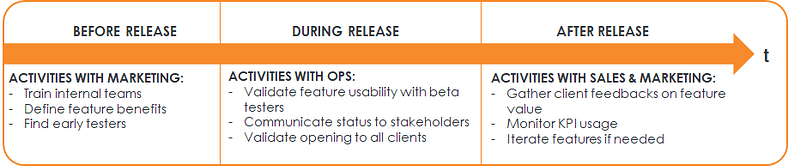
During this phase, product managers collaborate closely with Marketing and Operations teams:
- Before the release to ensure features are integrated into global go-to-market plans
- During the release to validate feature is working properly with early testers
- After the release to aggregate client feedback and iterate on the feature if needed
Since I joined Criteo, I have spent significant time working on these four activities and collaborated closely with many different cross-functional teams. There is no day that looks like the next one!
How do we grow a product team?
Criteo built a career framework development to enable product managers to grow.
Product manager is such a cross-functional position that sometimes, it’s difficult to come up with a sensible list of skills we want our product team members to possess, especially for junior profiles.
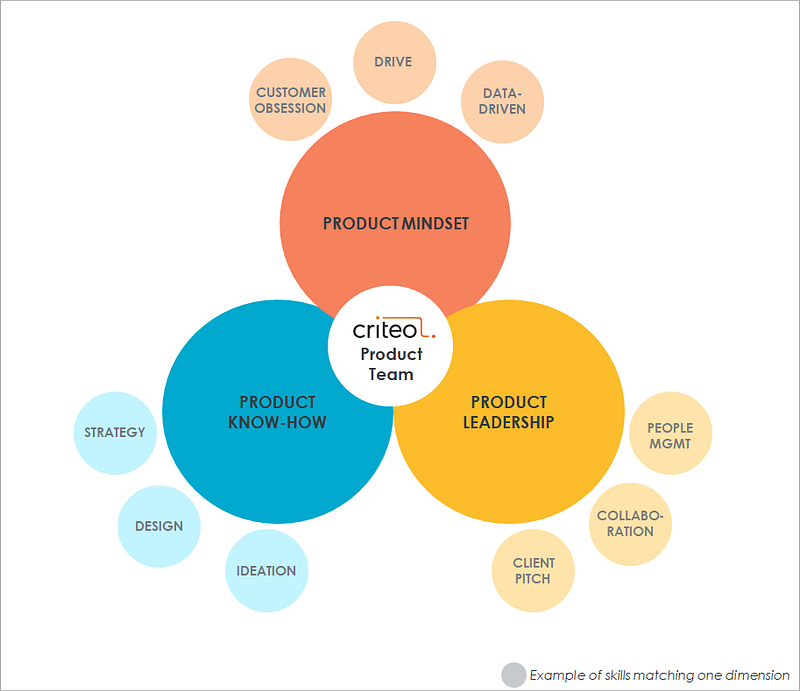
To put it simply, at Criteo, we help our product managers progressively acquire skills belonging to the three following dimensions:
- Product Mindset, to become a customer-obsessed evidence-based owner
- Product Know-how, to work from the customer pain points to impactful deliveries
- Product Leadership, to rally a team around a product vision and deliver it together
Concretely, our career development framework is designed to help product managers developing the skills they need based on their position and personal interests at each step of their careers. As product managers grow and gain in seniority, they master more and more skills and become responsible for impactful product initiatives that require strong discovery and planning activities and larger scopes, up to leading a product group.
So, if all of this sounds like something you may be interested in, we’d be happy to hear from you! Please look at our open positions in the Product team: