
Sodom — Hold The “y”
How religious misinterpretations oppress the LGBTQ+ community
The Sodom story
Abraham, the destined great patriarch of the ancient Hebrews, was minding his own business, hanging out on the veranda in front of his tent. When he was just about to fall asleep on that sweltering day, he saw three people approaching his parcel of land.
Being a social guy, Abe got up and ran to meet them. They were dressed differently, obviously people of royalty. They were taller. Somehow, they just looked powerful. Fact was, it was God Almighty, showing up personally to visit Abe.
Abe ran out to meet them, bowing as he addressed them, saying. “Let me wash your feet as you rest under the shade of this tree. I’ll get you some food so you can feel rested before you continue. I am your servant.”
Abe had the customer service thing mastered. After his guests agreed, he ran into his living space and asked his wife Sarah to get out the best flour and bake some bread. At the same time, he got a servant to fetch a young goat and make a dinner for his guests. Yes, Abe had servants who enabled him to live in luxury while they did the work enabling him to hang out in his tent complex and contemplate life’s meaning.
In these days, God walked around just like the rest of us and spoke with some people. God wasn’t into acting like the fearful and all-powerful deity who spent weeks sitting on a jewel-studded marble throne, flicking out peels of lightening.
So here was God with two angels.
God said “Say Abe, where is Sarah?”
Abe said “She’s back in the tent, rustling up some goat stew. Can we fix some for all three of you?”
God looked at Abe and she thought he was kind of cute in his hospitality mode. Sarah was fortunate to have Abe around to help with the accounting of her goat farming business.
God went on, “Well, just so you know, I’ll be coming through here this time next year and by then, Sarah will birth a son. Congratulations!”
Sarah overheard God say that just outside the tent. Conversations in and outside of a tent could easily be heard, as were the sound of their goats bleating from fifty cubits away. She immediately chuckled to herself because she and Abe were nearly ninety years old.
“What does ‘all night’ mean to you, Abe?” she murmured to herself quietly giggling.
Just outside, God heard Sarah’s amusement and said to Abe. “You know, she laughs but anything is possible with Me. I’ll be seeing all three of you this time next year.”
By now, Sarah was frightened that she, even quietly, questioned the likelihood of her and her old man going for a romp in the hay. Even less likely was the possibility of her producing a child.
In those days, women weren’t supposed to question authority. Mostly because women weren’t supposed to have any authority. It did help, though, that God was female and when she showed up, the guys backed off with their bravado.
But Sarah felt guilty for laughing at God’s talk of them starting a family.
“I didn’t laugh!” Sarah blurted out, lying unconsciously to the voice coming from their front porch.
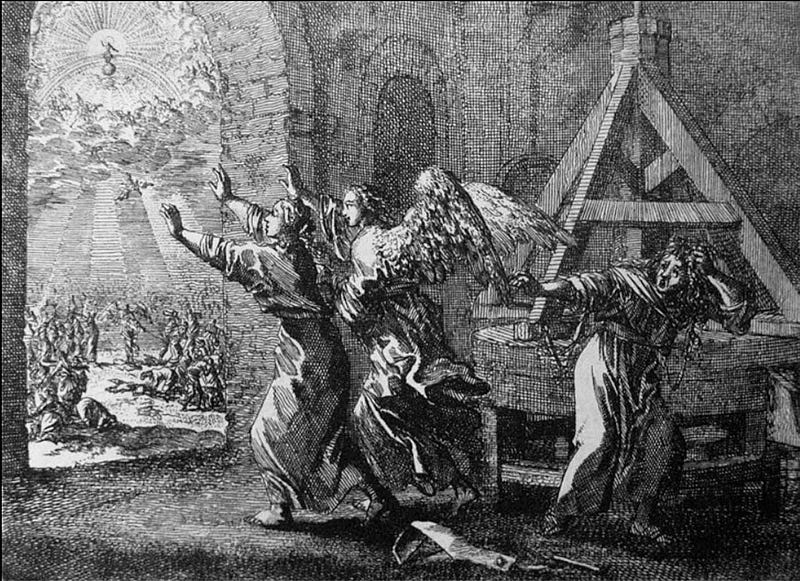
“Sure you did!” God’s voice shot back with a laugh. But come on out and meet my friends Cirrus and Finial. Both of them were as tall as God and were muscular and rather physical.¹

¹ We find them described as “angels” in Gen. 18:22. Unfortunately, the ancient scriptural writers didn’t speculate on detail about God and these two other supernatural beings. It would have made for a more fun narrative.
To Sarah’s relief, the visitors were welcoming and cordial. All three of them sat down and ate lunch with Sarah and Abe and everyone talked politics. Bad kings, greedy politicians and lying magistrates.
Finial, one of the two angels, had advanced degrees in volcanology, geology and karate. During lunch, he told so many jokes that he had everyone laughing hysterically.
Cirrus, the other angel, was also a welcome guest. She performed magic tricks that God suggested and gave advice about handling conflicts between teens and rowdy camel herders.
God’s plans revealed
After a fascinating lunch conversation, Cirrus and Finial announced that they ought to be moving on for their mission. Abraham and God walked to see them off to the main road. Still appreciative of the lunch and wine Sarah and Abe had given them, God stopped and looked at Abe with renewed seriousness. She said, “Finial and Cirrus are heading off to the twin cities Sodom and Gomorrah. Do you remember what I had to do back in Noah’s time?”
A look of horror slowly spread across Abe’s face. He said, “You’re not, . . . are you?”
God said, somewhat defensively, “How about the rainbow? That was a nice touch, don’t you think?”
But God quickly continued, not waiting for Abe’s approval. “These people have gotten as corrupt as they can be. The leaders are pathological liars. The rich have rigged everything so that they have all the wealth and everyone else is forced to live in an impoverished subsistence. The magistrates are narcissistic authoritarians. The wealth gap is incomprehensible”
God stopped walking and put her arm on Abe’s shoulder. “While we’re on this; how are you justifying you and Sarah living a distinctly different lifestyle than your servants?”
God put her other hand on Abe’s other shoulder and looked him in his eyes. “Hagar, the slave whom you got from Egypt, is not how you are supposed to grow a new clan. You and the rest of your male buddies have a whole thing going where you treat women like sexual objects! Having multiple marriage partners is really screwed up. How would you feel if Sarah was regularly having flings with every sheepherder in these parts? You are ruining your whole culture by making some people have more power than others. Only Sodom and Gomorrah have exploded with their evil.”²
² It would be great if God really had intervened in this moment in time and tried to teach humans the injustice of sexism, racism and predatory capitalism which have plagued humanity since the beginning of time. Maybe God did but Abraham forgot the lesson.
God looked out to the horizon, continuing. “I have had it with them. They are like a plague on humanity that is spreading and enveloping everyone. I won’t wipe out everyone like I did in Noah’s time but I’m sending Finial and Cirrus to shut down those cities.”
God continued, “But I’ve got positive news to tell you. It will be hard to get your head around this and I’m not sure you are able to take this in. I really shouldn’t tell you. It’s more than you can handle.”
“Well try me” Abe put in, lowering his head humbly.
“OK,” God went on. “You and your clan will become numerous and powerful — an entire nation. In fact, many will experience blessings through you. I want you to tell your children and their children’s children how to do what is just and right. That’s my intention for you.”
Turning to look down the road, God continued. “The reports I’ve heard from Sodom and Gomorrah make me sick. They’re so corrupt, I’m going to wipe them out. I’ve had it with the way they treat people!”
Finial and Cirrus started off toward Sodom while God and Abe remained in conversation.
Abe said to God, “Are you going to wipe out the good and the bad people? Suppose there are fifty good people in the city. I don’t think that’s your style to treat the bad and the good the same.”
God patiently responded, “If I find fifty decent people in Sodom, I’ll spare the whole place just for their sake.”
Abe jumped in again and said, “I’m nothing but dust and ashes myself, but suppose, just suppose, there are only 45 good people around? Would you spare the whole place for those forty-five decent people?”
God said, “Forty-five good ones would save the towns from annihilation.”
Abe quickly put in, “Suppose there were just 40 good people. Would that save them?”
God said, “I will hold off destroying them if there were only 40.”
Abe said, “How does 30 sound to you. Would that save them?”
God said, “Thirty good ones would save them.”
Abe continued, “How about 20? Would you hold off the annihilation if there were twenty good ones?”
God, at this point, was smiling because she knew there were not even twenty decent people in those cities.
Abe said, “One last question: how about ten? Would you stop the carnage if there were as many as ten good people?”
“For ten, I would not destroy them” God said. And with that, God walked off and Abe walked back to his tent to tell Sarah of his conversation with God.
~
Cirrus and Finial arrive at Sodom
It was evening when Finial and Cirrus arrived in Sodom. Lot was sitting near the gateway of the city because he was a prominent city official. When he saw Cirrus and Finial approaching, he bowed to them and said “Please come to my house and we’ll wash your feet and you can spend the night so you can be on your way in the morning.”
“No thanks” they both answered. “We’ll be spending the night here in the town square.”
Like Abe, Lot had the gift of hospitality. In fact, a few years ago, he and Abe had talked about starting a hotel franchise.
Lot insisted so strongly that Cirrus and Finial agreed to accompany him to his house. Lot and his wife prepared a meal for them, made unleavened bread and they had dinner.
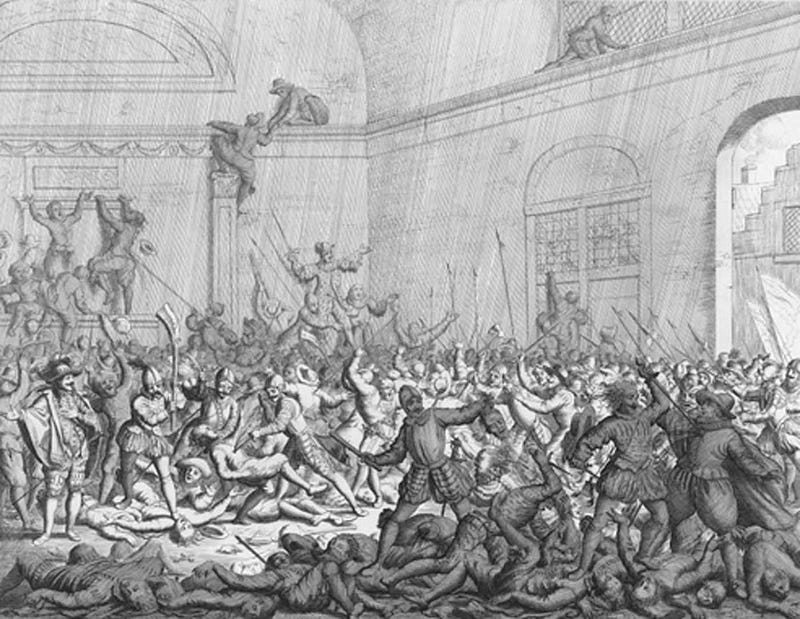
Not long after the meal, Lot and his two guests heard a racket. A mob had formed in front of the house. There were hundreds of people. They were angry, pushing and yelling as if they had just poured into the street from some barroom fight. They were clearly “wilding,” hell-bent on violence and skullduggery.
Voices called out to Lot, “Where are the two who came to you tonight. We’d like to meet them and get to know them and have some fun! In fact, we’ll rape them. They’ll wish they never came here!” (It was common practice in these times of savage war for conquering armies to savagely beat, maim and gang rape the survivors of the conquered army.)
Lot squeezed himself through his locked front door and said to the mob, “No, my friends. Don’t do this wickedness. But look, I have two virgin daughters. Why don’t you let me bring them out to you and you can do whatever you want with them? But stay away from these two guests of mine.”
In that moment, Cirrus turned and said to Finial, “What?!? Are you sure we are supposed to save these people? Have we misunderstood our task here?
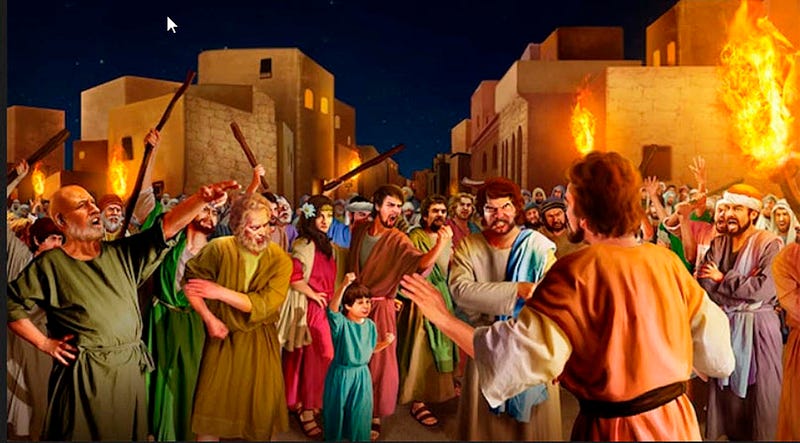
The angry voices called out, “Get out of our way Lot. You are a foreigner and you’re certainly not one of us. Who are you to judge us? We’ll treat you worst than them!” And they kept pressing in to enter Lot’s house, starting to break down his door.
Before that could happen, Finial pulled in Lot by his cloak slammed the door, dragging him to the rear of the house with his family. Even though the mob seemed to be trying to break through the door, Cirrus calmly stood there. With a small waving of her hand, Cirrus struck everyone outside in the mob blind. They moaned and screamed, falling helpless to the ground. They couldn’t even find their way back to Lot’s door.
Cirrus and Finial asked Lot “Is there anyone else here? In-laws, sons or daughters? Anyone else in the city who belongs to you? Get them out of there. Everything here will be destroyed. The despicable violence of these people so offends God that we are here to put an end to all of them.
Lot went out the back door to his sons-in-law’s house just next door. They were pledged to marry Lot’s daughters. Out in front of his house, the street was complete pandemonium. But Lot told them to hurry and come with him, saying “God is about to destroy the city!”
Lot’s sons-in-law didn’t take his words seriously and went to do other things.
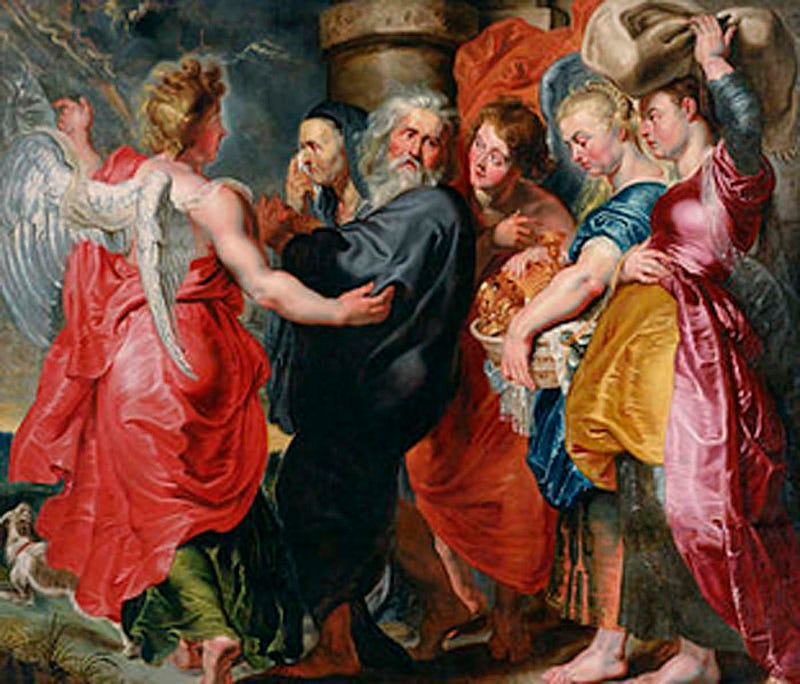
It was now approaching dawn and Finial and Cirrus pressed Lot. “Hurry. Take your wife and two daughters and get out now or you’ll perish with the rest of the city. All of this brutal cruelty and selfish vanity is being destroyed.”
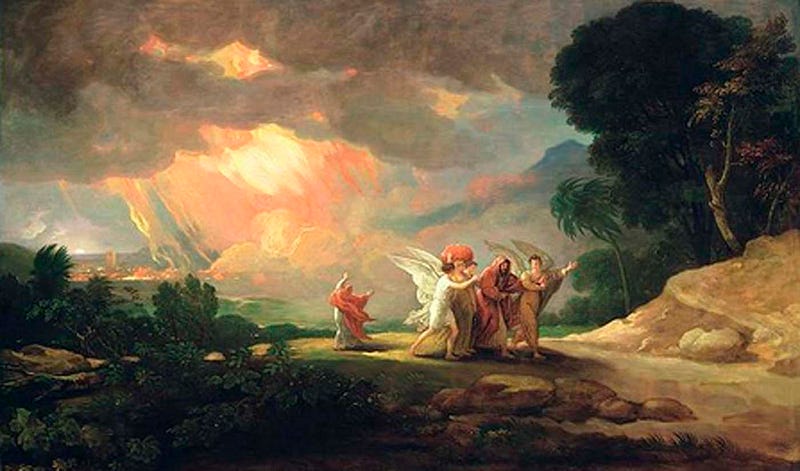
When Lot didn’t look like he fully grasped what was happening, Cirrus and Finial forcefully took Lot, his wife and both of their daughters by their hands and led them through a back alley and out to the edge of the city.
Finial commanded them, “Run for your lives. Don’t look back and don’t stop anywhere on the plain. Flee to the mountains or you’ll die with the rest of these scoudrels!”
Lot said, “No, please. You’ve been kind in sparing our lives. But I can’t flee to the mountains. It’s too much for me. I’ll die. Let me run to Zoar, the nearby town.”
Cirrus said, “I’ll grant you that and I’ll spare that town. But get there quickly. I cannot complete this task until you escape.”
The last thing Cirrus said to Lot. “Notice how many of you are here. Only four. Not fifty. Not even ten but only four.”
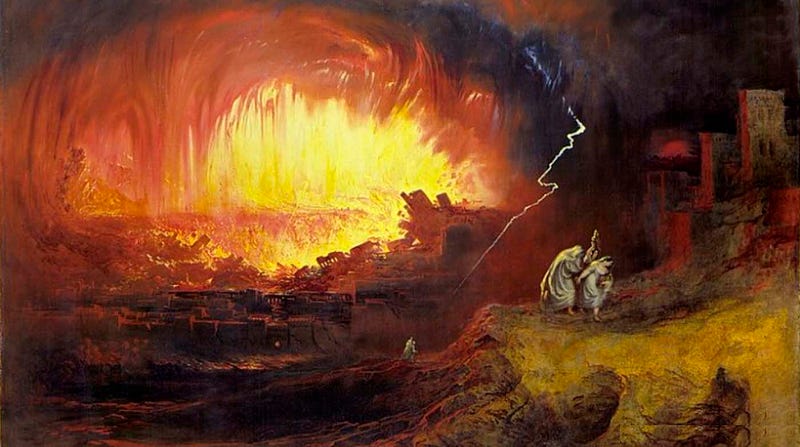
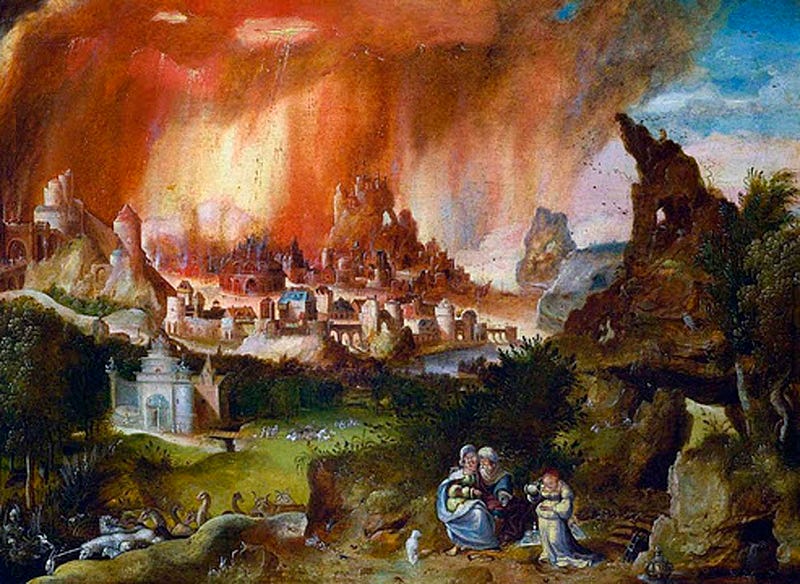
By the time Lot and his family escaped to the neighboring town, the sun had risen. As Finial had calculated, the nearby volcano began raining down burning sulfur on the cities of Sodom and Gomorrah. An earthquake split open both cities, utterly destroying the surrounding plains. All people, buildings, livestock and vegetation were turned to cinders. Unfortunately, Lot’s wife looked back at the catastrophic destruction and in doing so, she was instantly reduced to block of salt.
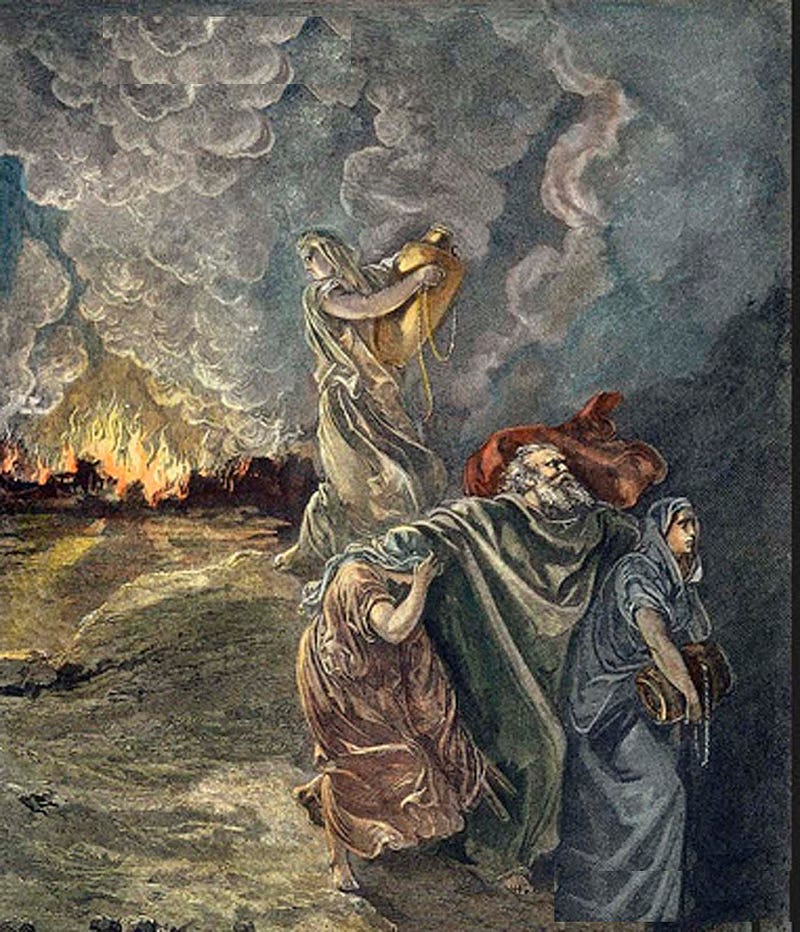
Early the next morning, Abraham got up and stood where he had previously had his conversation with God. He looked across the hills toward Sodom and Gomorrah and the plain. He saw dense smoke rising from the land as if it was a large furnace.
When God destroyed the two cities of the plain, God remembered Abe as promised, and saved Lot from the annihilation of his hometown.
~
Lot and his daughters
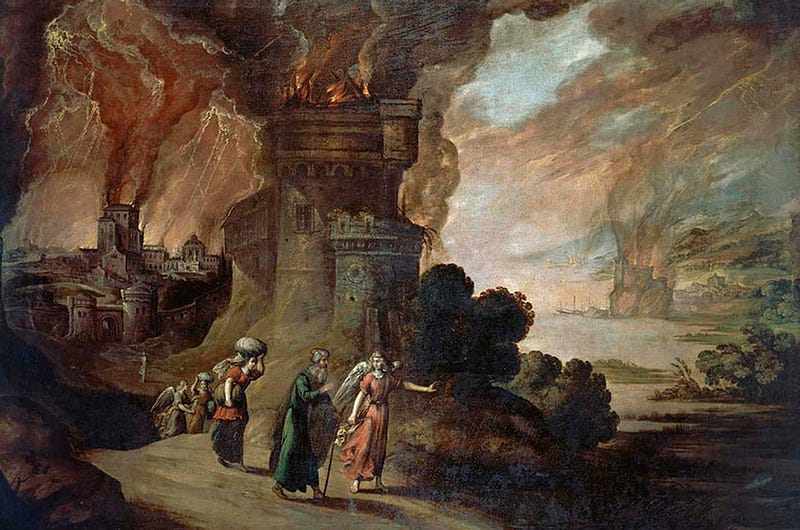
Lot and, now, only his two daughters, left the small town of Zoar and crept up into the mountains. He was afraid to stay there in case the townspeople would hear of his involvement in the cities’ destruction. They hid in a cave, waiting for some sense of normalcy to come.
One day, the older daughter said to her sister, “Father is old. There is no man around here to give us children. Let’s get dad drunk and sleep with him to preserve our family line.”
They got their father drunk and the eldest slept with her drunken father.
The next night, they got him drunk again and the youngest daughter did the same thing.
The story has it that Lot didn’t know what was happening to him on either occasion of his daughters’ sexual encounters.
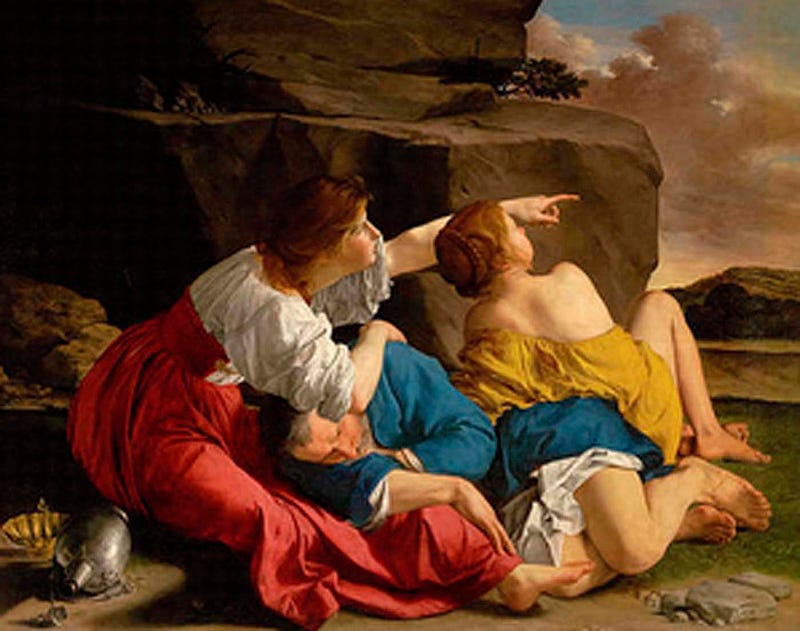
Both of Lot’s daughters got pregnant from their father. The eldest had a son named Moab (in the Hebrew sounds like ‘from father’) who became the patriarch of the Moabites. The younger daughter had a son she named Ben-Ammi (meaning in Hebrew son of my father’s people) who became the patriarch of the Ammonites.
One can only guess what kind of inherited congenital deformities plagued Lot’s ancestors from his incestuous relations with his daughters.

Seven reasons we shouldn’t make a word out of Sodom by adding a “y”
1. The Sodom story is about violence, not sexual orientation
The Old Testament passage which historically has been most influential on attitudes toward homosexuality is Genesis chapters 18‑19. The story of Lot’s family safely getting out of the condemned city of Sodom, at the minimum, is bizarre. The sins of Sodom and Gomorrah were so great that judgment was said to be passed on people who, in the opinion of the traditional interpreters, were similarly involved in same sex behavior.
In the story, the mob wanted Lot to hand over the two out‑of‑town visitors (who happened to be angels) for them to (as they say) “know” or have sexual intercourse.
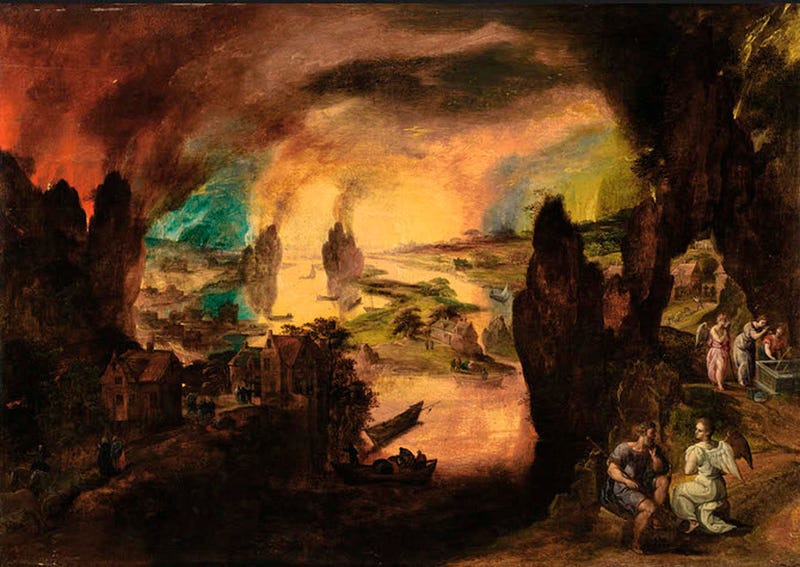
To understand this scene, we must grit our teeth and face the fact that the mob wanted to gang rape and brutalize these two celestial visitors.
Through the centuries, though, translators and commentators have wrongly associated the mob’s intended action with homosexuality. Because of this, the word “sodomy” was wrongly derived from this biblical passage. Technically, sodomy refers to anal intercourse but for more accuracy in understanding this incident, we should remember that rape is not a sexual act so much as it is one of a violent abuse of power.
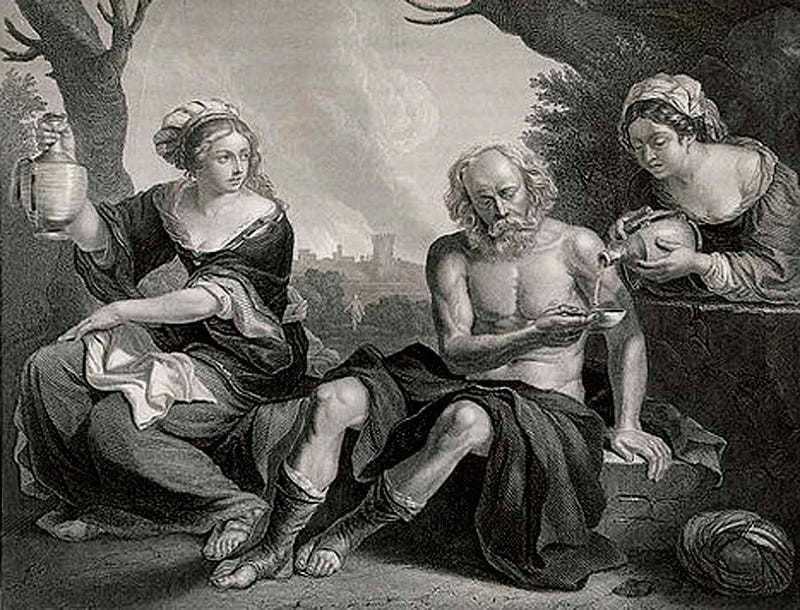
Historical context shows us that in those ancient times, conquering armies frequently flaunted their victory over a conquered people by treating the captured enemy leaders with the greatest possible contempt. They forced the defeated royalty down to the lower status that women were assigned — usually with public gang rape. To put it briefly, and this is horrific imagery to contemplate, the mob didn’t want to abuse those two guests because they were oriented to their own sex. Rather, they were arrogant and violent psychopaths who wanted to totally humiliate those strangers to the city.
Rather than the story making a point about same sex orientation, the Sodom story focused on one specific evil: violent gang rape. Violence is the real point of the story.
2. Lot was no hero
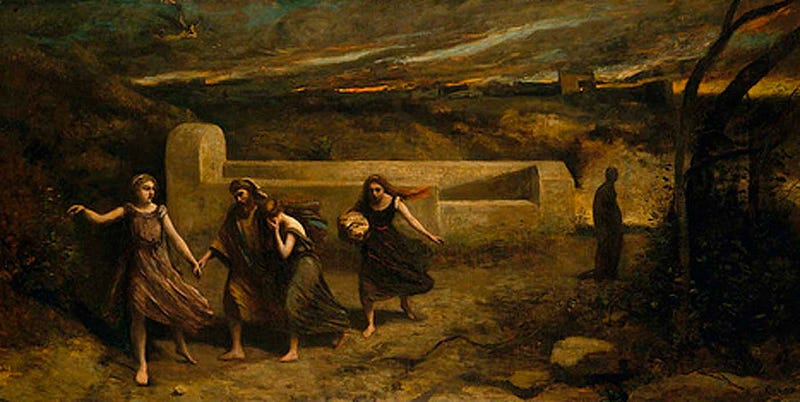
Notice that Lot tried to save his two supernatural guests by offering to throw his two teen age daughters out into the mob for them to molest. Why hasn’t Lot gone down in history as a heinous example of how depraved humanity can become? Here, in this scriptural passage, it is the epitome of mindless and ruthless sexism. Perhaps these angels of death should have left Lot behind to experience the fate of the rest of the inhabitants.
But the Bible is often its own best commentary and interestingly enough, we find the scriptural explanations for Sodom’s destruction as having nothing to do with homosexuality. How then does the Bible (itself) interpret the sin of Sodom?
The immediate literary context screams out that hostility to strangers is the real subject. Look at how Abraham is falling over himself to welcome God and the two angels. Next, compare the almost identical welcoming Lot gives to the two angels. Lastly, compare, the opposite response of the mob to the two angelic visitors to the city.
There is a parallel story over in Judges 19‑21. A Levite is on a trip with his concubine and while they are in an unfamiliar city, a crowd comes to the house where the couple is staying. This mob demands that the homeowner send the male Levite out so that they may “know him” — again the use of that word).
In place of the Levite, the host verbally offers the mob the Levite’s woman friend and his own daughter. In the confusion, the woman friend of the Levite is thrown out the door, … she is gang raped and abused to her death. Again, amazingly, … the male scriptural writers and editors placed no judgment on this behavior. Another gruesome story but parallel and probably dependent on the previously written account of Sodom.
Whatever a person decides about the interpretation of the Genesis Sodom story, one must decide about the Judges narrative. The same violent mob action was described. The gender of the offended party is not the point. The subject is the humiliating violence. From these two passages alone, one cannot suggest there is a specific teaching on the issue of homosexual relationships between consenting adults. The Sodom story was about commonly practiced violent gang rape in the ancient cultures.
3. The wider literary context
In the first chapter of Isaiah, the nation of Judah is rebuked by comparing it with Sodom and Gomorrah. The specific sins mentioned are greed, rebellion against God, empty religious ritual (without true devotion to God), failure to properly care for orphans and widows, failure to pursue justice and failure to champion the rights of the oppressed. There is no mention of homosexuality.
In Ezekiel l6:49‑50 it says: “This was the iniquity of your sister Sodom: she and her daughters had pride of wealth and food in plenty, comfort and ease and yet she never helped the poor and wretched. They grew haughty and did deeds abominable in my sight and I made away with them, as you have seen.” Still no specific mention of sexual orientation.
In the New Testament, Jesus refers to Sodom not in the context of sexual acts but in the context of inhospitality. He says, in Luke l0, “When you enter a town and they do not make you welcome… I tell you; it will be more bearable for Sodom on the great day than for that town.”
Jude 7 does refer to the sexual sins of Sodom, commenting on their fornication and “unnatural lusts.”
The emphasis, here in the Jude passage, is on heterosexual intercourse outside of marriage and going after alien or (literally) `strange flesh’ as the original Greek says. In the unusual context of this letter, these “unnatural lusts” might refer to desire for contact between human and heavenly beings but we are uncertain because of the difficulty of the text.
There is a related passage in Deuteronomy 23:17‑l8 that uses two Hebrew words often mistranslated as “sodomite” and thought to mean homosexual. The words here are used to condemn the men and women who lead in the pagan worship of the gods of the fertility cults. But there is nothing in the text to justify the idea that the male priests were engaged in homosexual activity, even though men and women priests were involved as cultic prostitutes. And one would be hard pressed to figure out how the symbolism about fertility would have any connection with a priest who might be homosexual.
The Sodom story says nothing at all about sexual orientation. The only real application would have to be a general one: everyone should show hospitality to strangers, dealing justly with the poor and vulnerable, … and should not force their power or violence (sexually or otherwise) on others. Dare we seek the relevance of these lessons to how our nation has recently treated immigrants? Are the actions of our nation’s leaders (who have miserably treated refugees fleeing death and torture) similar to those judged in these ancient texts?
4. Ancient Israel’s holiness code in Leviticus
The central theme of Leviticus 18‑20 is “holiness before the Lord.” In this passage, as well as elsewhere, the ancient Jews tried to define a state of ritual purity and moral integrity. The priests thought that if these rituals could be followed, they would succeed in being a “pure” nation in the world. They devised an organizational scheme which tried to categorize everything in nature.
Wholeness of body was one class that was considered better than the class of people who were diseased or physically challenged. Priests were not to wear suits made out of more than one kind of material. In some ways, these priests were a little like the Amish cult we see today.
They organized animals into “clean” and “unclean.” They decided that because God usually made animals with cloven hoofs who chewed their cud, God must have intended this to be the norm. So camels, rabbits and pigs were considered out of order or “unclean.”
The priests, in their organizational mania, figured out that water creatures usually have scales and fins for locomotion. They reasoned, then, that God must have been thinking of a category of “clean” water animals — all properly having scales and fins. They legislated that scaled and finned water animals could be eaten. Water animals that did not have that combination, such as frogs and lobsters, were designated as “unclean.”
It was also against the Jewish law (and punishable by death) to consult with a medium or wizard, to curse at one’s parents, to commit adultery and to have intercourse with a menstruating woman. And since it was thought that God created the so‑called “clean” category of heterosexuality, to engage in homosexuality was ruled as “unclean” as well — deserving the death penalty. In all the above-mentioned examples, it was taught that violation of these priestly laws was a violation of God’s laws.
When punishments prescribed for violation of these categories of “cleanliness”, they stipulated that violators “shall be put off from among their people.” It meant that they were to be executed.
Facing the modern reader, then, is this basic question: `What does one do about these ancient rules on capital punishment? If some are thought to be valid today, … which ones, … and on what basis does one determine the validity of one over the other?
5. Paul’s writings
Paul mentions some of these ritual purity laws in Romans 1‑3. Virtually all scholars agree that Paul is describing the general condemnation of Gentiles and Jews under the scriptural law. Paul’s major point is that everyone is found morally wanting when their actions face the scrutiny of the laws. The problem, Paul says, is that people have rejected God and have made themselves autonomous. Consequently, God has abandoned them, leaving them to their own disgusting lives, which are dominated by sexual immorality and other forms of behavior which violate what Paul calls “natural.”
Quoting Paul:
God gave them up to the defilement of their bodies, … shameful passions, males abandoning sexual relations with females which accord with nature, were inflamed with their longing for one another, males committing shameless acts with males…” and so on. And Paul calls the behavior unfit and improper.³
³ Romans 1.26.
In Romans 2:1, Paul turns his attention to the person who would self‑righteously pass judgment on that behavior. No one, Paul is saying, is innocent of such offenses. In saying that, Paul is obviously not claiming that everyone transgresses every law on this list. He is saying that everyone is found guilty of failing to live a lifestyle which fully conforms to the Jewish law.
Paul is certainly not advising Christians to return to the Levitical laws of ritual purity. On the contrary, he is trying to pry that kind of legalism out of his readers’ minds. He is just mentioning the old Jewish law to remind some (perhaps self‑righteous and legalistic Jews) that even they are not pure or good enough (according to their own and ancient system of rituals) to escape guilt. “All have sinned and fallen short of the glory of God” he concludes.⁴ Paul’s point is that all people are under the power of sin.⁵ He is not making a point about sexual orientation.
⁴ Romans 8:23.
⁵ Romans 3:9.
Paul knew that homosexuality went against the ancient priestly categories, as well as swearing at one’s parents or having sex during menstruation. But he certainly was not defending those categories of the ancient Jewish cult. He was just using the ancient legal categories as a block of material familiar to his Jewish readers for the purpose of illustration.
To be thorough, we should also notice that in 1 Corinthians 6, Paul lists some evils, …again using some hard‑to‑understand Greek words. The translators differ on their renderings. Various attempts include: “homosexuals, sexual perverts, those guilty of homosexual perversion, sodomites, effeminate and sensual people given over to unnatural vice.”
Which of these many images did Paul originally intend to convey to his readers regarding a lifestyle of wrongdoing?
Well, look at the other things in his list. Idolaters, adulterers, thieves, greedy people, drunkards, revilers and robbers. It would make more sense to understand that he was trying to describe flagrantly immoral behavior … licentiousness as a lifestyle. It would be impossible to interpret this text as making a comment on one’s basic sexual orientation — a distinction only recently understood in our own time.
In other words, when Paul condemned behavior that was thought to be associated with homosexual activity, he was condemning licentious and vulgar behavior that is a product of an overall lifestyle that totally rejects the authority of God. He was not commenting on, nor was Paul even aware of, a natural orientation to those of one’s own sex. He seemed to be condemning those who exhibit an entire lifestyle of total debauchery and hedonistic sexual activity (apart from committed and caring relationships).
So, the Bible is silent on the matter of a person’s acquired sexual orientation. It also appears that New Testament Christianity threw out the archaic ritualistic laws of ancient Israel’s cultic classifications. People are simply not punished for wearing a mix of polyester and cotton clothing. And given the fact that the Bible seems to only condemn licentious sexual behavior by heterosexuals and homosexuals, we seem to be left with several rather pointed questions.
6. Unanswered questions remaining for us today
- The ancient Israelis thought that marriage was God’s only intention for human beings. Given that some people choose to be single today, does that make them less than what God wants? And given that some people discover that they are oriented to those of their own sex (through no fault of their own), what is one to do with that ancient perception of Israel?
- The author of Job tells us that the mysteries of God’s activities as the Creator cannot be completely comprehended by the human mind. Job believes that no doctrine of creation can state all the truth about the Creator. So, does organized religion’s knowledge of God’s work as Creator continue to grow? Does time, science, medicine and experience lead us to new glimpses of the Creator’s plan that vastly exceed ancient cultures’ primitive understandings?
- Homosexual behavior violated ancient Israel’s male dominated gender scheme. Treating one’s wife as an equal also violated their male‑dominated social order. By what criteria should a modern person of faith decide that one part of the Israelite male‑dominated society reflects God’s eternal plan — while other ancient Israeli social customs only represent a culturally‑conditioned human understanding of God’s plan?
- Homosexual behavior between consenting males and heterosexual intercourse between a husband and a menstruating wife were both punishable by death in ancient Israel. By what criteria does the modern person of faith decide that one law reflected God’s plan and the other only a culturally‑conditioned human understanding of God’s will?
- While Paul quoted a traditional Jewish list of things that were ritually out of order in Romans 1:18f., did he do it approving the use of the list; … or was he not, in fact, using it to forcefully remind a self‑satisfied judgmental audience not to depend on their law codes to justify themselves? On the contrary, he seemed to suggest his audience seek to find fulfillment in God’s unconditional love.
- When Paul talked about those in Romans 1, who have consciously chosen to replace truth with untruth, … suppose we assume that he was thinking that heterosexuals can consciously choose to become homosexual. Today we understand that homosexual persons have not made such a conscious choice. Would not we, again, assume that Paul is not talking about one’s orientation? Instead, he seemed to describe elicit, licentious and deliberate acts of vulgarity and pleasure seeking. He likely was talking about people who were so perverse and warped that they would engage in an overall lifestyle of “anything goes” experiences — something like a drug user trying any new drug just for the fun of it?
- In 1st Timothy 2:9‑15, it clearly states the author’s opinion that women are not to braid their hair, wear gold or pearls or costly clothing. Women are advised to learn in silence and never teach or have authority over men and they are to keep silent. It goes on to suggest that Adam was not deceived but Eve. This is stated in 1st Timothy, even though Adam, according to the Hebrew text, was right next to Eve and had obviously taken a bite himself.
Now it is clear that modern faith traditions believe that new understandings about the equality of women and men have been affirmed by scriptural understandings. We believe that faith groups have been led by different understandings of what it means to be a woman or a man living today with these values. We’ve seen new light on the issue of slavery and have condemned the social injustice of slavery.
7. The faith-based community today
Traditions in organized religion have made life tremendously difficult for our gay, lesbian, bisexual and transgendered brothers and sisters. How can we help to eliminate the social injustice and affirm their equality and dignity?
These issues matter. They matter to the individual person who is gay, lesbian, bisexual or transgender. They matter to individuals, their loved ones and ultimately to every one of us in our society.
We are at a time when old systems and ideas are being questioned and falling apart, and there is a great opportunity for something fresh to emerge. I have no idea what that will look like and no preconceptions about how things should turnout, but I do have a strong sense that the time we live in is a fertile ground for training in being open-minded and open-hearted. If we can learn to hold this falling apart-ness without polarizing and without becoming fundamentalist, then whatever we do today will have a positive effect on the future.
Working with polarization and dehumanization won’t put an immediate end to the ignorance, violence and hatred that plague this world. But every time we catch ourselves polarizing with our thoughts, words, or actions, and every time we do something to close that gap, we’re injecting a little bodhichitta into our usual patterns. We’re deepening our appreciation for our interconnectedness with all others. We’re empowering healing, rather than standing in its way. And because of this interconnectedness, when we change our own patterns, we help change the patterns of our culture as a whole.⁶
⁶ Pema Chodron, Welcoming The Unwelcome. Shambhala, 201900, page 28.
Helpful Resources
Letha Scanzoni, Virginia Ramey Mollenkott, Is the Homosexual My Neighbor? (New York: Harper & Row, l978).
The Blue Book, 1. 190th General Assembly l978 of the United Presbyterian Church in the United States, May 16‑24th, l978
William Sloane Coffin “Homosexuality,” in The Courage to Love (New York: Harper & Row, l982).
Reports to the 203rd General Assembly, 1991, Part 1, Keeping the Body and Soul Together: Sexuality, Spirituality, and Social Justice by the General Assembly Special Committee on Human Sexuality, Presbyterian Church U.S.A., 1991


