
Social Media Is Essential For Creators… But Only in the Beginning
Then, podcasting can help you thrive online

I have less than 1,000 followers on Instagram, and just over 500 on LinkedIn. As for Twitter, Facebook, Clubhouse, Tik Tok, Pinterest, Snapchat — peanuts.
Despite these low numbers, I’ve been able to make money online. Since January, I’ve made over $4,000 through Udemy courses, coaching, and other income streams. I’m now on track to leave my 9–5.
Punchline? It started with podcasting.
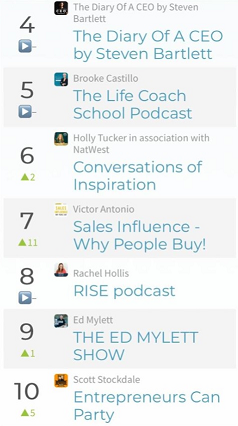
On the 4th March 2020, I launched Entrepreneurs Can Party. Six days later, it featured in the top 10 of the U.K. Apple Podcast charts for entrepreneurship.
I’ve since had the pleasure of speaking with my favourite entrepreneurs. In turn, these people have sent countless opportunities my way.
This brings us to social media.
To launch my podcast, I used Instagram a lot. However, now that I’ve built an audience elsewhere, I do very little on social. The reason is this.
You’re at the mercy of algorithms.
According to Pat Flynn, there are only two things you can own on the internet: an email and a website. Everything else is rented, including social media. It’s also getting harder to reach followers because of pay-to-play factors.
Even so, social media can be helpful when launching a podcast. This is great news for content creators. After all, it’s free!
Here are eight steps to launch a podcast, build meaningful connections, and make money from your content.
1. Craft your podcast name
Journalists capture attention. The Sun reportedly spends thousands of pounds on writers whose sole job is to create front-page headlines.
Here’s a conversation I had with one of my followers about how I crafted the name Entrepreneurs Can Party:
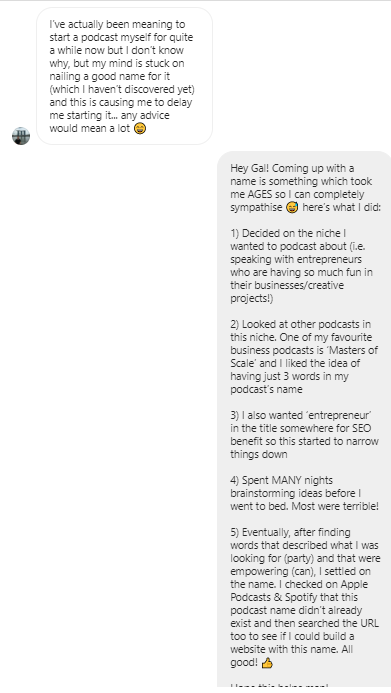
All in all, it took me 3 months to come up with Entrepreneurs Can Party. I’m sure it won’t take you this long!
2. Carefully consider your podcast categories
There are over 100 categories and subcategories to choose from in Apple Podcasts. You can choose up to three. The first has a greater weighting than the second, which has a greater weighting than the third.
I suggest you go narrow on your first.
For example, I chose “Entrepreneurship” as my first and “Management” as my second. Both of these are subcategories of “Business” — my third. Picking a less competitive subcategory gives you a greater chance of ranking in the Apple Podcast charts.
If you’re not sure which categories you want to rank for, don’t worry. You can change them at a later date on your hosting platform.
3. Make a compelling trailer
Creating a two-minute trailer that introduces your show is useful for a couple of reasons.
Firstly, it builds excitement.
Marketers know people often need to see things at least 6–7 times before they take action. Therefore, don’t worry about over-promoting. Whenever you can, mention in your content that you’re launching a new podcast and include a link to your trailer.
As a minimum, your trailer should include the following:
- Who your show is for
- What listeners can expect to learn
- How often you’ll be releasing episodes
- When the first episodes will be released
Secondly, releasing a trailer gives you an opportunity to test your podcast hosting.
It’s reported Apple Podcasts currently accounts for around 60% of all unique podcast downloads. For this reason, you’ll want to make sure your podcast is on this platform when you launch.
4. Schedule a minimum of three episodes
The number of episodes to launch with is up for debate.
My mentor suggests six. The logic is if someone listens to your podcast and you’ve only got one episode, they’ll only register one download. Launch with six and you could get six times as many downloads.
However, I believe we podcast listeners are ‘completists’. We like to finish what we’re listening to. Launch with too many episodes and you run the risk of overwhelming listeners.
As such, I launched with three episodes, plus the trailer.
5. Encourage people to subscribe
To rank in the Apple Podcast charts, you need downloads and reviews. You also need consistent downloads for each episode you release.
This signals to Apple that your podcast has momentum and is trending in the right direction.
How do you build this momentum? Ask your network to subscribe to your podcast when they listen. This way, they’ll be notified every time you release a new episode — just like YouTube.
Do you need lots of downloads? It depends.
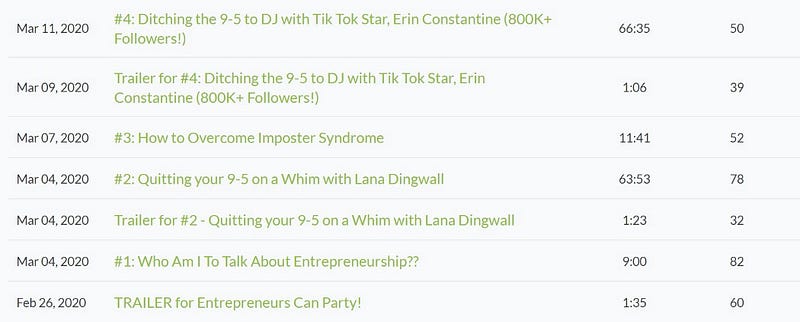
Here’s how my first month of episodes performed. The download numbers are in the far-right column.
As you can see, the numbers weren’t huge, but you may need more for your category. Some are more competitive than others.
6. Get those reviews in!
Depending on which category you choose, you’ll be surprised at how few reviews you need to get a good ranking. For me, 24 reviews were enough to break into the U.K. top 10 for entrepreneurship.
How should you ask for reviews?
I knocked up a spreadsheet and sent DMs to 30 people in my network every single day post-launch. The spreadsheet tracked who I contacted, the platform I contacted them on, and when I contacted them.
It wasn’t the same blanket message to everyone. I was also tactical about who I contacted. I figured my closest friends wouldn’t need much prompting so I contacted them first. From here, I gradually moved to connections on Instagram and LinkedIn.
As a rule of thumb, 10% of the people you reach out to will leave a review. In other words, if you’re looking to get 100 reviews, you’ll need to ask at least 1,000 people.
Something else to be aware of is it’s not possible to leave a review on Apple Podcasts from an Android device.
For this reason, I’d recommend using a tool like ratethispodcast.com when asking for reviews. It lets you create a personalised link and takes users to the most suitable platform for them to leave a review.
Should you follow up with people to leave reviews? Reminders can be useful. Personally, I wouldn’t feel comfortable reminding the same person more than once.
You just have to accept that even though it takes less than 30 seconds to review a podcast, some people won’t bother.
There are other ways to jog peoples’ memories. For example, I ran a competition to win a year’s supply of Netflix throughout April 2020. I figured more people would be watching TV given the pandemic.
To enter, all people had to do was leave a review on Apple Podcasts. If they wanted bonus entries, they could share the competition post on their Instagram stories.
This resulted in five more reviews and many social shares.
7. Once you’ve launched into the charts, you’ll be able to attract ‘bigger name’ guests
Following these tips gives you a good chance of a successful launch!
Once it happens, it’s worth updating all your social profiles to state your podcast’s ranking. It’s also a good idea to start reaching out to ‘bigger name’ guests to appear on your podcast. They’ll be more likely to say yes.
Here’s the email template I use when inviting people onto my podcast.
After a guest has agreed to come on, we’ll decide on a recording date. I’ll then say something like this:
“You can choose a time from my calendar that works for you, or if you’d prefer to send me some dates, I’m happy either way.”
Most guests will choose from my online calendar. (I use calendly.com). From here, they’re taken to another page to answer six short questions to confirm the booking.
Five of these questions relate to podcast preparation, and the sixth is where the magic happens…
8. Build meaningful connections by sending thoughtful gifts
“I love sending a little thank you to guests after they’ve appeared on Entrepreneurs Can Party! What would be the best home address for me to send one to if you’d like to receive one?”
From over 60 guests who’ve appeared on my podcast to date, only one has declined. We all love a gift!
What should you send them? I know many of my guests are interested in personal development. They also like to read.
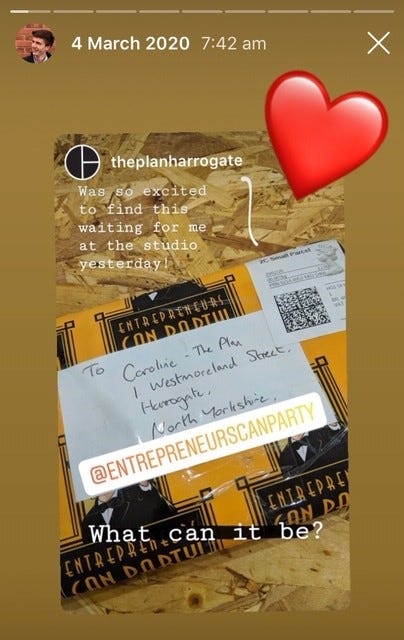
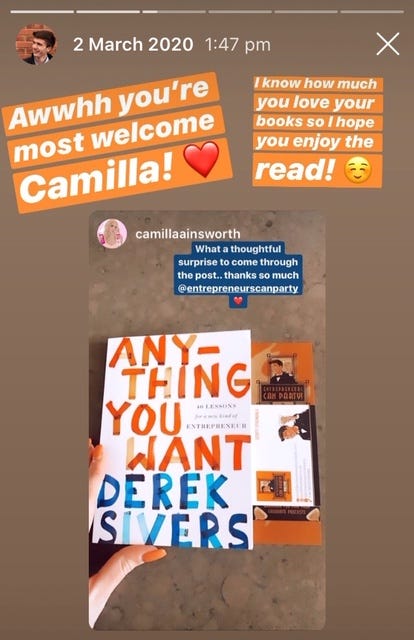
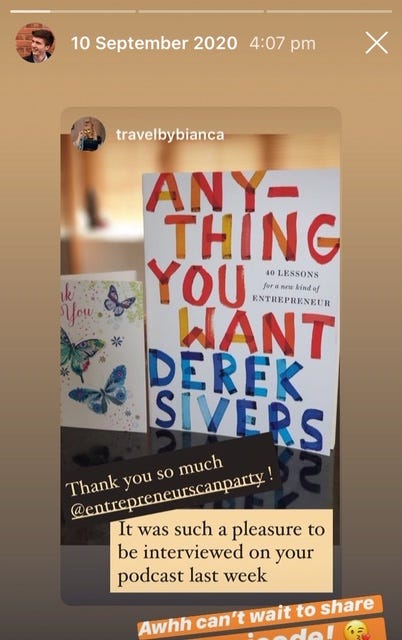
With this in mind, I like to send guests one of my favourite books. It’s usually a copy of Derek Siver’s Anything You Want. As well as containing amazing advice, it’s only 88 pages long, meaning it can easily be read in one sitting.
I’ll also include an Entrepreneurs Can Party bookmark. I hired a designer from freelancer.com to create it and used helloprint.co.uk for printing. If a guest keeps it, they’re reminded of my podcast.
Finally, I’ll include a handwritten card expressing my thanks. This is all then wrapped in tissue and parcel paper. Sometimes I’ll slip in an Entrepreneurs Can Party laptop sticker for good measure.
I appreciate this costs money. If this is a concern, a handwritten card on its own is still a nice touch.
Here are six benefits of giving gifts to your podcast guests:
- It’s a nice thing to do!
- It shows you care.
- You differentiate yourself from hundreds of podcasters. As a result, the guest is more likely to remember you. (This is particularly useful if you’d like to speak with them again in the future.)
- The guest may share the gift across their social channels. Note: I never ask or expect guests to do this.
- Including a branded item with the gift (e.g. a bookmark) makes the guest more likely to remember your podcast. It also allows them to talk to others about your podcast.
- If a guest trusts you with their home address, you can surprise them with future delights. For example, I sent Christmas cards last year to all the guests who’ve been on my podcast.
Takeaways
Podcasting has been a game-changer. It’s given me a platform to connect with others, establish multiple income streams, and share my learnings. Best of all? I’ve made wonderful friends without depending on social media.
If you line up your dominoes, you’ll be able to focus on promoting your podcast during its launch week. This includes encouraging people to subscribe and enter your competitions.
The most important advice I can give?
Get as many downloads and reviews as possible in the first 6–8 weeks after launching. Doing this should help your podcast scale Apple Podcasts. You’ll then be able to attract ‘bigger name’ guests and strengthen connections.
From here, the opportunities could take you anywhere.
Just last week, one of my previous guests asked if I could help her outsource to a virtual assistant. She’s already taken my Udemy course. We’re now having calls once a week until she’s gone through the process so I can keep her accountable.
To me, this is proof the best opportunities will take you by surprise.
Want to ditch the 9–5? Get my free 19-page guide: Everything I Did to Quit My 9–5 Job & Transition Into Profitable, Sustainable Solopreneuring :)


