
SOCIAL MEDIA | ADDICTION
I Did a Social Media Detox for a Full Week — And the Results Surprised Me
Here is how my productivity and mental health improved
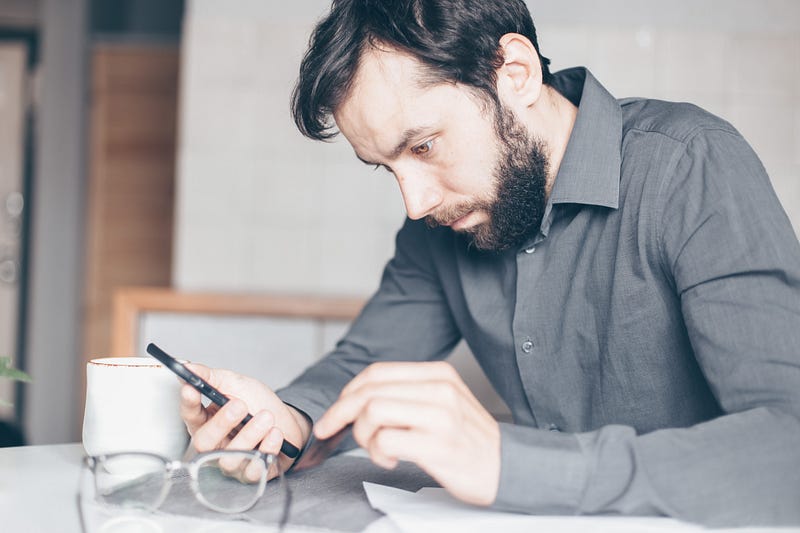
I’m sure it affects you too. I open my social media all the time.
Since 2013, social media has been an integral part of my life. I’m the generation that grew up with it and internalized the swipe-to-refresh gesture like no other.
I finally managed a detox a few weeks ago—7 days without social media. The reason for it is simple: Twitter, Snapchat, and Instagram steal my time. I expected to gain more time by no longer getting interrupted — but benefits I didn’t expect showed up.
The Saw Blade Effect Has No Longer Killed My Productivity
I don’t have to explain that your smartphone is stealing your attention. There are several stages of realizing how harmful it is. Yet, most people neglect an essential factor.
Whenever you grab your smartphone, your attention is lost. Sure, each reach for your smartphone might only take 30 seconds. Yet, if you’re like me and grab your phone 100 times a day, it adds up.
The loss of attention to important things is already very uncomfortable when realizing. But there’s something else you should know: your focus has different stages.
Take a look at this graph:
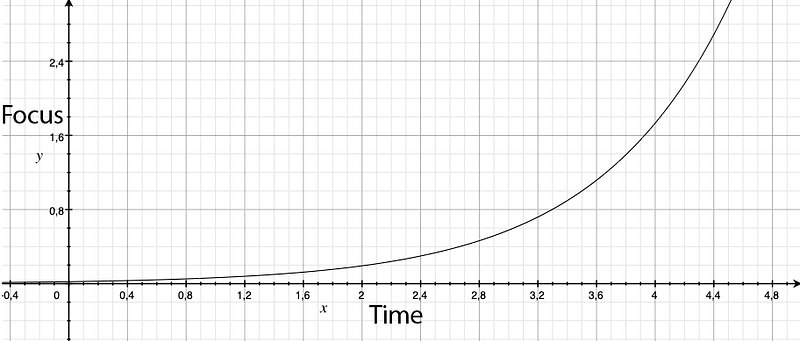
The graph shows the relationship between time and focus.
The more time passes, the higher your focus and thus your efficiency in accomplishing a task. Of course, this graph does not scale to infinity. That’s the point: the graph shows the time within a phase without interruption. As soon as your attention is interrupted, the graph starts again from the beginning.
You lose your efficiency because you have to get back into the task.
That’s where the name saw blade effect comes from. If you regularly reach for your phone while working, your performance will look like a saw blade:
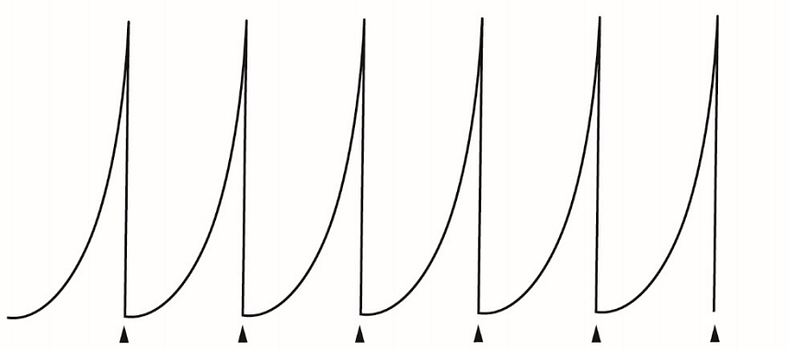
The bad thing is that you hardly notice this effect. I no longer constantly accessing my phone because Instagram, Snapchat, and Twitter have saved more time than I would have thought.
My Mental Health Became Drastically Better.
Social media is suspected of being extremely harmful to mental health.¹
The problem is that most people don’t understand why. I notice this, especially when talking to older people. They think children need to be protected from explicit content on the Internet.
That’s true, but it’s also only part of the story.
The things we see on the Internet and think are normal are sometimes the most dangerous. Social media is what Jean Baudrillard would call hyperreality. The content we see pretends to be reality — but isn’t.
Photos are edited. Old pictures are posted, sometimes even more than just once. Content that isn’t even our own is shared. Only a slice of life that is “appropriate” for social media is presented.
I believe this is what is so damaging to our psyche. An urge for happiness and conformity without reference to reality arises. We compare ourselves to what is not real at all — because we cannot distinguish.
I know young people who complain that their friends seem so happy. Later, I found out that this impression is based on their friend's portrayal on social media — not reality.
We are not only consumers but forced participants
My mom is regularly hooked by what her female friends post on their Instagram Stories.
“I guess now I have to post something too,” she said to me one day.
Even when we’re just looking at pictures and videos, we feel like a participant in other people’s lives. I was burdened by precisely that — not wanting to think about who was partying with whom or who was dating whom.
Social media is like a better reality TV show that we’re all addicted to.
When you’re right in front of someone, talking to them, you know you’re being seen. That unsettles some people; some people aren’t. Following other people’s lives through your smartphone is so invisible — but do we feel that way?
When I left social media entirely, I felt less watched.
A social pressure lifted from me, and I didn’t know why at all at first. Then I understood that I’m not able to distinguish between real and digital. Even when I was liking photos and watching Stories, I felt like other people were seeing me.
We know about our addiction, and it depresses us.
We unconsciously reach for our smartphone up to 100 times a day. Yes, we are programmed for it — and yet we notice it. Well, at the latest, when you interrupt a phase of deep focus to check your Twitter feed, you have a depressing moment.
The many interruptions make us feel stuck or just not capable enough.
When I checked how much I was on my smartphone per day, I was crushed. So much time wasted due to an unnecessary reflex.
My 7-day long detox, on the other hand, was a sense of accomplishment for me. I had more time, more focus, and felt powerful because I finally controlled my urge.
A Few Tips To Make a Social Media Detox Happen
Admittedly, the beginning is difficult. Going from 100 times a day to 0 times a day is an adjustment. The fear of missing out is enormous. This is exactly why many people don’t make it through withdrawal. But don’t worry, a mindset shift has helped me.
If you’re not missing something on social media, you’re missing something in real life.
Every time you check your feed, you’re trading in your time. Who knows what useful things you could do with that time?
That’s what I told myself every time the urge to open Twitter, Snapchat and Instagram got stronger. I’m not making this withdrawal to spite myself, but to have more of my real life.
On your smartphone, there’s an option to block apps. I know it works on IOS as well as Android — best to check for an actual tutorial.
If you want to play it safe, you can use the following trick: Lock your apps with a code. When you want to open a social media app, your smartphone will ask you for the code. You can have a friend or family member create the code for you.
Only this person knows the code and gives it to you when your detox is over. With this trick, you will quickly avoid relapses and, at the same time, increase the pressure on yourself.
Sources
[1]: https://childmind.org/article/is-social-media-use-causing-depression/