
Social Journalism Comes to Life
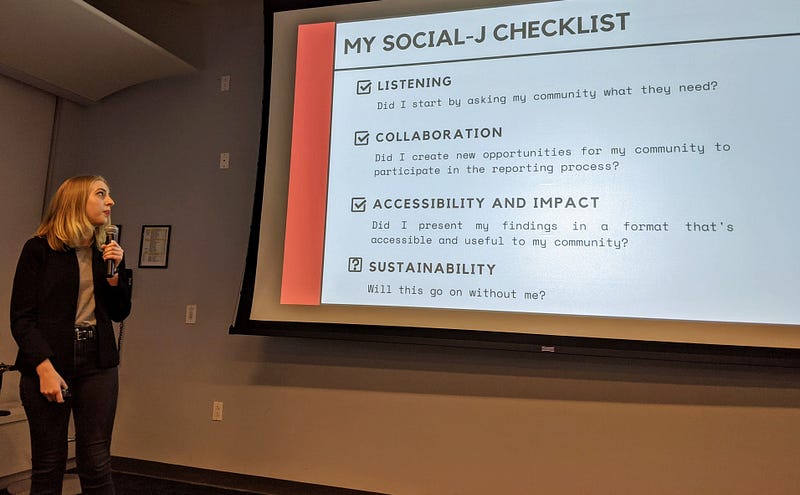
The other night was the most gratifying moment I have had in my career in journalism: watching the fifth class of Social Journalism graduates at CUNY’s Newmark School of Journalism as they presented their stunning final projects serving communities — and presented their visions for a new journalism that values listening over lecturing, conversation over content, collaboration over consumption, service over product.
There’s no crying in journalism but as one of the students said to another: “Jeff’s ugly crying.” I was, more than once. Tears were spotted also coming from the Social Journalism program’s phenomenal director, Carrie Brown, as well as reportedly on the dean’s cheek, and from at least two grizzled editors on the faculty.
These students took the precepts of a kind of journalism taught by Carrie and me — and the dedicated faculty Carrie leads — and made it their own, bringing it to life by indentifying, observing, listening to, empathizing with, reflecting, and serving communities with humanity, utility, information (of course), imagination, cooperation, and bravery.
In class, we talk about the need to listen first. We don’t pretend this is new. Some faculty at the school recently read the book The Conversation of Journalism, written in 1994 — before the web — by Rob Anderson Robert Dardenne and George Killenberg. “Listening, when done well, is a potent relational force that cements relationships and proves that people have made a difference in the lives of others,” they wrote. “Listening becomes more than the mere reception of communication messages; it becomes a message in itself, confirming the identities and importance of the speakers. Speech divorced from listening, no matter how graceful, is more empty than eloquent.” And they say: “To fulfill its responsibilities, journalism must consider its role as a listener and facilitator, hearing and heeding society’s many voices; generating dialogue; contributing to understanding; and helping people and communities live, work, and govern together.” That is the Social Journalism, the journalism of conversation and service, that our students practice.
In their presentations, they spoke about what guides their work and what thus defines Social Journalism. “The most important thing about being able to pursue a degree in Social Journalism is that I have made an impact,” said Lena Camiletti. “Social Journalism gave me the permission to be an empathetic storyteller while being an honest and ethical journalist.” She served the families of those lost to opiods, filling information gaps left by traditional journalism and also creating All Our Hearts with Vermont’s Seven Days to provide an online memorial. “I know this may sound like advocacy….” she said. In Social Journalism we are not afraid to explore and test that line.
Zanna McKay served a related community: recovering addicts. Too few, she said, know that addicts can survive, for the media narrative is all about failure. She was allowed to sit in on weekly support group meetings at Odyssey House in the Bronx, where she found that when they need information about insurance, housing, education, anything, counselors resort to a “big, bad binder.” She is developing an online directory to make those resources accessible.
Again and again, the students recognized the need to build — not rebuild — trust as journalists with communities. Beatrix Lockwood reached out to the families of the incarcerated — “who’ve been doing time in their own ways” — for work with The Marshall Project. Like Lena, Bee gave people the opportunity to be heard. When she began, only half of the people who’d responded to her said they’d be willing to talk to a journalist; after she listened to them, 90 percent said would talk with a reporter. In her criminal-justice reporting, Bee created voters guide for the incarcerated and recruited fellow students to bring them to Rikers. She created a zine on what the incarcerated eat. She helped organize a project for the Washington Post Magazine prison edition for a man out of prison to document his life as it is electronically monitored.
Many of the students said their job was to show up, to be present, to listen, sometimes leaving the notebook and recorder and camera home, not trying to extract a story and leave but instead to build relationships. Mekdela Maskal said that as a woman, a person of color, and a first-generation American she had to recognize her own mistrust in media as she strove to build trust with people in Brooklyn, covering what media call food deserts but what the affected people call food apartheid. “Journalism doesn’t have to be a story,” she said and so she organized workshops with people so they could feel safe to talk about how they cope without shame. She saw her job as sharing solutions as other journalists share issues. Because many of her community members were not online, she brought portraits of leaders and pasted them to the walls of food gardens. “Your north star,” Mekdela said, “should be impact.”
Lauren Constantino was a young teacher in Florida, where she confesses she was frightened talking to parents. So when she came to Newmark she chose to serve parents of students in Red Hook, who have been underrepresented in discussions about school integration. She learned from community organizers, who urged parents to come sit at the table and they would sit with them. She brought information about meetings to parents via social media. She live-streamed meetings so parents could watch them. “This project is born out of deep listening,” she said. Among her lessons: “Build it and they will come is a myth. Don’t mistake decades of mistrust for apathy or disinterest. Show up as a person first, journalist second. Leverage community solutions in addition to writing about them. Sometimes, it means leaving the recorder at home.”
As a high-school journalist, Tori Hoffman won awards for coverage of the shooter who attacked her school. She decided to focus on the roots of toxic masculinity and violence in her work at Newmark. So she became certified to facilitate discussions with boys and men in East New York: Journalist as facilitator of conversation. Journalist as bridge builder.
Isadora Varejão served women who entered sham immigration marriages and often are the victims of abuse. “The community didn’t really want me to report on marriage fraud,” she said. She found ways to report to them — rather than about them — on abuse. She created a chatbot to make confusing laws on violence against women make sense. She was trained in the Theater of the Oppressed and had a group of women dramatize their experiences, with a therapist and lawyer there to help them. “In Social Journalism, we are taught to think critically about the reach and impact of the work we produce,” she said.
Without ever making their journalism about them, our social journalists found the need sometimes to share their own experiences with those whose experience they sought. Ariam Alula served caregivers for loved ones and spoke about caring for her own brother. “We get to give a little of ourselves to gain a lot from our community,” she said. Tiziana Rinaldi used her experience as an immigrant from Italy to serve groups of under-employed immigrants, even arranging English lessons — because that’s what they said they needed — with grammar bingo and skits.
But, of course, social journalists need not be members of the communities they serve. Erica Anderson has no connection with adoption herself but as she listened to birth mothers who gave up their babies she found a process cloaked in secrecy with clear examples of unconscious bias against poor women. She gave these women the opportunity to tell their stories. “I’m so grateful to finally have a voice,” one of them wrote. “It is scary to put myself out there in a vulnerable way.” Erica in turn is “incredibly grateful that the lens through which I learned journalism was SocialJ. We learn from the people we work with. They lead us to the solutions.”
Similarly, Danny Laplaza is not physically disabled but before he came to journalism he worked with young students who are disabled and so he could see the world through their eyes, with empathy. He reported on the severe difficulty people have riding New York’s subways and found that the city’s online services themselves are not accessible to people who cannot use the web. So he created a bot that will answer questions about whether elevators and escalators are out in the stations that have them.
Kerem Inal spent his summer internship working for a fact-checking agency in his native Turkey. He found there — as in the U.S. — a large segment of the public, usually conservative, does not trust fact-checkers and thus will not trust their facts. That is how we end up in our epistemological warfare. Kerem is tackling the problem in a surprising way: providing a place in a subreddit (/r/verifythis) where critics of fact-checkers can air their grievances and where Kerem can then interact with them. “We must understand criticism to build on it,” he said.
Finally, Diara Townes and Lakshmi Sivadas did not live in the Rockaways but they teamed up to take the long trip from upper Manhattan there at least weekly to serve the residents and their neighborhoods still suffering seven years after Hurricane Sandy, to learn what information they need and find ways to provide it. “This work takes time,” they said.
Indeed. Social Journalism is not easy and won’t be cheap. Trust is an expensive asset to build, but valuable. I believe more than ever that building relationships to build trust in communities and serving their needs — which we gather from listening, not from our own presumptions and biases, not to exploit their lives and extract stories to draw others’ attention — will be the essence of journalism reimagined and rebuilt.
I am so grateful to these students and those who came in the four classes before for showing the way . I am more grateful than I can say to Carrie Brown for leading this program and giving it her vision and for recruiting the faculty who give the students the tools, license, and challenge to do their work. And I am grateful to our dean, Sarah Bartlett, and the school for enabling this program to begin.
I’m also delighted that the rest of our journalism school is ever more interested in what we’re doing in Social Journalism, and its precepts are seeping into other programs. Some people asked why, if we believed in Social Journalism, we didn’t just change the entire curriculum overnight. It’s because we had to learn — I will say I had to learn — alongside our students, who have taught us as their communities have taught them. The other night demonstrates how well Social Journalism can work. So I look at SocialJ as a Trojan horse, infiltrating journalism schools, yes, but more important newsrooms. The real magic is what happens when these students get jobs — and they do get good jobs — and they bring an entirely new perspective about journalism and what it can and should be into their newsrooms. It works. Moment by moment, they bring the innovation our field so badly needs, innovation based not on journalists’ needs but on the needs of the communities we serve.
Since we are celebrating the fifth year year of Social Journalism, we’re planning an event sometime in the spring to bring in alumni from each of the classes to share their work, experiments, lessons, successes, and failures. For their work speaks so much louder than my philosophizing ever can. Watch Twitter for an invitation.


