
Social Cognitive Theory: How we learn from others.

Social cognitive theory was developed by professor Albert Bandura. This theory provides an insight of how people shape and are shaped by their environment. It focuses on observational learning and modelling, and the impact of self-efficacy on the shaping of behavior. It refers people as active agents who both influence and are influenced by their environment.
Origins : The Bobo Doll experiments
In 1960s, Bandura and his team conducted some observational learnings called Bobo Doll experiments. Some pre-school children were exposed to an aggressive or nonaggressive adult model to see if they would imitate the model’s behavior.
In the aggressive condition, the model was verbally and physically aggressive towards an inflated Bobo doll in the presence of a child. Then the child was taken to another room to play with toys. Child’s play was stopped after two minutes intentionally to frustrate the participants. Then the child was taken to a third room to play with toys including a Bobo doll. To the researchers surprise, the children in the aggressive condition showed an aggressive behavior towards the Bobo doll. And the boys showed additional aggression than the girls.
In the subsequent experiments, a group was shown films of the aggressive model and another group was shown films of an aggressive cartoon character. Again the children were subjected to mild frustration before allowing them to play. As before, these children showed aggressive behavior and boys showed additional aggression than girls.
These experiments served as the basis for observational learning and modelling.In 1977, Bandura introduced Social learning theory which refined his ideas on observational learning and modeling. In 1986, he added cognitive elements to his theory and renamed it as social cognitive theory.
Observational learning
Bandura claimed that, by observing and imitating others people acquire information more quickly.
There are four main processes in observational learning
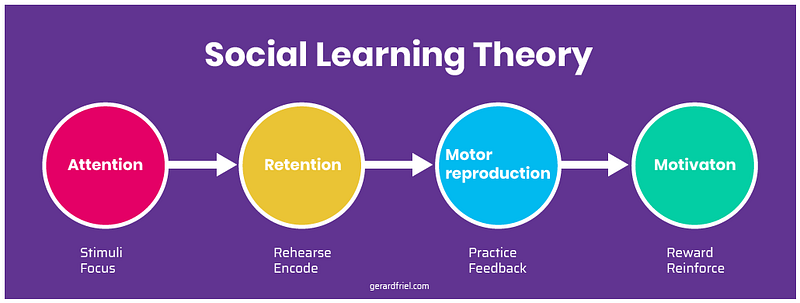
- Attentional processes — account for the information selected for the observation
- Retention processes — remembering the observed information so that it can be recalled successfully.
- Production processes — reconstruct the memories of the observations so what was learned can be applied in appropriate situations. Sometimes, the observer will modify the behavior to fit the context.
- Motivational processes — if an observed behavior was rewarded, the observer will be more motivated to reproduce it later. However, if a behavior was punished in some way, the observer would be less motivated to reproduce it.
Self-Efficacy
In addition to the observational learning, models can also increase or decrease the observer’s belief in self-efficacy to bring desired outcomes. When people see others like them succeed, they also believe they can be capable of succeeding. Thus, self-efficacy influences one’s motivations to perform various actions and one’s belief in their ability to do so.
Social cognitive theory can be dangerous or advantageous. It depends on us, how we utilise our media, how we choose our surroundings and how we impact others.
Thank you.