
Knowledge Brief
So You Think You Know Everything?
Think again!

I regard myself as mildly intelligent. That’s my personal assessment based on the fact that I can work through problems but generally fail at the final hurdle.
A really intelligent person gets to the end of the problem, and comes out with a hundred solutions. They might not be able to implement them because they are completely impractical and can’t unscrew a light bulb. But in theory, they can crack most problems. Even cryptic crosswords that I look blankly at before going onto the coffee break version.
I’m half intelligent, half practical. Which is why I work as a groundsman/gardener in rural France. I have a scientific knowledge of plants, but I also have a practical side to me that gets the job done.
That’s where I stand on the scale of intelligence (if there is one). But when you start delving into Wikipedia (and I’m using Wikipedia as a reference point, and it is by no means the definitive encyclopedia of human endeavour), it’s apparent how little I know.
The Wikipedia page I was looking at yesterday was about a novel I’ve just finished called “That Awful Mess on Via Merulana” (Quer pasticciaccio brutto de via Merulana en Italiano) by Carlo Emilio Gadda. It’s essentially a crime novel set in early fascist Rome in the mid 1920s. It’s a fascinating book, and I highly recommend it.
After reading, I naturally wanted to know more about the author as well as his contemporaries like Italo Calvino, Pier Paolo Pasolini, and Alberto Moravia. From there I wanted to know about 1920s Rome, Mussolini, and Fascism in general.
Before I knew it, I had a million windows open on my browser, not just Wikipedia entries, but obscure newspaper articles such as this one from Il Giorno.
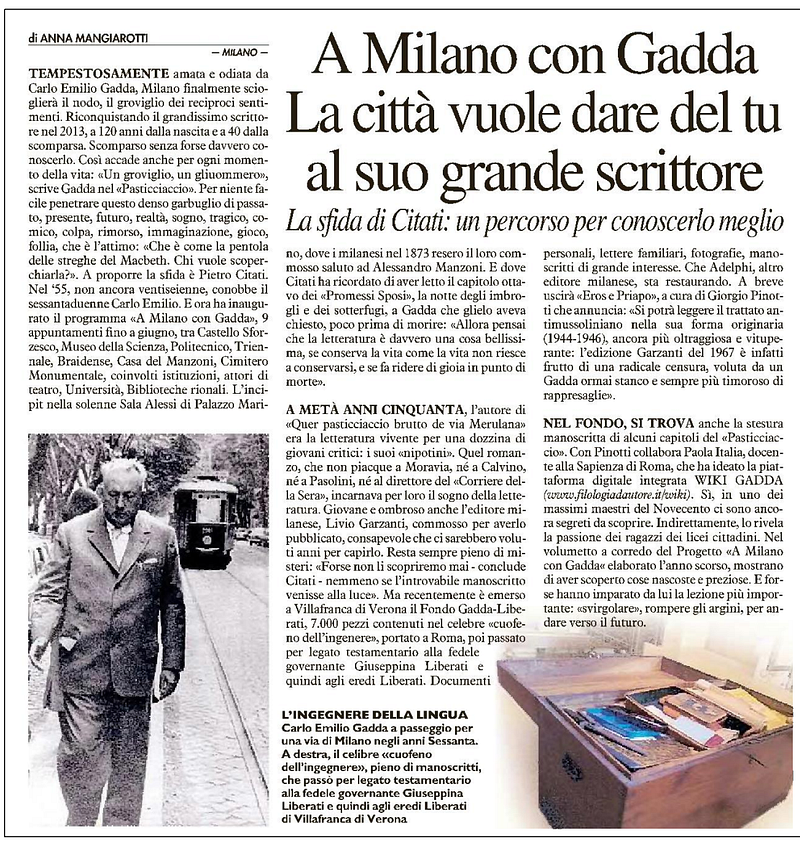
I don’t even speak Italian, but I got the gist of it through my knowledge of French and Spanish.
Point is, once you start drifting through the endless reams of human knowledge, you feel yourself becoming smaller and smaller as you get overwhelmed by the sheer number of people, ideas, places and theories you never knew existed.
Sometimes I have to shut it all down, go to my window and say “Shit, where did all these people come from?”
Then I go back and read some more and be fascinated, until the overwhelm starts again, and I have to go and stand by the window again, and say “Shit, I never knew that book existed.”
And the cycle is repeated until I’m full of knowledge and I have to lie down or take a long walk to try and digest what I’ve just learned.
Yesterday, it happened to be early 20th century Italian writers. Tomorrow it might be early 1990s English footballers. This is a subject I know more than anything about as I was brought up on the sport. But occasionally, there’s a story I’m not familiar with.
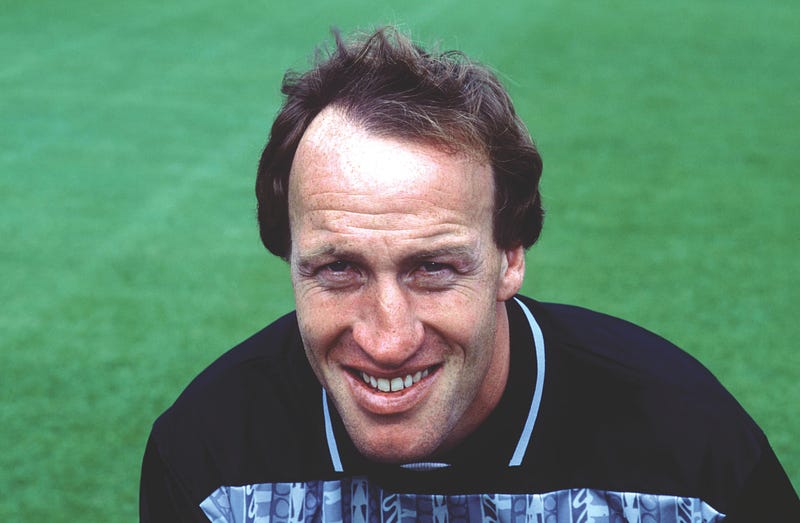
Like Steve Ogrizovic for example: The ex Coventry City goalkeeper — whose father Nikola was a Serbian prisoner of war during World War II — not only played professional football, but also played professional cricket. Furthermore, he started his football career in Chesterfield where I grew up, and before playing football was a policeman. Finally, his nickname was Oggy. Just like mine.
Fascinating! But how much can you learn? Or is there a limit before your brain becomes overloaded with garbage like a computer disk when it reaches capacity.
At pub quiz nights I can pull obscure facts out of the hat, especially questions on football, geography and historical dates. But I can’t remember everything, there’s just too much.
One may argue, therefore, that it’s pointless learning stuff if you’re only going to forget it. Why not consolidate and remember the stuff that’s already there?
Because learning is fun!
I love learning about stuff I didn’t know. It gives meaning to life, to know there are so many things I didn’t know, and that really I’m just one human out of billions who have lived on this planet.
And that one of those was Carlo Emilio Gadda. A writer who wrote two novels, and never finished either of them…
(true)
Thanks for reading, for more unfinished business, check out