
So You Signed Up for Medium, Now What?
A 3 pronged approach to creating an effective content production process for novice Medium writers

I decided to get serious about my writing in Jan. 2021. Having spent the past year wallowing in my isolation or gazing out my window as I pondered over book idea after book idea, I decided it was time to cut the crap.
I’d picked up blogging on Medium a few months before my official return to the site, but had only released a few pieces. None of which had gone anywhere. Needless to say, I knew I’d have to make a few changes.
For one, I’d have to stop writing things that only I would want to read. For me, an audience of one was equivalent to having no audience at all. For two, I needed to find a niche that I was comfortable writing in.
And three, if I was going to be successful on Medium, I’d have to come up with a system for content creation that worked. At the time, I thought this would be my easiest task. I’ve worked in content production in some capacity throughout my career, and thought to myself: “surely I’m prepared for this.”
“Plans are nothing; planning is everything.”- Dwight D. Eisenhower
I was wrong. Creating an efficient content creation process that allowed me to produce valuable content on Medium turned out to be one of the hardest things I’ve ever had to do in my writing career.
Now, a few months after my ordeal, I’m ready to share my story and explain how those who find themselves in a similar predicament after signing up for Medium can make the most of their account using effective content creation strategies.
Here’s my approach to creating content.
Phase 1: Ideation

Phase 1A: Thinking
For many, this is the hardest part of any content creation. The very nature of ideating requires quite a bit of mental gymnastics. When you ideate, you’re plucking an arbitrary concept from obscurity and molding it into something that you hope will be equal parts impactful and interesting.
Simply put, coming up with a great idea requires a great deal of thinking. So much so that you might find yourself agonizing over one facet of an idea to the point that it becomes moot, useless and insignificant to your final big idea. In this case though, I’d argue that the journey to discovery is as valuable as the discovery itself.
Pay close attention to the “errant” thoughts you have while contemplating a certain thought or idea. If your initial idea is to write about golf, make note of the first thing that comes to your mind when you think of the sport. Is it golfers, clubs, something else? These notes may seem arbitrary now, but give it time.
You may find that their true purpose leads you on a completely different path then you planned. Suddenly the story about golf is now a think piece on the conversations men have on the golf course, or maybe even a feature story or one golfer who you know personally. Or, why not both.
Pro tip: It may be useful to watch or read something out of your preferred genre if you’re struggling to come up with new ideas. If you typically use works of fiction for creative fodder, try watching a documentary on potato farming or some other “dull” topic. Sometimes a change in scenery can be just the thing to get you thinking about new topics, or in this case, help you realize how much you hate documentaries.
Phase 1B: Condensing
Once you’ve got a few ideas down somewhere, the easy part is done. You’ve successfully ushered a few potential story ideas through the clutter over your brain and onto the confines of whatever notepad or word doc you have in front of you.
Now, take a look at each idea you had and ask yourself the following: Can I find enough information to write a compelling piece about this topic? Is this topic too broad? And if so, can I condense this topic into more than one article?
“One idea lights a thousand candles.”- Ralph Waldo Emerson
I know, I know. You barely made it through the arduous task of actually coming up with an idea, and now I’m asking you to condense it even further?
Well, hear me out. Though the task of condensing your ideas certainly won’t be easy, it’s a necessary step in the content production process and one that will save you tons of time down the line.
For instance, I knew that February would be a great time to write about Black issues and ideas, and so I framed potential article ideas around this umbrella concept of “Blackness” and rejecting the idea that the Black experience is a monolith.
In order to do this, I knew I’d have to present stories about Blackness that were multifaceted and diverse. My writing niche is media and literature, so I figured what better way to push back against the perceived monolith of Blackness than by introducing readers to different Black characters in books and media that subverted this narrative entirely.
An important takeaway here is the use of “opposites” as a method for content ideation. In this case, I came up with the idea to do a story on 5 of the Best Black TV Heroes on TV Right Now, then developed an inverse piece called 5 of the Best Black TV Villains of All Time to make a set. Think about how the ideas you developed might manifest in alternative ways.
If you’re writing about the benefits of fruit, then also consider what a piece about the negative impacts of fruit might look like. If you’re writing about the sun, could you also write a piece about the sun?
You can probably come up with a direct opposite for most anything you decide to write about. Just don’t be afraid to give these alternative topics some credence as well.
Pro tip: It’s ok if your ideas don’t always land like they should. Think of your earlier ideas as experiments and tests before you hone your strategy. My Black TV Heroes and Black TV Villains stories did terrible financially, but they taught me valuable lessons about what does and doesn’t work when it comes to content on Medium.
Phase 1C: Keywords
My planning phase always culminates with research. This phase looks a little different for me depending on what I’m writing about. But I typically begin by inputting a few key search terms and words to Google.
Then I’ll use the Chrome Extension “Keywords Everywhere” (free and available on the Chrome extension site) to determine what key words and phrases I’ll go after for any article. Take a look at what keywords came up when I conducted initial research for this piece.
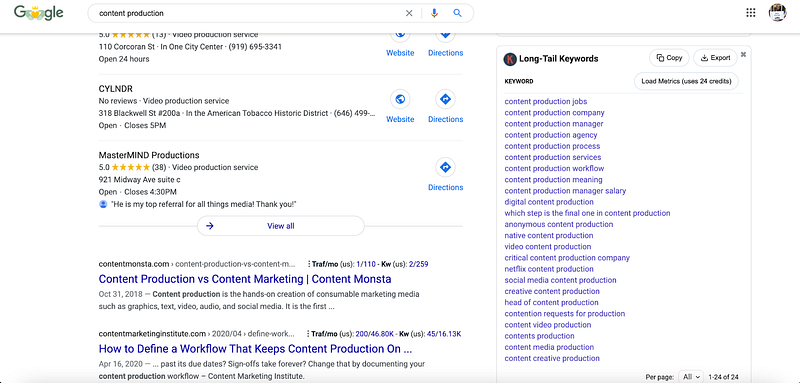
I work with different forms of content in my current profession, and have developed a good understanding of search engine optimization (SEO) as a result of my work. There are certainly better programs out there that you can use to help your articles “rank”, but I’m a huge proponent for using free tools whenever possible.
So if you’re interested in SEO and utilizing it to ensure that your article includes various search terms and inquiries, then I’d suggest taking advantage of some of the free SEO widgets out there. Here’s a few of the best rated online SEO tools to get you started.
Pro-tip: SEO rankings shouldn’t be your only measure of success, but if you get them right they can result in tons of increased revenue for your stories. I’ve seen everything from book reviews to #FreeBritney Medium posts make up the first three entries of a search engine results (SERP) page. So writing a ranked article on Medium is definitely doable.
Phase 2: Mapping

Phase 2A: Naming
For me, this next step is the most exciting. Once you’ve done all the work to actually come up with an idea, deconstruct it to form smaller ideas for other stories, and then also come up with keywords for each story idea, it’s time to name your creation(s).
I’ve never really had a problem with naming my work, except when it comes to longform content like short stories or manuscripts. But, I sympathize with those who struggle with this. Assigning a name to your work before even writing it is hard.
However, I’d argue that by coming up with a name before you ever put pen to paper you’re saving yourself a world of headache when it comes time to actually draft something up.
If you’re writing about hippies in the 60s and you title your work: “Groovy Man: The Psychedelic Happenings of Woodstock and Hippies from the 1960s,” then you know two things.
One, your work has to talk about Woodstock. And two, you’ve got to mention Hippies in the 1960s as some point.
In this way, a title can be used as a kind of marker to establish what you’ll say in your piece and how you’ll say it. Sure, you can always go back and rework your title to make it more punchy, straightforward or something else, but your title can literally guide your writing and determine where your story will go.
Phase 2B: Research
Many posit that your research stage is the most important step in your writing process. That being an adroit researcher can make or break your work in more ways than one. I disagree.
The way I see it, research is an essential step to any writing process, yes. But I find the thinking of first you research then you ideate then you execute to be too linear. I put the research phase here for the sake of keeping with my step-by-step format, but really I’d argue that research should be a continuous process.
I’m not saying everytime you hit a wall while writing that you should head to the library or dust off your old World Almanac. But what I am saying is don’t limit yourself when it comes to research. My research phase is always two-pronged.
First, I’ll do a quick Google Search for my topic shortly after naming it, and then write a shell of my piece for later use. Then, once I start writing, I might skip around and write sections of the piece that I know well, then head over the internet to do some more web surfing, and even find a book recommendation or two.
I realize that my process might not work for everyone. Some writers find comfort in regulating their research to one specific session, while others gather information as needed while working.
I think the biggest takeaway here though, is that it’s important to find a method that’s balanced. Producing content for Medium consistently is demanding work, and so it’s important that you establish sustainable practices in all aspects of your writing process.
Pro Tip: I wrote a story in February about Gorilla Glue Girl after stumbling upon her story during an aimless Google search. I jotted down a few notes then, and went back to research once I had a clear idea of what story I wanted to tell. To date, this story has remained my top performer, surpassing any of my new or older works for the past month and a half.
Phase 2B: Input
Most people might get some kind of gratification from the physical act of crossing off an item on their eternal to-do list, but for me I’ve always found pleasure in the actual act of creating a to-do list or mapping out how I’ll complete something. And that’s what the Input phase is all about.
Once you’ve come up with a concept, distilled that concept into multiple stories, then fleshed out each, now you’re ready to get even more granular. At this point, you’ve probably come up with a goal to get up a certain number of stories per day, per week or each month.
This means you’ll probably be working on multiple pieces at once, so you’re going to need some kind of content production tracker or a way to keep tabs on your progress with each individual article. Enter the Matrix.
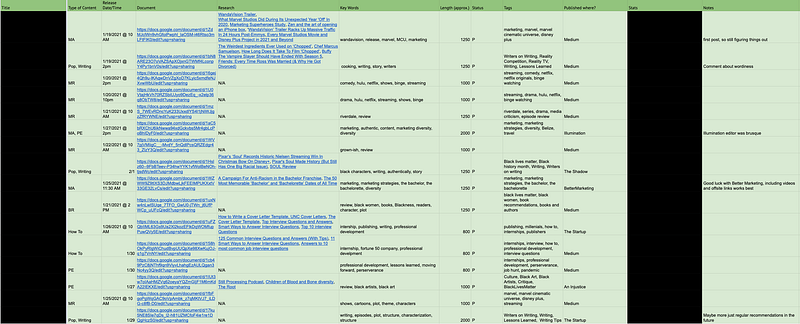
The Matrix is my version of the ultimate content production master tracker. It’s a melange of production tools like Asana, Trello and good ole Google Sheets that’s helped me stay organized and meet deadlines. Here’s a step-by-step walkthrough of how I use my Matrix during this phase.
- When I first come up with a name for my piece I’ll put in the “Title” column
- I’ll head over to the “Type” column to come up with a content tag for each of my stories. Here are the tags I use to categorize each story:
- MA: Marketing
- MR: Media Review
- BR: Book Review
- Pop: Pop Culture
- PE: Personal Essay
- How To
- Writing
3. I’ll put each of the key words I came up with in my Keywords step and then input them into my “Keywords” column
4. I’ll come up with a few Medium specific tags and put those in the “Tags” column
5. I’ll write an expected length for a piece in the “Length” column
6. I’ll finish by jotting down a few “dream” publications that I’d like to get this work published in and write those in the “Published Where?” column
Note: I keep these publications italicized until the piece has actually been accepted by them. If/when they are actually published/accepted, I’ll go back and unitalicize each publication name.
After this first pass, I’ll go through and update the Matrix as I work on and complete pieces. I have a key in place to represent each phase of my content process that any piece may be in at a given time. Here are the 5 keys I use to monitor my pieces:
- GDC: Google Doc Created
- RC: Rough Copy
- LL: Last Look
- S: Submitted to Publication
- P: Published
Pro Tip: I’d recommend “Freezing” the first title column of your sheet through the “View” dropdown. It makes it so much easier to input data and notes as you’re working.
Phase 3: Evaluation

Phase 3A: Stats
Once you’ve written your piece, published it and had a celebratory drink or to, you’re ready for this last step. As important as it is to actually follow through and finish something, it’s equally as important that you take time to reflect on your work once it’s complete.
My reflection periods typically last for about two weeks after the end of the month. During that time, I’ll work on new pieces for the month, or study up with a Masterclass or two. But I always set up some time around the 15th or 16th to go back and review each piece I wrote for the previous month.
This doesn’t mean going back and reading over every published piece for grammar, word choice or any of that. Instead, I go back and take note of anything, well, noteworthy on each of my published pieces.
I’ll jot down what readers highlighted the most, responses I received, claps, read time ratios. Basically anything that can shed some light into how readers interacted with my content is important to me.
All of this information is then recorded in the “Notes” column of my Matrix, along with earnings for the month. These notes will help me plan out the following month’s content and guide my content strategy for the next month.
In February, I questioned if I should continue pursuing book/media reviews in future months, after my first couple stabs at them landed flat. However, I noticed an uptick in readership for my “branded” book reviews, or reviews that are inspired by the holidays in any month. This revelation led to the creation of two pieces, both of which continue to be high performers today.
Phase 3B: Repeat
Ah, the final step. At this point, you’ve got a few reps under your belt. You’ve crushed your content, exceeded your goals and even made a few adjustments for the future. Now it’s time to do it all over again.
“…Every repetition makes us better.” -Shahenshah Hafeez Khan
I schedule all pieces for the following month around mid-month. So if I’m planning for May, I might start planning my content on Apr. 15th. This gives me two weeks of prep to tackle writing in the coming month.
During this time, I’m also still working to get pieces up for the current month. And with a full time job and a part-time gig, Medium can seem like a chore.
This is especially true when you’re first starting out. In your first couple months, you might not have any loyal readers or fans at all. So pouring your heart out into a longform piece only for it to receive maybe 32 views can be disheartening.
But the important takeaway here is that if you are wanting to start writing for Medium. And I mean really start writing for the site, not just one or two posts whenever you’re in the mood, then you have to figure out your why.
Why are you writing? What’s the thing that keeps your fingers moving, gliding across the keys when you’ve got other more pressing things to do?
For me, it’s the joy I get from writing. From rolling an idea over and over in my head. Smoothing all it’s edges out until it’s rounded and ready to be dispensed from my head like a gumball from a machine. It’s the satisfaction I get from blending sentences together to produce something that might encourage someone to think differently, feel something, to be better.
That’s why I write. So before you get started with Medium, ask yourself what’re you doing this for? What’s your why? Because once you figure it out you’ll be well on your way to success on Medium and beyond.