
So Why Did You Come to Poland?
This is the question I’ve been asked over a hundred times since arriving to Warsaw in 2006 from the States, and I’m afraid I’ve never given a suitable reply. Sometimes I offer the ironic answer. I came for the job opportunities. It’s true, I received a fine offer to teach English at an international school. School budgets in America are in decline, the recession is forcing many professionals to enter the education pool thus driving up competition for even the most unsavory of schools. But abroad, an English teacher finds himself coveted. He does not have to worry over administrative shackles, meeting federal testing standards nor dealing with an entitled parent community. Nor does he have to worry about the metal detectors placed at the front gates, nor the industrial-prison atmosphere filtering the halls. No, the English teacher abroad needn’t worry too much over certification. Class sizes are more than reasonable. They fulfill a seasoned teacher’s fantasies. And the salary, relative to cost of living, is sound, not a struggle. So it’s more than ironic. It’s even pragmatic to say, yes, life is better in Poland than in the States. But that’s not the right answer to the question.
Sometimes I give the romantic answer and blur the lines between Poland and Europe as a whole. I retell a story of falling in love with Europe in the summer of 2005, when I spent three weeks in Berlin, Prague, and Kraków. It was Kraków that hit me hardest, from the moment I exited the train station. This was my first taste of accordion players hypnotizing crowds with Vivaldi in old market squares, my first taste of market squares, walled castles, aspiring church towers, cities constructed as odes to poetry with buckets of flowers marking each pathway into the burbs. I fell in love with the city and with a girl, and made vows to return in a year’s time. But why then did I come to Warsaw? Aha, here I have to shuffle my feet and revert to my original answer. Job opportunities. From romance to reality. And still I haven’t said all I want.
Perhaps I have a trusted ear. I can go into more personal details, like a divorce in my late thirties, a growing restlessness labeled by many a mid-life crisis. I can wax philosophical about my long contained fascination with all things Old World, the Prague of Kafka, the Florence of Dante, the invisible cities of Calvino, the Dublin of Joyce, and the Paris of American expatriates like Hemingway and Fitzgerald. The films of Bergman, the guitar folios of southern Spain, the fictional roads traveled by Don Quixote and Sancho Panza, a world for the mythological wayfarer, born in Athens, Rome, Alexandria, coming of age in Paris, Berlin, London, finding a ship in Glasgow and passage to New York where the dream paradoxically rejuvenates and dies. In America, assimilation kills the soul. While in Europe the lines are still drawn. Each nation sleeps next to his or her ritualized enemy, as Mars sleeps next to Venus. There is tension in Europe, history, volatile spirit, identity and conflict. And this is why you came back? We’re getting close, but not there yet.
Because the real reason I came to Poland can only be mouthed to a discreet audience. Those sensitive to the word pogrom. Those who can recount with melancholy the names Singer, Tuwim, Holoubek, Anielewicz, Edelman. Those with a compulsion for unkempt cemeteries and Friday evening chants. Those who hear the threaded sound of tears and laughter in every note of Klezmer. And those who perceive violins played from rooftops, and lift their heads to see no player.
And within that audience, the brow arches itself with the logical follow-up: you came to Poland because you’re Jewish? If I was part of a 14th century caravan heading East, fleeing a series of persecutions in Teutonic and Gallic lands, this question would make some historical sense. But to leave the promised land of America for Poland in the 21st century makes little. However, I’ve always been touched by a line of thought voiced by the American poet Walt Whitman:
Clear and sweet is my soul, and clear and sweet is all that is not my soul/Lack one lacks both, and the unseen is proved by the seen/Till that becomes unseen and receives proof in its turn.
So it goes that there is a specter haunting Europe (again!) and its presence requires proof, a visible coincidence. The many who walk the Polish terrain may not perceive the footprints joining theirs, those made by a millennium of Jewish existence. But those prints are clear and sweet, as is the absence of a people making them. That absence, due the inapproachable term “holocaust”, began to itch under my skin as the material pleasures of America spoiled and waned. So it goes, pursuing an exact answer to the original question, that I came to Poland for the holocaust. Even chasing it. The brow releases, the belly sighs.
I’ve been living in Warsaw for ten years. In that time, I have made acquaintance with the synagogue on Twarda street but my attendance to regular services has never taken shape. My search for Jewish identity has never been fulfilled in the company of Jews. Rather, with Goyim. And most significantly here, the Polish school children I teach in Kabaty. It is there that I feel my grafting into Polish society most natural and least like a memorial service. My students are very much alive and do not need prodding to bring up the “Jewish question”. It is through their presence that I’ve learned this question to be an eternal one, with no material solution.
The best questions lead to illumination. Here are some I’ve received from my students, ranging in ages from 10–18. The conversations that ensued cannot be included, for they would replicate entire 45 minute lessons, and if any readers happen to be my school administrators, I’d have to explain that I do sometimes teach English.
“Mr. Krasner, what is a Jew?”
“Mr. Krasner, is it true that the Jews are secretly ruling the world?
“Mr. Krasner, why are Jews so good at business?”
“Mr. Krasner, why are you not good at business?”
“Mr. Krasner, is it true that all Jews are smart?”
“Mr. Krasner, if the Jews are so smart, how did they manage to get almost all of themselves killed?”
“Mr. Krasner, why did your family leave Russia?”
“Mr. Krasner, is it true that Jews killed Christian babies for their blood?”
“Mr. Krasner, what is matza?”
“Mr. Krasner, why do Jews wear so much black?
“Mr. Krasner, do you celebrate Christmas?”
“Mr. Krasner, if your mother is not Jewish, can you still be Jewish?”
“Mr. Krasner, you’re not Jewish?! Why are we having this conversation?”
“Mr. Krasner, why did the holocaust happen?”
“Mr. Krasner, why do so many people hate the Jews?”
“Mr. Krasner, do you feel safe here?”
“Mr. Krasner, why did you come back to Poland?”
Aha — my students’ last question addresses the original one: why did I come back to Poland? It assumes I lived here before. So it must be this is where I’m from. And disregard the fact that my family actually emigrated from Odessa a century ago. It is not one branch of family I am tracing. It is the whole, the collective Ashkenazi existence, which like a veined tarpaulin stretched across all of Europe with heaviest sag in Poland, a tarp within a tarp, with prominent rents in Kraków, Łódź, Lublin, Lesko, Łańcut, Zamość, Tarnów, Włodawa, Białystok, Kock, Tykocin, Warsaw.
Warsaw. It made sense. I was after all attempting to rebuild my life from the rubble. And if one is tuned to the unvoiced voices, does not Warsaw speak loudest and piercingly clear? Kraków may be an aesthetic city, with a loose spirit, melodic Planty and medieval overtones. But Warsaw cries out. This cry I must have heard when making gestures of courtship to the vague Old World. Odd that it should have made itself tangible in the form of a faxed contract.
Now, if my questioner is unsatisfied, annoyed, or simple minded, and requires a concrete answer to this new question, why did I come back to Poland, I just deadpan, “For the holocaust!” Isn’t it obvious? Can you avoid this monolith and live here in peace? No, an American Jew comes back to Poland not merely to teach English and make contact with the Diaspora, but to explore as well the Shoah — and come to terms.
I imagine the most spiritually open of Poles goes through a similar process, waking up confused, not sure what is antagonizing his or her soul but forced in any case to dwell upon the phantoms of hardship, asking the question, am I accomplice or victim? Why must I, born in the aftermath, also be a witness? And while the Jew recognizes the role of history in his own religion, the need to process and categorize it, wonder at the consistency of exile and terror, and speak to God of these disquieting things, and wonder what it means to bear a covenant to a God that allows them to be (and wonder if there is a God at all listening) perhaps the Catholic’s primary endeavor is to absolve himself of the guilt having inherited man’s sinful condition. To forgive the unforgivable. Repent and love more fully.
Coming from either end, the goal is to restore one’s faith. Those who sense their faith broken, and find it impossible to live as such, go seeking. And seeking, encounter the timeless past. Do I tell people that I came to Poland for this? That I am seeking a broken cord and must somehow mend it? Is this conversation in passing? You see my problem. I tell them it’s the holocaust. That’s really it. That’s the reason I came back. It’s the most honest, concrete, direct and dumbfounding answer.
#
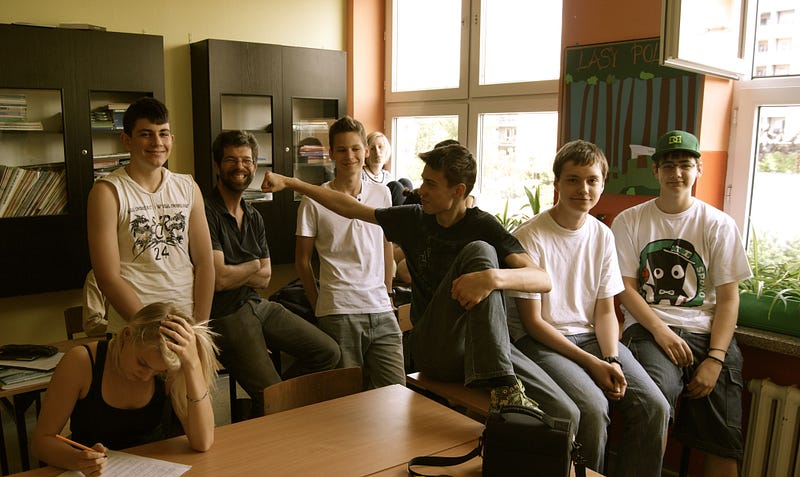
Now comes the point in time when the thing most alive in my life, my students, and that most dead, the holocaust, came to meet. It happened as the result of another question:
“Mr. Krasner, we never learn anything in school. Can you take us somewhere where we can learn something?”
The question was sprung by Ola, a scowling faced girl who sat in the back right corner.
“Like where? A museum?”
“No, that’s like going to school. Somewhere real. A city, a beautiful thriving city.”
“Like New York!” a second student cried out.
“Vienna!”
“Prague!”
“Berlin!”
“I know,” I finally jumped in. “How about Auschwitz?!”
Dead space.
“You want something real? You want to learn something?”
“Yea, but…”
“But what?”
“We get the holocaust everyday in our books,” a student moaned. This was Artur, a wiry and sardonic boy.
“Haven’t you seen the whiteboards when you enter the classroom?” he continued. “They’re always Hitler, Hitler, Hitler. Hitler this, Hitler that.”
“It’s not always Hitler. Sometimes it’s Stalin.”
“Great…take us to Siberia.”
“Auschwitz is closer. Listen,” I said, “you said you wanted to learn something. And it doesn’t seem like you’re learning anything studying the holocaust in your books. It happened in your backyard. How many have been?”
No hands.
“Really? And how many have seen films about Auschwitz, like Schindler’s List?”
Over half the class.
“So you get the holocaust everyday in books. And you get it every once in a while in film. But you’ve never experienced it in reality. Even though you live here.”
“How can we experience it?”
“I don’t know. We can’t, exactly. But it happened in reality, on actual land, in actual communities, in real buildings and chambers and we can experience that. Aren’t you interested in how regular everyday people could construct such a living hell? And inhabit it? It’s not a horror film.”
“It’s better to leave it as a horror film,” Ola said. “We’ll never understand how it happened anyway.”
“Maybe the point is not to understand.”
“Then what?”
“To feel.”
A series of moans.
“And both sides of it too,” I continued. “Because the killing and the being killed, both are human. Don’t you want to be human beings?”
“We are human beings.”
“I’m not so sure.”
“Mr. Krasner, I don’t understand,” another student interjected. This was Marta, a wizened 14 year old girl with shocks of long blond hair. “You want to take us to Auschwitz to become more human? I would think it would be the opposite.”
“Well, yes, on the surface. But if we ignore Auschwitz, if we just say forget it, it’s not mine, we become less human. Living in the present means also stepping into the past. Talking to your parents and grandparents about their lives, you guys do that.”
“No we don’t.”
“Well, you will. That’s stepping into the past. Walking through the old Warsaw ghetto, aware that the radio building near ulica Prózna was once a bunker during the Warsaw Uprising, that Plac Grzybowska was once a Jewish marketplace, that Hala Mirowska, where they sell flowers, was once the site of a world fair and also a Gestapo prison, that’s stepping into the past. When we set our feet into the past, we become more human because our consciousness grows.”
“I want to go.”
I can’t remember who said it first.
“Me too.”
“I’ll go.”
“I have a grandparent who died there,” Marta broke in.
“Really?”
“Yea, but I don’t know the whole story. It’s my great grandmother I think.”
“Was she Jewish or Polish?”
“Polish. She could have been Jewish. Who knows. We have her picture from the camp. In uniform.”
“I also have a grandfather who survived.” This was Mateusz. He was a laugh-happy boy who practiced hip hop steps between classes.
“You did? Did you ever meet him?”
“No, he died before I was born. I just heard about him.”
“What’s the story? What do you know?”
“Not much. My parents like to call him a hero. I should get the whole story.“
“Yes you should. There are many stories we should know. They’re out there, spoken, just waiting to be heard. They take place here, in our world. On this land, these streets. That’s how the past asks to be part of the present. And the present is much larger, much more dense than we imagine.”
The class was thinking.
“I’ve got some books we can read in preparation.“
“Noooo! No more books. You said we’re going to experience the holocaust.”
“Listen guys, I wouldn’t be a very good teacher if I didn’t believe in the experience of books. I’ve got some good ones in mind. A graphic novel actually.”
“A graphic novel?”
“A comic book. Lots of pictures. Is that acceptable?”
“Yes….”
“And some poems.”
“Noooo!”
“Just leave it to me. We have time.”
#
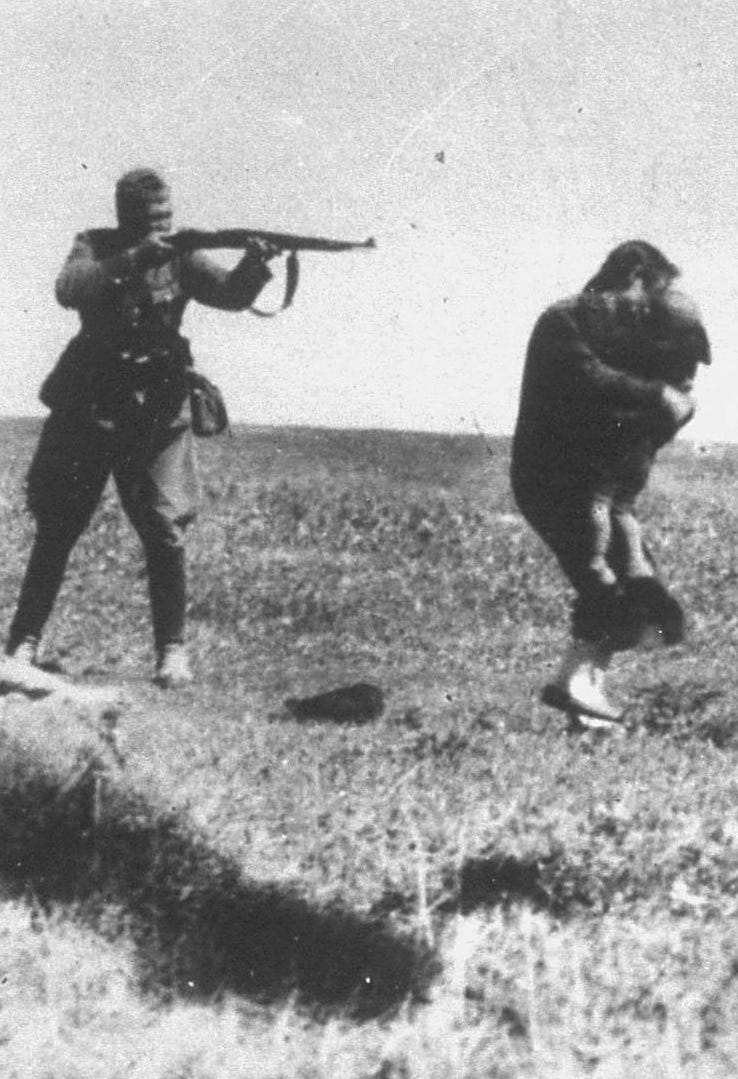
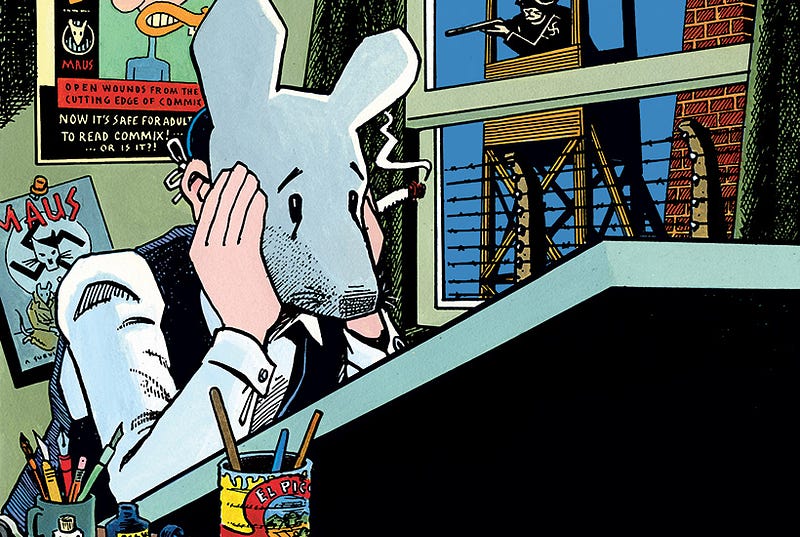
The book I chose for the group was Art Spiegelman’s Maus. We preceded the reading by comparing photographic images of the holocaust with equivalent cartoonist drawings. Some of the images were iconic: prisoners in their bed-sheet uniforms, standing gaunt and waif-like behind barbed wire. Heaps of human corpses. Hitler at the rostrum, virulent and wide-eyed, his right arm hoisted upwards in a centurion salute. The cattle wagons. The roundups. The selections. And most affecting, a Nazi soldier firing a rifle point blank at the head of a mother who cradles her child in an enveloping embrace. The photo is blurred and the backdrop barren. Its rectangular frame can be folded down the middle, so on one half we view man’s sadistic cruelty, and on the other a mother’s instinctual love. We have, in short, good and evil, or evil and good, and we see how they are mutually dependent. But the question arising from such a photo is how can the human character have the potential for such extreme contradiction? How are we at once killers and protectors of the innocent? Lions and lambs? Annihilators and creators?
Marta, my gangly Wiccan, said that the answer was in the photograph: we are simply men and women.
“Aggression and violence are traits bred in men since we lived in caves,” she said. “Giving life and nurturing the young are instincts for women.”
Her comment simplified things a great deal.
“So it is only men who have to worry over their evil nature?” I responded.
Ola quickly chimed in.
“There were plenty of examples of murder by women during the holocaust,” she said. “You think just men pointed them out on the streets?”
“That’s not the same as pointing a rifle into a mother’s head.”
“Why? In both cases someone’s dead.”
“Could you pull the trigger though? That’s man’s specialty.”
“I could pull it.”
“I’m not saying women aren’t culpable,” Marta continued. “Or violent. But they’ve got the best teachers in the world in men.”
“A female tiger will defend her cub better than a male.”
“Oh, tigers. I didn’t know we were talking about tigers.”
“Whatever,” Ola relented.
“And to settle this argument you two women will fight?”
“Yea, yea,” the boys hollered. “Fight. Fight.”
“Cat-fight!”
“Enough,” I said. “I think a point has been made. I’m not sure what.”
“I know,” Artur joked. “Women are just as violent as men, as long as they’re fighting other women.”
Marta laughed. Ola rolled her eyes.
“I don’t want to make this about gender,” I said. “The point is we don’t know exactly how any of us would respond during the holocaust. Once the moral rules shifted, and it became acceptable to round up and kill Jews, every person’s true nature was tested and exposed. This is a central theme in Maus.”
I had students form logs of “holocaustic” acts found in the book, ranging from the most despicable to the most laudable. Some entries on those logs:
A member of the Jewish community informs on his own people, leading Nazi officials to their hiding place.
A father sees his daughter and her family selected for the “wrong side” at a community round-up and decides to scale the fence separating them, thus condemning himself to her same fate.
A female kapo takes pleasure in beating the weakest of her cell block and assigns her the most physically demanding tasks.
A resourceful prisoner earns extra food for giving English lessons in the camp, and exchanges some for a uniform that will fit his friend more properly.
A group of Nazi soldiers liquidate a Jewish community almost literally, taking the crying children by their feet and bashing them like baseball bats into a brick wall.
A Polish woman risks her life by hiding Jews in her cellar.
Another takes up a Jew’s residence after the war, and when the original owner returns, having survived Auschwitz, has him hanged in the barn.
Spiegelman’s creative act seemed to leaven man’s mixed flour of violence and compassion. Here is a man who did more than just step his foot into the past. He was born to the past, as a child of holocaust survivors. He was raised by a father who might have tended to the young child’s tears by stroking his hair, or wiping his face, and revealing in his outstretched forearm his numerical branding — “holocaust — always, forever”. In writing and drawing his father’s story, he became intimate with every last detail of the Nazi death factory. He also had to face the objective portrait of his father as a miser and racist. He had to face and resuscitate his mother’s suicide, and the blame he placed on her for sentencing him to his own camp. He had to give life to all this negative energy. And this was a teaching I wished to pass on to my students.
At the end of the unit, I speechified a bit.
“There is a karma to the holocaust and a danger in stepping into its swirl. But it’s a danger we must face if we are to deepen our own nature. And at root in that nature, regardless of our capacity to love and hate, is our capacity to create. Maus affirms life, and in it, the holocaust is a life giver.”
I wasn’t finished with this exercise in creative transformation though. I had one more task for the students. This I saved upon entry to the camp.
#
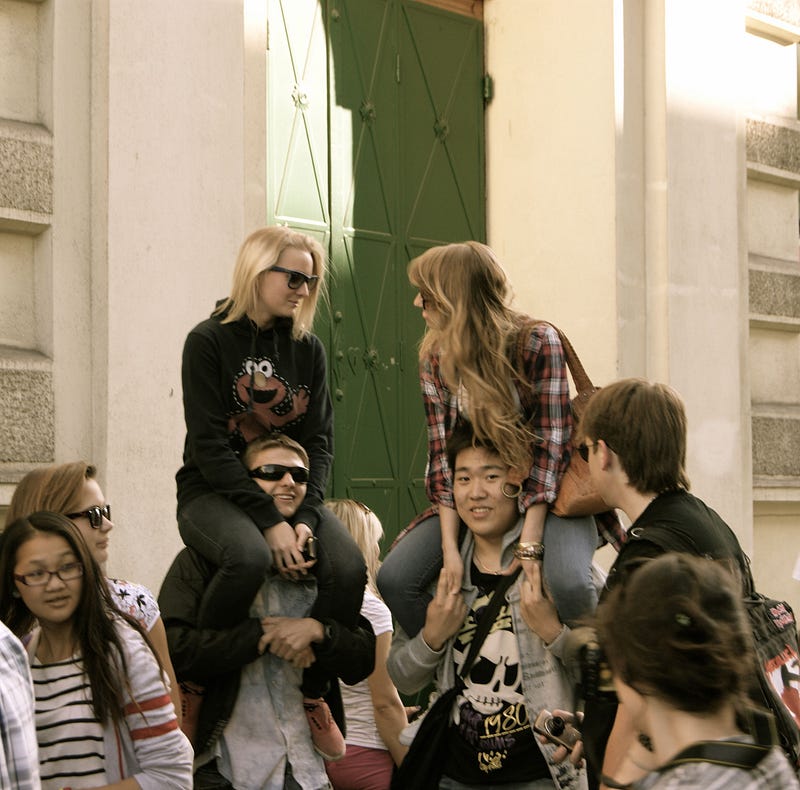
30 students joined the trip. Most of my 9th grade attended, with some notable exceptions, including Ola. The date was set for late May, when schools loosen their grip on students, much as cocoons can no longer withstand the wriggling energy of the butterfly. We had a healthy mix of 14–18 year olds and stayed overnight in Kraków. The students felt the special energy of the city immediately. We strolled the Planty and smelled the scent of flowering lipa trees. Some students rode the shoulders of boys and I felt no need to direct them down this path or the other. We climbed the statue of Mickiewicz. We walked aimlessly. When the trumpet alarmed from the top of Mariacki, I asked if anyone could see the player. None could.
Then the melody aborted itself and I asked if the students knew why.
“Of course we do Mr. Krasner,” Marta answered. “We know our Polish history.”
The hourly Krakow anthem ends abruptly in memoriam of the 13th century trumpeter, who legend tells was struck in the throat by an invading Tatar’s arrow while sounding the alarm.
Marta’s comment reminded me that I was the one in unfamiliar territory.
#
The next morning, after a sleepy bus ride through the hillsides of southern Poland, we arrived at the town of Oświęcim. The students perked up at the camp entrance signs.
“We’re here guys,” one said.
They rubbed their eyes and straightened up. Once parked, the group collected sheepishly underneath two trees and waited while I secured our tour. When I returned, I brought them closer together. It was clear I was going to give a speech. They shook loose from their casual demeanors. Speaking and hearing my voice in turns, reckoning myself an unfit authority at the gates of Auschwitz, I asked them to try and remember that the holocaust was an experience, not a place, and for most people who entered these gates, their last experience.
“It’s with those people that we can open up to while we walk the grounds today,” I said. “Or perhaps that is the effort — to make a connection between us and them, between now and then.”
I pulled a slip of paper from my pocket and asked the group to listen. The poem I had in my hand was one we read in my 9th grade class. It was by Tadeusz Różewicz. My students recognized it. But to hear it at the gates of the camp, amongst the birdsong of the surrounding trees, was quite a different thing than from within the walls of a classroom.
Leave Us
Forget about us
Forget our generation
Live like humans
Forget us
We envied
Plants and stones
We envied dogs
I’d rather be a rat
I told her then
I’d rather not be
I’d rather sleep
And wake when war is over
She said her eyes shut
Forget us
Don’t enquire about our youth
Leave us
After a pause, I asked if anyone wished to leave. No one replied. When I read this poem in the confines of the classroom, most of my students were of the opinion that the speaker was right. We should live our lives and not be burdened by someone else’s sorrow. What good can come of it? What can we do for them? Mateusz’s grandfather, or great-grandfather, did not speak of the war. He did not want to burden his children with those memories. He did not want to darken their sun. And yet we come to Auschwitz in droves, the scene of humanity’s great eclipse. Was it only ghoulish fascination?
I dropped a pile of red envelopes into the dirt.
“Inside each envelope is a poem. These were written from children interred at Terezin, a camp outside of Prague. The camps may be different, but the experiences were kin.”
I had the students select a poem at random and emphasized that it was written from someone much like them — a teenager who had life out there in front of him or her, much as they do now, but due a turn of fate had that life squeezed til it wasn’t life anymore.
“Still, the child wrote poems,” I said, “and they seem magical spells now. These poems were voiced to be heard. They’re not complete until heard. And so you have the following task: to keep your poem with you while we take the tour, to find a quiet place somewhere within the gates, to sit alone and read your message. In this way, time travels. This person living then, his or her soul, is preserved in this red envelope. When you open it, it becomes part of yours. There is no separation between us and them. Really.”
Each student was eager to reach for an envelope. Many had to be restrained from opening them immediately. In fact, about five minutes later, still waiting for our tour to commence, I watched helplessly as a group of 8–10 students sat on the shaded benches and tore into their envelopes like Christmas gifts, reading the poems in a cursory manner and trading them with others. My first reaction was to govern their actions, to make this an enforced task. You must be alone. But how quickly I had forgotten my own maturity at the age of 15 or 16. Would I have had the courage to sit adrift my clique and share a private moment with this dead soul? Would I be able to process the teacher’s instruction, that the soul is living? That it is in fact me?! I breathed a sigh of relief and returned to my less grave self. Let them be. Maybe by focusing so much on them, I was ignoring my own reception of the dead souls….
“Mr. Krasner?”
“Yea?” I was approached by Gosia, a bouncy straw haired girl, one of my more silly students.
“There’s one poem left. I accidentally chose two. Do you want it?” She handed me the envelope, already opened.
“I opened it. But I didn’t read it.”
She pranced off to be with her friends. Our tour guide came at this time and made to greet us. I tucked the poem away in my pocket, eager to read my message later in the day.
#
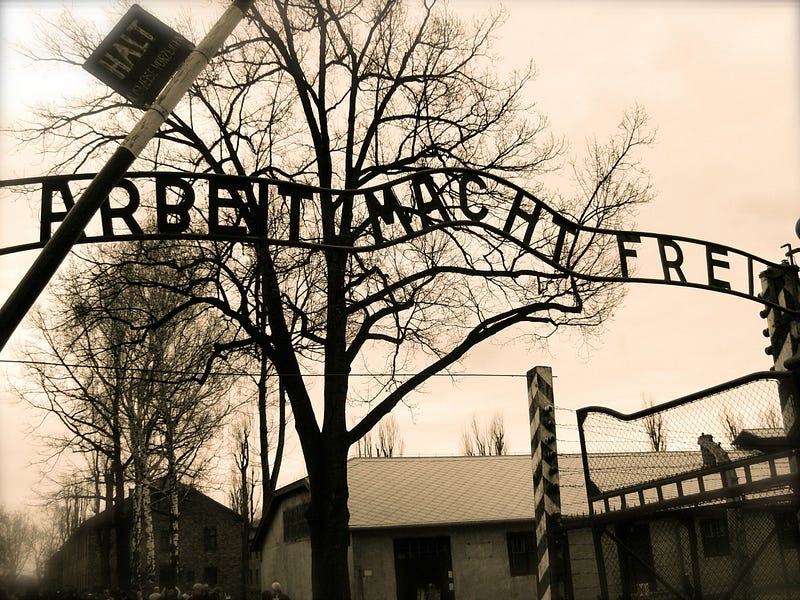
We collected outside the infamous “Arbeit Mach Frei” gates amongst a few other swarms. I noted the irony of these groups, all conforming to their own language and ethnicity. Each keeping a healthy distance from the other, each walking in a stunted conformity, heads bowed or swiveled. The silence. Our guide, a slightly built woman, had a softened but steady voice. She spoke with a tinge of weariness, occasionally veering into indignation, and led us skillfully through the cell blocks, avoiding those with overflow. In the first block, my students were shown displays of the camp uniforms as well as confiscated prayer shawls. They observed the kapo’s quarters, the washroom, prisoners’ bunks, and intimate drawings of the happenings within each room. Gosia commented that the drawings were something like Art Spiegleman’s cartoons, more affecting than photographs. In the hallway, we witnessed the wall of photographs taken of the prisoners as a sign of registration. So much for Gosia’s comment. She was glued before them, much as the others. We learned that the Nazis could not maintain this depth of accounting throughout the war and abandoned the photos for the tattoo’d numbers. Marta approached me with a kind of flickering light.
“So my great grandmother is here somewhere.”
“Somewhere.”
She inspected the grid of photos but it was impossible not to get stuck on the expression of one, and linger for a while before her. Then another. Then another. How long is proper to address each? Why do I look at this one, but neglect the others? The rows unwound like wallpaper. After a while I had to turn off my attention and glance at a forehead here, lips here. And then the features blurred, the stacking of individuals overwhelmed, and I had to dilute their personalities, their hints, their lines of genealogy. By the wall’s end, with students filing out into the light, it seemed that we were meeting the photos in passing, much like the accountants who made them.
We were led to the next display. But Marta remained a long time searching.
It was hot in the May sun. The group had to squint its collective eyes while standing in front of each cell block. We made it to the torture chambers, where prisoners only had enough room to stand, and in some cases, bend over. We were given a few seconds to pause before each, then the line continued to plod, much like cattle towards its predicted destination. We again returned to the light of day and in the direct sun viewed the execution wall. Our guide informed us how this part of the camp was shielded from the view of other prisoners. Some of the students approached the wall and touched the bricks. Other tourists posed for pictures in front of it. A student approached me. It was Mateusz.
“That’s just wrong,” he said.
“What can you do?” I replied.
“And they’re smiling.”
“I know. It’s a historical place, like the Roman Forum.”
“It may as well be Disneyland.” He walked away confused.
In another block we were given a statistical perspective of the holocaust, with a wall length map showing all the camps of Europe with interconnected arrows and migratory paths dated and assigned numerical values. All roads led to Auschwitz, a melting pot to rival Manhattan’s Lower East Side. My analogy was affirmed by the display of a massive urn in the room’s center, filled to the brim.
“How many died here?” a slightly aloof student asked. “Like 200,000?”
“A million or so,” I replied.
“Oh.”
While being led out, we passed an enlarged photograph of a forlorn mother and child having exited one of the cattle cars and marching with their baggage in hand. Our guide gave us precise information about the mother, as the photo was identified and confirmed by a descendant.
“She was from Slovakia and came close to the camp’s liberation….”
“Does it really matter?” another student approached me with a low voice. This was Janny, a high-strung boy who was showing signs of irritation, anger. Later, after being shown the heaps of hair, glasses, shoes, baggage, and Zyklon B cans, he asked if we could leave.
“I have a stomach ache.”
“You can wait for us outside the gates if you like.” He held onto his stomach and groaned while a close friend tended to him.
“No…” he reflected, “I’ll continue. But I need a break.”
#
We made it back to the waiting area outside the camp and had a short respite before being driven to Birkenau. The students were wilted. I told them that this would be a good time to eat a snack, but none were hungry.
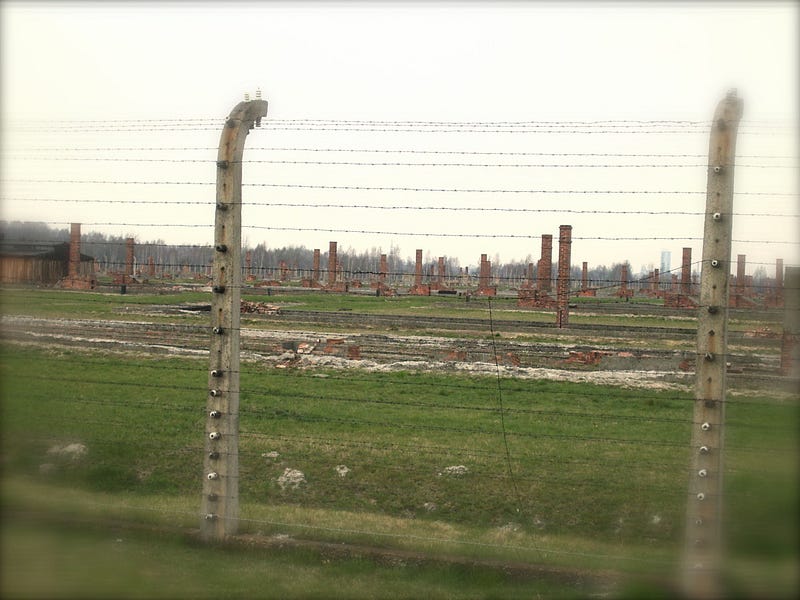
In Birkenau, we gathered a second wind. Playful students raced from our buses to the iconic entry. Some took pictures of the rail line’s lonely approach to the gated entrance. Inside, we immediately noticed the contrast in space. No longer compacted into thin halls and keeping to a suburban set of roads, here we were washed over by a vast green landscape, spiked with the eerie duplication of skeletal barracks. In massive patchworks, the narrow columns of decimated chimneys stood in uniform attention, much like masts to frozen ships. The neighborhood streets were replaced with wide grazing fields and a borderless avenue that split the camp into its two genders. The blocks became stables, built hastily, with cracks between the roof and walls, which our guide emphasized had tragic effects in the harsh Polish winters. Simple wood planks, row after row. Try to imagine, she spoke, close to 200 people sharing this room. Many with infections, many with typhus, lice, wearing the same underwear as from the day they were dropped off. Try to imagine the relationships fostered here, the kind of person you would become.
Artur, my lanky and sarcastic student, stood next to me. He turned to me in confidence.
“You’d be a rat,” he whispered in reference to Maus.
I nodded. Then we were taken to the adjacent stable, the public urinal and washroom. Again we were painted an image by our guide, asked to conjure the stench of this room, the open sewage and lack of ventilation.
We returned to the wide avenue and marched to where a single cattle car remained as a goad to memory. Here was the selection point, made more queer by a displayed photo of a Nazi Lieutenant, at this exact spot, assessing with a passive eye the feeble line of subjects that stood before him. His hand was pointed to his right. Our guide gave resonance to the acuity of suffering those people experienced on this ground, at this moment, having just lost their homes, their trusted family bonds stretched and torn, having survived days on end in the windowless, waterless, and airless wagons, with no succor for the wild anxieties taking hold their brains, all the while in some cases having to remain sane for the little ones at their knees. Then released, then groping for air, then restoring for a brevity a sense of life, only to be prodded forward to another station and judged fit to live or die. The people could never know what awaited them. To the left, prolonged labor until starvation or sudden death. To the right, perhaps more generously, immediate strangulation in gas. So here families, joints already tested beyond natural limits, were torn as limbs from a heifer on the slaughterhouse floor. Our guide did not impart all this. She was spare in her chosen details.
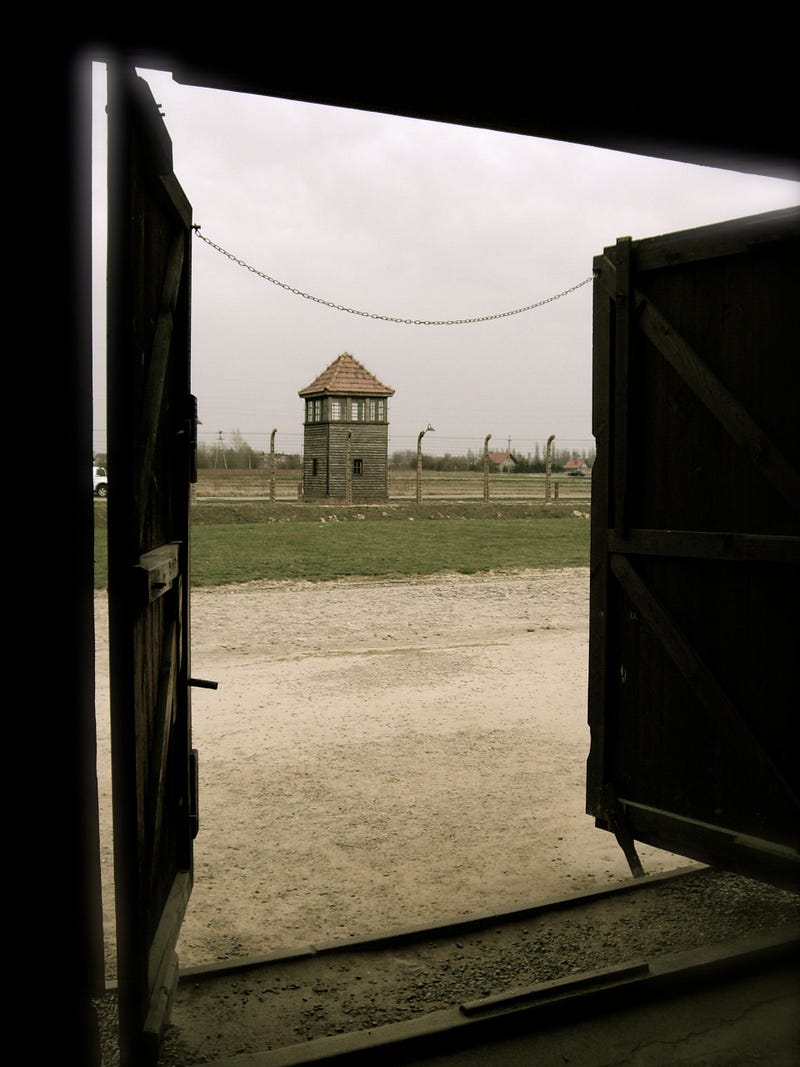
“So this is where Vladek and Anja stood,” Gosia said, thinking of Maus.
“Yes.”
“You remember how Vladek got a job fixing roofs so he could be closer to Anja and speak to her?”
“Over there somewhere.”
“It’s impossible to imagine,” she said. “There’s nothing left.”
Our guide rousted us a final time and led us on to the final sight: the blown up crematoria. We walked sluggishly up the condemned road, mostly unclustered. Artur, walking with his head to the ground, caught up to my pace. He wanted to say something.
“Mr. Krasner,” he started, “I’m worried. I don’t feel anything.” He spoke with a kind of indifference that is both cynical and self critical.
“Yea, I get that.”
“What am I supposed to feel? Sadness, guilt? Revenge, compassion, what?”
“Maybe all of it. Maybe nothing.”
“Great,” he said with a sigh of nihilism.
“It’s hard to feel,” I added.
“So am I a bad person or something? I mean, torture chambers, execution walls, horse stables. It’s like ideas stacked on top of one another. I don’t sense what was actually here. It needs to happen again.”
“Don’t say that.”
“Why, it’s true. It will keep happening again and again because people can’t feel.”
“You’re a wise boy Artur. Have you read your poem?”
“Not yet. I’m waiting for a proper moment. I’m going to read it alone.”
“Maybe we can talk more later then. We can talk more about it.”
“Yea.”
We walked some paces in silence.
“Mr. Krasner?” he rejoined to better finish. “You know, there are kids texting their friends and playing games on their iPhones. I’m sure they feel a lot.”
I just gestured. Who knows.
#
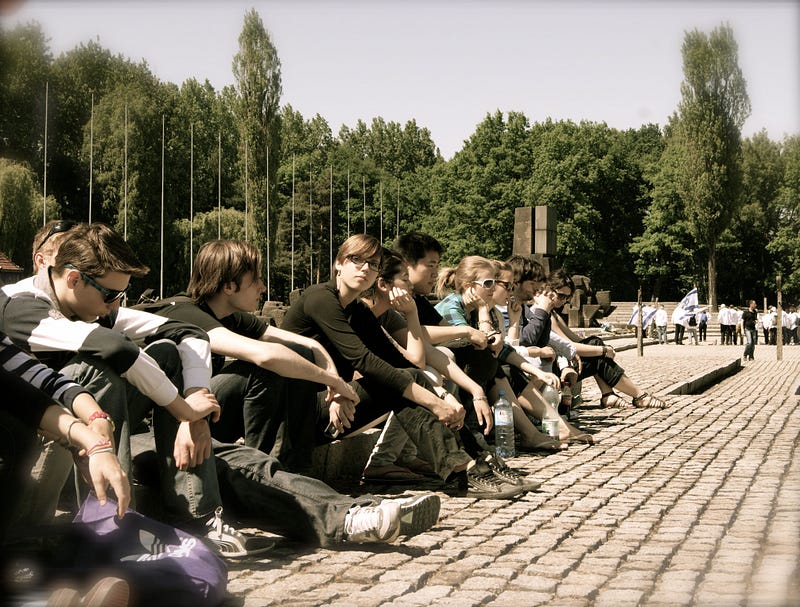
At the end of the camp, seated in a long row by crematoria 1, our guide gave us some final words, heartfelt, resigned and ethical. She was about 40 years old, a mother and resident of Oświęcim. She thanked everyone for coming and asked if there were any questions about anything on the tour. One of the students, a brash and bony 11th grader named Marcin, asked what it was like to live in Oświęcim.
“Very hard,” the guide said. “This is our legacy. Sometimes you want to ignore it, move on and forget what happened. Then another survivor visits the community and shares with us his or her story, adding more details, and the history becomes more real and human. It’s something that must be pieced together.”
“And what happens when the survivors stop coming?” Marcin asked. “Will you still continue?”
“That’s a very difficult question. It’s like passing a gravesite on the side of the highway. When the families of those buried have all moved away or are no longer alive, it’s just a collection of stones. Nobody visits and the stories vanish. But this is not just any gravesite. It’s cliché perhaps, and you’ve all heard it by now. If you forget the past, you’re bound to repeat it. And this is something we can never repeat.”
Marcin relented further questioning. I looked over at Artur to see if his expression showed anything. It was blank, here and somewhere else. All the students were gazing off into different directions. Some gave the guide their most earnest attention, as good students, while other held their hair, and others still dipped their heads into their bent knees.
“It’s important that you came, at least once in your life to come here,” she continued. “And I’ll still be doing this, likely throughout mine. I don’t know how many generations it will last.”
With that we thanked her and watched her go on her way. Many students rolled onto their backs. The air between us loosened. The regular cliques formed, some students standing and creating shadows for the others. We became sociable, generally fond of each other, and grew eager for lighthearted conversation. The red envelopes came out. With the exception of a few students, including Artur and Marta, the students read their poems shoulder to shoulder, again passing the sheets on as soon as finished. But something was happening. One student, a congenial boy named Antoni, was curled on his back, his head in another student’s lap and his iPhone out shielding his eyes from the sun. I came closer to him and saw that he was typing a lyrical response to his poem. He read his lines enthusiastically, inventing as he spoke. The iPhone went around the circle and Antoni perpetuated his rhymes aloud, searching for words.
Marcin handed me his poem with a casual air. It contained the lines:
The wind sings songs of far away
Just look to heaven
And think about the violets
Listen!
Now it’s time.
“I can’t imagine it,” he said. “She was probably hearing gunshots.” I took the poem from him and looked it over again.
“Time for what?” I asked him. He shared my glance down.
“For death. What else? The wind sings songs from far away. Look to heaven. Think of violets. It’s time.”
“Maybe it’s time for something brighter? An escape?”
“You’re too romantic Mr. Krasner. It’s time for death. That’s all that was here.”
“It seems. But she was here and she had a soul. She did not speak of death, even if that’s what time it was. She spoke of things alive, either in her imagination or in reality. She made a call. She was bigger than death.”
“I’m not so sure. Death was bigger than her. She could not escape it.”
“None of us can Marcin,” I said. “And anyway, she’s here now.” I gave him the paper back. He had more to say, but nothing came out.
“Maybe,” he said.
I continued moving through the groups. I passed Sebastian, a 16 year old boy who would qualify as the class Goth. He wore heavy metal t-shirts and had a talent for writing grotesque stories. But under his scowl, he was tender. I asked him about his poem.
“What poem?” he said in his monotone.
“The one in your pocket.”
“Oh, I’m waiting. Too many people.”
“Good idea.”
“I don’t understand why anyone would write a poem in these circumstances. It makes no sense.”
“But they did. So it has to make sense. It wasn’t a school assignment.”
“How do you know? Maybe it was.”
“Well, they did form schools in Terezin so maybe it was.”
“See.”
“That still doesn’t explain how they wrote them. Nor what’s inside them. I don’t think any of these sound like assignments.”
“Maybe,” he said with his surface glum.
“So you’ll let me know what you think about it?”
“Think about what?”
“Your poem.”
“Maybe.”
A few paces away I found Marta still holding her poem and working with it. Marta did not have to be given context to the writing of poems, even in such dire circumstances. She was a poet herself, a dark one, and loved good difficult verses above all else, though she pretended a stoic temper. She passed me her paper.
“Read it,” she commanded.
The poor thing stands there vainly
Vainly he strains his voice
Perhaps he’ll die
Then you can say
How beautiful the world is today
“Beautiful, he says beautiful,” she said as if working out a problem. Then she sighed. “It’s amazing.”
I studied the fragment. At first I was disappointed Marta received what was the shortest and seemingly simplest poem of the lot. I was hoping she would receive one of the more gifted poets, either Fanta Bass or Hanus Hachenburg. The latter wrote poems that could serve as anthems, expressing emotional complexities and a sense of Jewish identity beyond his 15 years. Interestingly enough, the greatest poem of Hachenburg was received by the student with the meekest English skills, Chen, a girl from China.
“Why do you say?” I asked.
“Well, it’s obvious isn’t it? He goes from death, not some idea but his actual death, and a miserable one at that, to beauty in one breath. That’s a rare instinct.”
“And in your world, given all your comforts, where is beauty?”
“It’s with death.”
“Aha,” I smirked with recognition of Marta’s wit.
“That’s a bit tragic Marta. But perhaps I’m not understanding you.”
“You’re never understanding me,” she sighed playing a familiar game. “Beauty is only perceived, only truly perceived, in death. In the loss of a flower’s petals, the breaking of a heart. The setting of the sun. Or the — ”
“The sun also rises you know.”
“That’s not beauty.”
“What is it?”
“Hope.”
“Aha.” I paused. “So, you like the poem?”
“Of course I do,” she sighed, and snatched the paper back and walked away.
At last I found Artur, returning from his chosen spot under a tree. His expression was of the same family as Sebastian and Marta’s. Cool, dismissive, smart-ass, hiding something.
“So?” I greeted him.
“So?”
“Too soon to talk more?”
He passed me his paper. It was from Fanta Bass.
The rose, the rose
How marvelously sweet it smells
The scent wafts far over the countryside
This rose, this rose.
The sweet familiar scent
Drifts over sorrowful fields
Already it withers
The rose, the rose
The rose is already faded
The scent it dies
That wonderful fragrance
That wonderful rose….
“Yea, he’s a poet,” I said. “You like it?”
“The rose, the rose….” he mimicked. “We’ve read lots of poems about roses. Always roses. Wasn’t anything else here, like sunflowers, or tulips, or poplars? Or grass? Nobody writes poems about grass.”
“So you don’t like it?”
“It doesn’t really matter if I like it. He’s gone, just like that rose. What does he care if I liked his poem?”
“That’s true. It’s not about liking. Did you feel it?”
“You and your questions! You’re always teaching Mr. Krasner. Do I feel it? Yes I feel…no I don’t feel it. I mean, it’s just words.”
“Come on Artur, that’s a cop-out. I love you are just words too. But you can tell when they mean something.”
“I think it’s a sweet poem. He’s obviously sensitive. The rose is a metaphor for himself. A sweet thing, a fragile thing.”
“Uh-huh, nice analysis. This isn’t class remember. This is real. The rose is very real. It’s not words.”
“It’s not words and it is words.”
“Did you feel it?”
“I don’t know. I have to think about it.” He laughed at his paradox. “Okay, okay, I felt it. I felt something! Okay? Happy?”
“You’re a difficult one Artur. But I think you feel most of anyone here. I wouldn’t lose hope.”
“Great.”
We returned to the group. I still couldn’t resist my urge to connect with all my students. Maybe this was a defense against my own uncomfortable emotions. At funerals I often find myself telling jokes. It’s as if I were confused by the invitation and thought I was at a wedding. Death, when it is not ours, as it always isn’t, has a riddled way of communicating itself. In me, it serves to tighten the bonds I have at that moment. Perhaps like bolts. Don’t let me go! And yet, to go seeking death, as it seems I have done, to move to Poland for the holocaust, what then could this mean? What instinct is at work here? Do I wish what Artur wishes, do I fear what he fears? Am I equally troubled by Marta’s poem, do I share her sigh? Do I require the hardship of life to reckon its beauty? Must I live with the dying to remind myself of the urgency in living? Can the holocaust teach this? Move like love through the leaves, blow its urgent soul upon everything that breathes? Awaken beauty, form friendships? In Poland, my closest friendships were with 15 and 16 year olds. And I never felt closer to them than at this moment, living literally in the shadow of death.
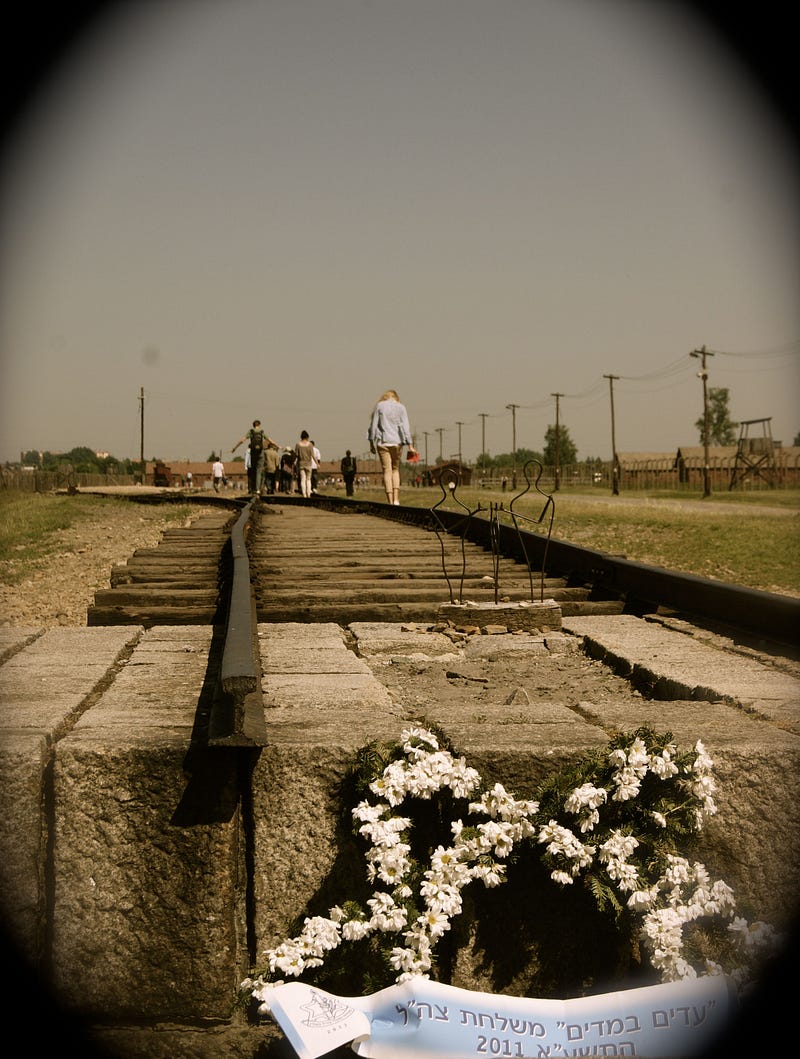
They were moving on without me. I remained a while behind, seated on the hard stone of the holocaust memorial. I pulled out the red envelope left for me by Gosia. “It’s time,” I quipped to myself. I realized that the exercise drawn up for them was really for me.
“Time for what?” I wondered….
Here was my message, given to me by Eva Pickova, a 14 year old student from Prague:
Fear
The ghetto knows a different fear today
Close in its grip, Death wields an icy scythe
An evil, sickness spreads a terror in its wake
The victims of its shadow weep and writhe.
Today a father’s heartbeat tells his fright
And mothers bend their heads into their hands
Now children choke and die with typhus
A bitter tax is taken from their bands.
My heart beats inside my breast
While friends depart for other worlds
Perhaps it’s better — who can say?
Than watching this, to die this way?
No — my God! We want to live!
Not watch our numbers whither away.
We want to have a better world
We want to work — we must not die today!
I held the poem for a long while. Just a girl. Just a 14 year old girl. She was beautiful for sure. Did her death make it so? That would be tragic. Or was she still alive, these words of hers mouthed in mine? What is our relationship? I rather not answer, nor ask any more. I was crying.
I kept my head up. I gazed at the sky above Oświęcim. I could glimpse my students in small figures ahead. I recognized them. They were mine. But they were moving further and further away. Almost shadows. To let them go? To let it go? To let it all go? The holocaust? The pogroms? The annihilation? Fanta Bass? Eva Pickova? Poland? The Pale? The shtetl dream of a fiddler dancing precariously on a roof? One can’t keep everything in his heart. It’ll explode.
Feeling is a problem.
I sat for a moment longer. The last of my students was making her way down the rails. It was Marta. I could only see her wild blond locks and her tip-toeing frame. She danced lightly on those rails, out of the sky, and on through the gates.
I was happy.
I was ready to go home.
Postscript:
I met someone new yesterday. We met on a plane from Frankfurt back to Washington DC…my “home”. She was my neighbor to one side, and to my right sat her husband. They had been in Prague working on a documentary film about Zuzana Ruzickova. She was Europe’s most promising harpsichordist prior the war, and according to my new friends, survived internment in four different concentration camps. After the war, she remained in Prague, where she still lives (happily) and teaches harpsichord to aspiring virtuosos.
Inevitably, my new friend asked the question: So, why did you move to Poland?
Given our nine hours of flight time together, she had time for the long account. And she was not a dummy. In her own way, she too was chasing the holocaust. If ever I had a sympathetic ear, this was it.
But having told the story long and short, I decided I needed to arrive at something in the middle. A poem. I did not recite it for my friend on our shared flight from the Old World to the New.
But grounded and removed, I recite it now. Maybe in her own corner of the world, she can hear (and you too):
I came to Poland to reclaim the wandering Chassid
to grasp at reigns of lore
the Reb Tevyes, the Baal Shem Tovs
encroach their wells at the base of hills
with an empty American pale —
I came to place a brick in the ghetto wall
segregating Jew from Gentile
condemned from living
to re-enact and witness
the greatest crime of all —
I came to plant a tree in the soil
follow a ploughed trail
rambling East the forlorn fields
carried forth in untrained procession
the barbs and jests and Freilach melodies
kicking up clay wrenched
in the rustic’s black boots
to fear God
to reacquaint with mothers and fathers
the inside wry smiles —
I came to light my own candelabra
and dress the window pane in dancing flames
to study an elder’s books
invite the suspicions of passers bye
and rejoice in a damp and woody cell:
my name! my name!
I came to reckon the futility of time
of provinces and kings
flags and telescopes and flotsam worlds
revolutions, slogans, immigrations, emigrations
assimilations, patriotisms, exiles and dreams
all but song — the seed
to find inside me
a friend
a Gilead Balm
melting my modernist form
into an unsoldierly brother of arms —
I came to Poland
to make fire and burn out
in the hoary sky
and wandering still
wonder where
is my faith in God?
This poem is for Eva Pickova…