
So …. what is it you do again?
It’s a fair question. ‘Cryptocurrency Evangelist’, as it quite clearly states on my business card, could mean, well, anything.
Since it’s a question that comes up time and time again, I’ve had to develop an ‘elevator pitch’ style response which goes like this:
“I advocate and promote the adoption and development of cryptocurrencies at all levels, from personal use right up to corporate acceptance through writing, speaking and use of social media”
This, inevitably, leads to the question “What’s a cryptocurrency?” so I have to have an answer ready for that too which runs as follows:
“A cryptocurrency is a new form of money that exists only in digital form and can be used as a payment mechanism anywhere in the world without having to use a central banking system”
In my experience of using these lines, my general feeling is that people will have some inkling at least of what a cryptocurrency is from my definition provided, but the ‘evangelist’ bit? Not so much.
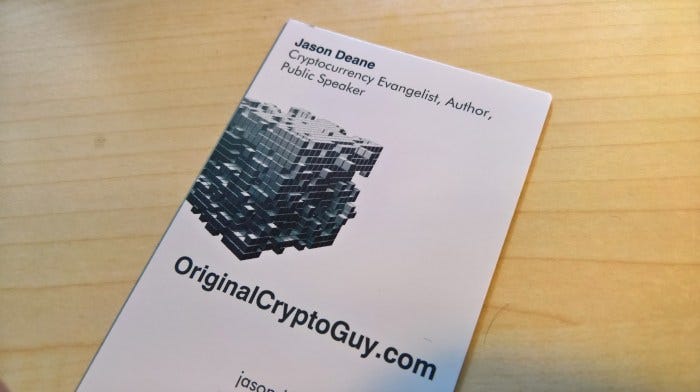
I’ll be honest, it wasn’t my word to start with. I stole it from 1997 Microsoft, but I feel confident they won’t come after me now as its been nearly twenty years since I left my job there as Brand Manager. You see, I was there for ’95, ’98 and the scary-as-hell (at the time) Y2K bug. I was also there when this weird new concept of ‘the internet’ came about. It was a radical, crazy idea that seemed to be here to stay, despite what the nay-sayers thought — and there were many of them.
But, for those of you who know your technical history, you’ll know that Microsoft was late to the game with the internet. They’d missed it completely on it’s first big push, and Netscape dominated the market with a 98% share. The first Microsoft Internet Explorer was slow and clunky by comparison and we hadn’t even got the internet on our PCs in the office in Reading yet. Yes, really.
This is all changed when Steve Ballmer, at the time Bill Gates’ number 2, came over to the UK on one of his regular visits to ‘sew the seed’ of internet fever. The whole company was changing direction — and fast.
I liked Steve. I got to spend a bit of time with him on several occasions over my years at Microsoft and I loved his huge personality, his booming voice that got slightly squeaky when he got passionate or excited about something (which was pretty much everything) and his undeniable total passion about what he was doing. His famous catchphrase at the time was ‘Revenue, Revenue, Revenue’ as a focus for the company, often accompanied by banging a large walking stick style prop on the floor of whichever auditorium he was in with each utterance of the word.
This time it was different. With most of the UK subsidiary present (it was only a couple of hundred in those days) and a big build up, he promised to reveal his revenue forecasts for the internet side of the business for the following twelve months. The moment came to finally reveal the slide. It was a giant zero, the size of the wall it was projected on. Pause for effect.

There was a stunned silence, followed by murmuring. How could it be nothing at all? The reason, Steve explained, was simple.
Microsoft was late to the game, they had already lost the game in many ways. It was necessary to re-position the whole company as utterly “internet ready,” a phrase we used a lot on those days, like we did recently with “HD Ready” TVs a few years ago. It seemed we were to invest a fortune and expect not a single penny of return for at least a year. It was aggressive, decisive and fast. We were all to get involved and drive internet adoption and, of course, Microsoft’s position in it. We were all, whatever our rank or position in the company, about to become ‘Internet Evangelists’.
Business cards were re-printed, posters appeared, training session happened, web sites were being ordered left right and centre and the PR machine went into overdrive, guided by ‘Corp’ — the unseen powers that be in Seattle. The entire company started talking about ‘the internet’ to customers, suppliers and even friends and family. These people were going to hear about and use the internet anyway, it was critical they heard it from us ‘Microsoftees’ first.
As we all now know, it worked. Within a couple of years Netscape Navigator was dead and Internet Explorer was king, for a while anyway. The new versions of Office were internet enabled, and whole new swathes of code based on internet working was added to Windows. Research showed that people thought of Microsoft as an ‘internet’ company. Job done.
Fast forward 25 years and not only did I steal the name for my own purposes, I have also stolen the genuine passion and interest in ‘spreading the word’ of my chosen field of specialism. For the second time in my life I am an ‘evangelist’.
I will chat to anyone who wants to about cryptocurrency, or answer any question I can. I will answer any email or comment with as much detail as possible, and point people to other resources that may help them. I’ll read several hours a day on new developments or applications and share it with groups and networks. I will pay for as many things as I can with crypto, tell people I’m doing it and, if they’re interested, I’ll show them how. It’s passion driven by a genuine desire to see this work, for everyone of any race, colour, background or financial status. A passion to see it possible for a person in a first world economy to trade directly with someone in a developing nation without borders or sanctions, or even a bank calling the shots. Just their product and smartphone.
I’ll admit to being a bit Utopian about it, and I’ll be the first to acknowledge the myriad of problems it brings to governments, tax systems, tariffs and crime fighting among many others, but each of those problems also brings new opportunities, and possible solutions that, for the very first time in human history, could be dealt with on a global scale through a border-less currency system. That’s quite a thought, isn’t it? It’s enough to get anyone excited, right?
So, next time the question comes up, I’ll simply point them to this website.
Unless they ask “what’s a website?”
In which case I’ll need to have a quiet word with Steve Ballmer.

Originally published at https://originalcryptoguy.com on September 19, 2018. Moved to Medium archives on September 5, 2019


