
So, What Are You Wearing to the Masquerade Ball Called Life?
If I were invited to a dinner party with my characters, I wouldn’t show up.
— Dr. Seuss, The Sneetches
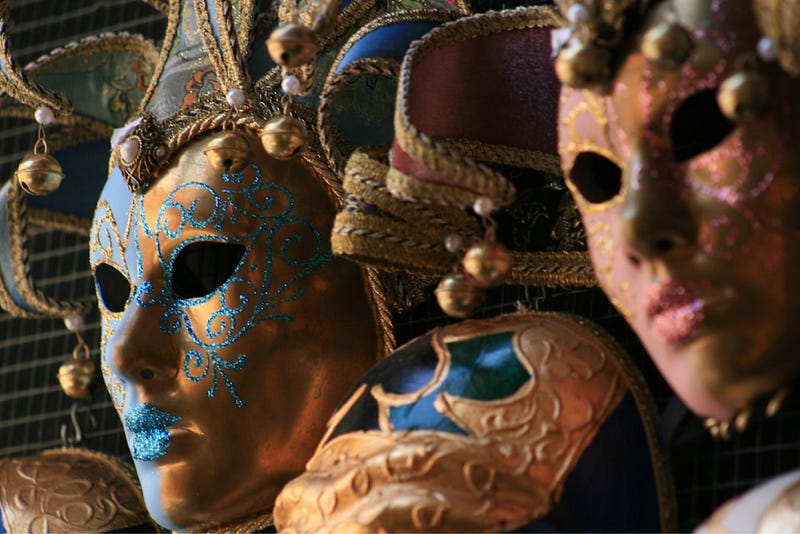
The reality is most of us don’t actually “know” anyone. How can we if we don’t even “know” ourselves? Upon waking up in the morning, I knew I was getting a divorce. It became clear to me that I didn’t know the man I called my husband. I only knew the character I had created for him, a character that fulfilled the character I had created for myself. Ultimately all relationships are interactions with the characters we create, bouncing off each other like pinballs in an arcade game. We each play our roles diligently until one of us tires of that game, desiring a new costume or a new face, while the other is hurt and angered at our absolute gall to change costumes midstream.
And then the real fireworks begin.
My entire marriage was based on a figment of my imagination; a fairy tale told to me that I manufactured into reality, although based purely on fiction. Part of my fairy tale was that I could not love myself and that I needed someone else to do it for me.
In the beginning, he was my knight clad in shining armor, sexy and smart, and an awesome lay. I was a beautiful young princess, powerful but feminine and needing a man who would whisk me off my feet, throw me on the back of his horse, and gallop away into the sunset. Even as the chinks in the armor began to show, I held on to my story because it was the only thing I believed would finally end the hurt hidden deep down inside. I certainly couldn’t fix it. I either didn’t know what needed fixing or I was unwilling to do what it took to fix it.
I remember the night we met. I was new in a small town where word of fresh meat traveled fast. I was at the home of one of my fellow filmmakers, working on a new film, the news of which had also spread about town. I was the new girl who had landed smack dab in the middle of the cool people and, without realizing it, wore a big target on my back for all the “knights.” I was the prize to be won, mounted, and eventually thrown out, used, and discarded, when new meat came to town.
I realize now that I put that target on my back, as it fits nicely with my beliefs about myself at the time: damaged, suspended while moving, and not enough. I feel so much compassion for that younger self, and when I look back, I want to give her a hug and say you are awesome, and I value you. But without learning these early lessons, I wouldn’t be the me I am, so there you are. And there I was, the new girl, surrounded by people I thought knew more than me, trying to fit in and feel relevant.
And the scene was set. Me, tipsy on the giddy feeling of being surrounded by all of these seemingly It People, and the It Boys knowing I was giddy, and him arriving on his horse (or sporty black Honda). Me, having just fallen off the back of another horse, I needed to be shown love, and I felt lost and insecure in a new place with no one I knew around. Because I could not show myself love, I looked outwardly for a man to do it for me. I attempted to fulfill my need to feel safe in this den of lions. I quickly donned my mask of damsel in distress because that usually got the guy, and what I got was a romance novel complete with a Ryan Gosling impersonator, poetry gliding from his tongue and muscles gleaming. Cue the music and the sunrise, and off we went. What should I have expected, being an impersonator myself?
How does a relationship sour? How do we go from poetry, flowers, and Sundays spent in bed to hate, resentment, fear, and a bitter battle where everyone ends up bloody and headless? In retrospect, having taken the time to watch the replay with a broader understanding of why I made the choices I made, I believe it’s because we fall in love with the mask, not the man, and we let the man fall in love with our mask instead of the real us.
As an actress, I played the role my husband wanted, the role I thought was the real me, the role I thought would make me happy. I played the role very well because I was so desperate for love and so afraid that no one would love me. I got so lost in the part, so method were my acting techniques, that I hid even the real me from myself.
To hide the shadows of our true selves, we create amazingly intricate masks designed to cover up the authentic face of who we are. The masks are created from the images of our beliefs about who we think others want us to be and the beliefs we carry about ourselves. They are carefully painted to hide what we so dislike about ourselves or are afraid to reveal, so pieces of us hide in the shadows, kept in the dark where even we often lose sight of them. Some dark part of me thought, I am not really lovable, but if I wear this mask of worthy of love, then I will be loved. So, wear it, I did.
I built my princess-and-supreme-hostess mask from the feathers of fear and rejection. I painted it with colors to ward off failure and everything I believed being vulnerable would bring me. I learned to gain what I wanted through other means by wearing masks of my own creation.
Before we had children in my marriage and were free from the trappings of real life, kids, car payments, and laundry, it was easy to play the goddess, secure and happy and carefree, powerful, sexy, and smart. All the things my handsome prince wanted, and in turn, he played gallant and brave, wise and all-knowing, able to protect me from the dragons of the world.
Except that is not who we really were. Deep inside, underneath our feathers, gold, and glitter masks, were two, maybe not completely broken, but very dented individuals just wanting to feel loved, safe, secure, and seriously hoping the other one would deliver that.
My relationship with my ex-husband was probably no different from most relationships out there. We started out madly in love — not with each other, but with an image we each projected outwardly. This was really hard for me to admit, this idea that I wasn’t being authentically me, the reality that I had adopted certain behaviors to fulfill a destiny I thought I wanted but hadn’t done the work necessary to make sure it was me that wanted it. It was initially terrifying and humiliating to say that everything I thought I was, I wasn’t. I wanted to be the supreme hostess in a way, but I realized I didn’t want it the way I had achieved it. By pretending and lying, I felt as if I had cheated myself because that reality wasn’t based on anything but false beliefs and judgments. Was I creating this life out of fear or out of my true soul’s desire? What did being happy and secure in myself, feeling true love, really look like? This was the work I hadn’t done because I never understood I needed to or how.
Clearly, my marriage was built on a foundation of fear and lack of self-worth, and somewhere along the line, my ex-husband and I began to see the real people behind the masks. Even the best actors break character occasionally, and every once in a while, our soul’s desire peeks out like a glitch in the hologram. And it makes us wonder if that way is really possible. When I finally could no longer ignore the quirks in the system, I realized there were bugs I needed to weed out.
Even if you don’t know it, the real you is within you. Even if you have covered it with so many layers it’s impossible to see, it’s there and working very hard to break free. My life after my divorce has been about finding that real me mixed in with all the masks I created. My process has been about uncovering my beliefs about myself and tearing down the reality I manufactured to hide those beliefs.
The concept of creating masks to hide who we are is complex. Of course, it is because if we humans were easy, there would be no suffering, starvation, war, or general unhappiness. But hopefully, the dots will be connected enough for you to find your way back to who you really are.
Ever since I was young, I believed I wouldn’t be loved unless I was successful at whatever it was I was doing, be it acting, music, or business. I tied my self-worth to being perfect and exuding happiness. So outwardly, I wore the mask of a confident, sexy, secure, ballbusting woman, and in turn, people loved me. And I believed they would never love me if I weren’t those things. We start out our lives as pretty, happy little beings, all warm and cozy in our Bugaboos, but slowly, we gather up beliefs about ourselves and the world and how it works. And we start to worry that if we actually told other people about those beliefs, they might think we were seriously nuts, so we hide them. Sometimes, those beliefs frighten us so much we hide them even from ourselves. Me, insecure and afraid of failure? No, not me!
We build intricate masks to fit into society and base them on what we think our communities, family, and friends want from us. We use them to hide our crazy, and we start congregating around other people wearing the same masks. There is safety in numbers, or you could say like attracts like. But however you want to put it, we feel better when people agree with us.
Why did we become such good liars? If you think about it, it’s no secret that our society doesn’t really want to know the real us. At work, a woman showing vulnerability is often considered not up to the task of getting things done, so women put on the mask of emotionless robots or bitches. If a soldier were to tell someone he’s conflicted about war, he would be considered weak or a pacifist, so he dons the mask of a coldhearted killer.
We think nobody wants to hear about it, so we cover up. What would happen if we let it all hang out, zits, stretch marks, and all? For a long time, I worried that letting it all hang out would lead me into total seclusion and loneliness. No one would love me, and I would die alone. So, with my warrior mask securely in place, I moved forward in life, my eyes covered with feathers.
Imagine what would happen if, after your coworker asked you, “Hey, how’s it going?” you said, “You know, my life kind of sucks right now,” instead of donning the mask of perfection and saying, “I’m great!” Okay, perhaps some discernment is in order, and maybe dumping on your coworker right before the big staff meeting isn’t such a great idea. But what would happen if you were honest and didn’t try to hide your true self?
This has been an eye-opening exercise for me, this willingness to be real with people. Okay, I didn’t just suddenly start running around playing the victim and complaining about how shitty I felt because my life was a mess, my marriage was over, and I was broke and lost and everything else. Instead, I started by playing with what was lurking in the shadows of myself. I began to bring those things out and express them openly. At that moment, they were the real me. Although they weren’t pretty, if I wanted to find the real me underneath all the manure I had piled on top, I had to be the me I was at that moment. Only then could I expand, change, or become something else.
At the time I got divorced, the real me, who was sweating and suffocating under the mask of flawlessness, was insecure. The real me was unhappy with my body, career, and marriage and unable to accept love, especially from myself. At that moment, that was real, but it didn’t have to stay that way. To the shock of many of my friends and family, I began to show the chinks in my armor. I cried when, for years, I hadn’t. When someone I knew asked me how I was, I told them, “I am in a very dark place,” instead of putting on my pretty, happy dancing mask. When I truly shared myself, others began to share themselves truly with me, and I suddenly realized I wasn’t alone. I gained more friends than I’d had in a while, only this time, I was being surrounded by people who also wanted to be authentically themselves.
At this point, you might wonder what this has to do with spirituality and living a spiritual life. Remember, I come from the belief that life — all of it — is spiritual, and peeling back the layers of the onion I’ve closed around my true self is the journey, the spiritual path. In doing this, I get closer and closer to my true self, my light self, my spiritual self, if you will. I decided that in order to become what I wanted, I needed to be who I was. I could undo what needed to be undone and find what had been underneath all along.
There was a balance here that I couldn’t overlook. There was a risk of becoming a victim when I was doing this work of being authentic. Still, I had to continue to work on finding who it was I wanted to be because I didn’t want to swing the pendulum the other way. That would mean falling backward, back to sleep, only this time, I might get stuck in the shadow world.
I began to find things in my life that reflected my true self, the self I wanted to be. My ex-husband had said I was mean and not compassionate, and part of me believed him. It stung when he said that, but once I took a moment to see beyond his reflection, I could see that I was a very passionate being. I asked myself why I believed him. It all boiled down to “a winner never quits, and a quitter never wins,” a saying engraved on a bracelet given to me by my father, whom I revered and adored.
What I understand this sentence to mean now and what I decided it meant when I was six are two different things. Not entirely different, just nuanced. In my childhood home, there was no room for complaining. My parents were of the generation that said you didn’t complain about it; you just endured it, or if you could, you changed it. My father told me that if you wanted something, you had to work for it. It probably wouldn’t come easy, so you wouldn't get it if you wasted your time complaining and not working. When he said this, he intended to give me resilience, but I, in my limited understanding, took it to a new level where it has stayed for my entire life.
Somehow, my belief that winning would bring me love got twisted up by my father’s words, and I decided that complaining was bad and would interfere with me getting the love I wanted. I was competitive from an early age — baton twirling, violin playing, dancing, singing, you name it — and I spent hours a day practicing. While other kids were out playing, I was in the driveway doing triple spins with my baton until I could no longer see out of my swollen eye (having whacked myself in the eye once too many). You might think my parents were awful for making me do all these things, but they weren’t awful at all. My mother often begged me to come inside and even refused to allow me to practice into the wee hours of the night. I had taken on the belief that if I gave in — if I complained or uttered a word about my exhaustion, frustration, or fear that I would never get it — I would lose all hope of achieving success. I was committed, and my parents honored that. Hence the mask of the warrior; I’ve got it all under control, girl.
Flash forward into my adult years. With my mask securely in place, I often took others’ (especially my ex-husband’s) need to feel heard, whether about why they were upset or why their body hurt, as complaining. And I would offer a way to change it. That was my version of being compassionate. I believed that they wanted whatever they were working on, practicing, or desiring, and in my own way, I was trying to help them. But in doing so, I lost sight of the possibility that they needed a moment to complain. They needed a shoulder to cry on, not advice, not tough love.
They didn’t want a bracelet to wear. After coming to this realization, I asked myself, How can I still be compassionate and supportive without being harsh? My answer was to take off my mask and listen to them without inserting my own baggage, my own fear of feeling vulnerable, and experience their vulnerability, and, in turn, my own.
When we are real, real with ourselves and others, we can see the masks of others and reach behind them. And if we hold our own and others’ realness with compassion, we give each other a haven for that safety we all so desperately seek. In that safety, you find a willingness to expose yourself, masks become unnecessary, and the real you shines.
I found a sort of balance in the ability to be okay with being multilayered. As I did the work of uncovering myself, I found that I wasn’t just one thing — there were many aspects of me, and I could be all of them. I could love each and every part of me, the happy It Girl, the vulnerable girl. Sometimes, hanging out with my layered self hurt, but these named layers were no longer caricature masks. They were me, all of me.
The foregoing is an excerpt from Tipping Sacred Cows by Betsy Chasse. Betsy is an award-winning filmmaker and author, perhaps best known for the documentary “What the Bleep.” Please follow her for more amazing writing and follow this Publication, PartingWays. Thank you for reading