
Israel Offers A Looking Glass Into America 2025
If only we had the time to look
As soon as I think life is calming down, getting back to normal so I can move on to working and writing and what I call my life…
Bam!
Something happens.
No. That something is not hearing a soundbite from the most popular and most disliked person in America:
It’s a very sad day for America…This is a persecution of a political opponent…If you can’t beat him, you persecute him or you prosecute him. — Former US President, Donald Trump, 2023
No. That something is not making the connection to the most popular and most disliked person in Israel expressing the same sentiment:
Citizens of Israel, what is on trial today is an effort to frustrate the will of the people, the attempt to bring down me and the right-wing camp. — Prime Minister Benjamin Netanyahu, 2020
No. I don’t often have time to hear these messages or to notice their striking similarity.
There are too many distractions.
A typical day in the neighborhood
Yesterday the thing that happened began with a text from my daughter.
Can you bring me another pair of shorts? Right now. Please, Daddy!
She’s a young teenager at a summer theater camp. Suddenly she needs another pair of underwear and shorts. You can guess why. If I were to do the right thing, the socially correct thing, I would walk to a bus or subway to bring my not-so-little girl what she needs.
Daddy, where are you? Have you left yet?
In our town, a midday, few-mile drive takes twenty minutes or more. By the time I arrive at the school, the roaring construction stalls all traffic. I sit for minutes, texting when it appears we will be allowed to pass.
Driving by in two minutes. Won’t be able to stop. Please wait out front!
I drive as slowly as I can. The construction guy waves furiously at me to keep on going. The driver behind me honks their horn. Twice. I don’t blame them.
Damn. I don’t see her. No one is outside.
The construction funnels me into a neighborhood I would never choose. Illegally parked, I grab a re-usable grocery bag, and stuff the clothes inside. I consider tossing the bag out on the fruitless second drive-by.
Third time is a charm, they say, but I am again stuck two hundred yards away. Traffic is dead-stopped. The phone rings, and my daughter says
“I guess I don’t really need the pants after all.”
No! I can’t have done this.
The time.
The energy.
The distraction.
Defending the American Way in Israel
A friend visited last week.
A generous person with a wonderful family, he returned to Israel three years ago to be near relatives. The schools aren’t as nice as in the States, he says, but the kids love the windsurfing team and robotics club and building lifelong friendships the family thought less likely to form in a harsh American city.
“Life should be more about shaping friendships, right? We worry ourselves silly about our kids’ educations and sports and college applications.”
Amidst the tiresome roil of American politics, he has kept me abreast of the challenges Israelis face. I remember his shock a couple years ago at the details behind the birth of his beloved Israel. He asked me to listen to the MartyrMade podcast, Fear and Loathing in the New Jerusalem.
It’s a fabulous listen if you don’t demand the fantasy of a manufactured past.
He shared with me his worries when Benjamin Netanyahu won his 4th term as Isreali Prime Minister in 2015, a year before Donald Trump became the US President.
Israel is running an experiment in decency and democracy
He cautiously expressed hope when Naftali Bennet was declared Alternate Prime Minister in 2021; Naftali headed a coalition of relatively moderate parties in the Israeli Parliament. He was not surprised when Netanyahu’s conservative coalition regained power in 2022.

He fears he is witnessing Israel, a country of refuge, turning its back on decency. Twenty percent of Israelis are Arabs with voting rights but drastic socio-economic disadvantages and little representation in Israeli government. In the face of the Palestinian conflict (a horror that serves up plenty of blame for everyone involved), the latest government has deployed its significant military might against Palestinians walled off in the Gaza strip and in the West Bank where new Jewish settlements steadily expand Israeli territory.
These are not the acts that most worry him, though. It is, instead, the careful consolidation of power by the hardly-majority, by a group that has a deep disdain for the power of the Israeli government, and by the weakening of the courts.
In response, my friend has recently joined in the largest political protests in the history of Israel. Tens of thousands of Israelis worry that in a country without a constitution and only a tacit separation of powers, Netanyahu’s plan to remake Israel’s judiciary is fraught with danger for their democracy.
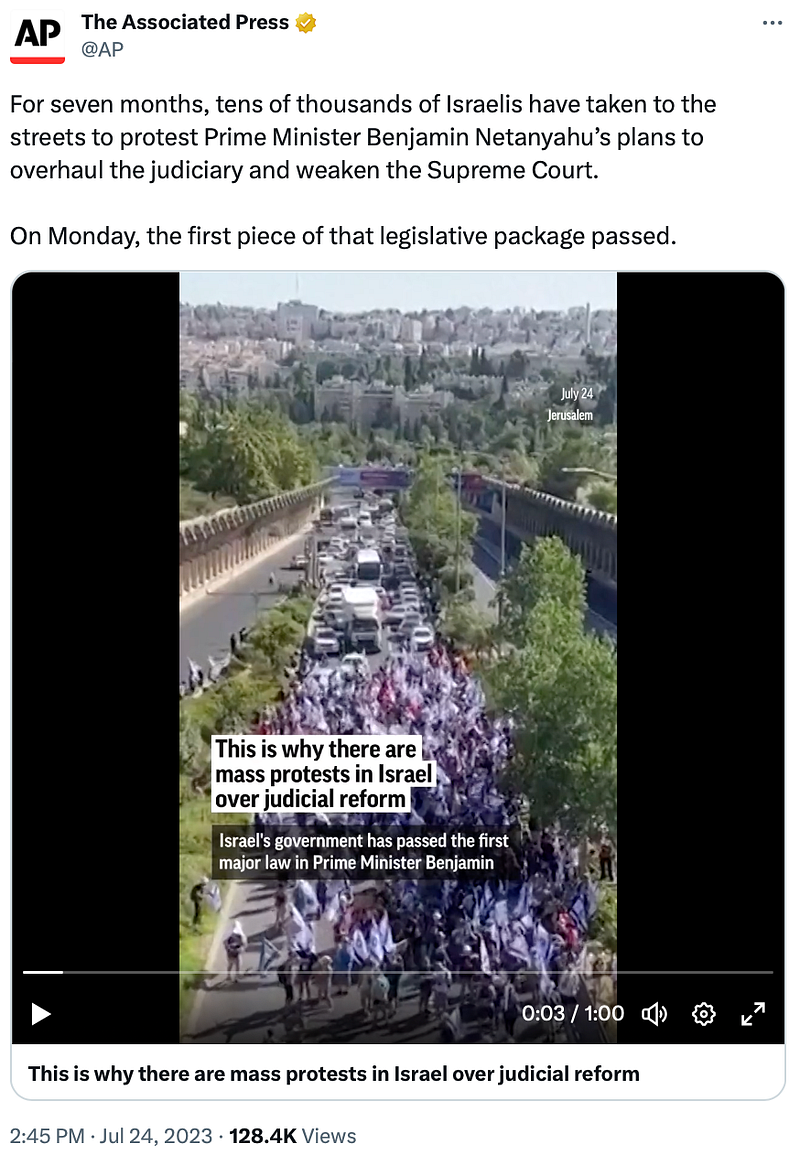
He has been further dismayed that his Israeli brother has NOT joined in the protests. Instead, his brother has been distracted by shaping an escape plan in case Israel’s democracy tips further into autocracy. His brother is close to obtaining those coveted family passports to an EU country.
Democracies can fail
My friend reminds me that 3 million people came to Israel in the past seventy years to escape oppression in their home countries. For many it was a mere generation ago. These families remember that countries can change. That what was good can become bad. That democracies can fail.
Democracy is fleeting and fragile
When I tell him that surely he worries too much, he says there are tens of thousands in Israel crafting escape plans, just like his brother. Some are fighting to keep democracy. Others are poised to move on because democracy is fleeting and fragile.
America and Israel
Pre-9/11, pre-War on Terror, pre-invasion of Afghanistan, pre-latest Mexican border crisis, I thought Israel and America not so very much alike. After these events and the last two decades of American politics, I have changed my mind.
Asking myself whether my friend is overreacting, a tiny bit of research — really, it’s just a Google search — says he may be correct.
Democracy in the US and Israel is on the edge
The United States and Israel sit at adjacent spots on the University of Wurzburg’s Democracy Matrix. Israel is ranked the 35th “best” democracy out of 175 world countries. The United States is 36th.
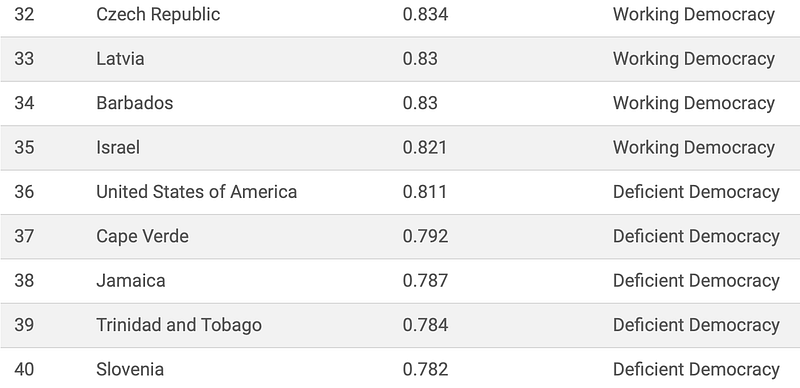
They each sit at the precipice, in the awkward place between “working democracy” and “deficient democracy.” This ranking was published for 2020. In that year, the US suffered a shocking Presidential election. Some believe one party stole the election at the ballot box. Some are certain the other party tried to subvert the Electoral College rules the following January.
Flawed democracy
The Economist’s 2020 Democracy Index offers up a similar assessment. The US is placed 24th and Israel 27th out of 166 countries. Both are in the same place, identified as “flawed democracies.”
Similar moments
The most popular political figures in both countries are Benjamin Netanyahu and Donald Trump. They are loved and detested. Both have led impressive lives pre-politics. Each has celebrated three marriages, two divorces, and multiple sex sandals while drawing upon the unquestioning support of religious groups. In perfect symmetry, each faces three court cases for abuse of power. Each has won or is winning significant control over their country’s judiciary system.
The US and Israel have the most lawyers per capita
There is one feature that is a little less obvious. As much as our countries can be proud of our democratic voting traditions, those traditions have been twisted in recent years.
Lawyers will argue that these deformations fall within the realm of legality and proper process, but there is little doubt that we are challenging the spirit of decency, if not the exact rule.
In the United States, the Presidential election of 2000 validated that US elections can be decided by non-voters: the Supreme Court and behind-the-scenes actors. This has always been the case in America, but it had not been made so clear before.
Justice John Paul Stevens dissented in Gore v Bush. He asserted that federal power should not usurp the state of Florida’ right to count its own votes. He disagreed with the smattering of arguments that came from judges whose families financially benefited from the decision. He went on to forecast Americans coming skepticism in their judicial system.
Although we may never know with complete certainty the identity of the winner of this year’s presidential election, the identity of the loser is perfectly clear. It is the nation’s confidence in the judge as an impartial guardian of the rule of law. — Justice John Paul Stevens in his dissent in Gore v Bush, 2000
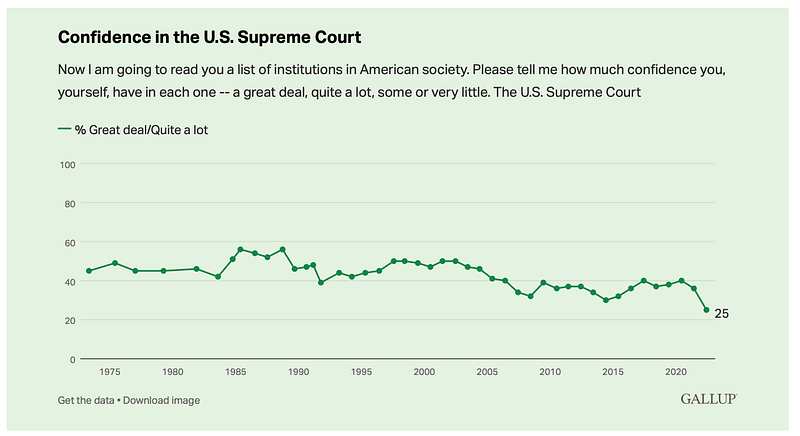
In the year 2000, it was shocking to see a 500,000 vote majority for Gore denied. By 2016, American voters were better conditioned to accept that almost 3 million “majority” Clinton voters had been denied. The system was, after all, designed with that possibility in mind.
Given this past, it is no surprise that in 2020 (and 2023) more than 100 million Americans refused to accept the honesty of the US voting system.
Why should they?
In Israel, the 2022 parliamentary election was a big win for the conservative Netanyahu coalition. American politicians would call it a mandate.
In truth, though, that mandate was fueled by a swing of a mere 30,000 votes from the previous election. 49.57% of 4.7 million votes won 64 seats for Bibi’s coalition. The losing 48.94% of votes earned only 55 seats. To my knowledge, there are no assertions of cheating, but it does seem inherently problematic that .63% of the vote grants so much privilege to some groups over others.
Bequeathed such power, the Netanyahu coalition is well on its way to remaking the status of the Israeli political and judiciary system.
There is no formal constitution in Israel. There are no states to balance federal power. There is little separation between the executive and legislative branches. The judiciary is the one overtly balancing force, and much of its power is being tempered.
We tell ourselves that America is different
America is different than Israel. Israel is a young democracy bolstered by friends and brilliance but challenged by geography, history, jealousy, and resentment. America has more buffers against the dissolution of its democracy, more history, more checks and balances.
That is what we tell ourselves.
A looking glass into the future: Israel
A commentator from the Philadelphia Jewish Exponent defends America’s $3.8 billion in military aid granted Israel by the US each year. He explains that Israel is “the laboratory for the US military.”
A laboratory for the US
I wonder if Israel is not also running an experiment in decency and democracy that Americans should be paying close attention to.
Tens of thousands in Israel are crafting escape plans
No matter how big the screen, however, we can notice the results only when we tear ourselves away from the distractions of our lives.
As I’m finishing this piece, the rain is getting worse.
The coaches at my little girl’s soccer session must have heard the rumble of thunder. Apparently they stuffed the campers into a room where all they can do is watch Despicable Me 2 or the screens in the palm of their hands.
In there for an hour now, her texts to me approach twenty. As the rain continues, I am certain the message will come soon enough.
Wait for it…
Wait…
Daddy, can you come take me home?
Maybe I can think about American democracy more when she heads off to college.
Comments are welcome. Claps are deeply appreciated.
J. Andrew Shelley has spent years in startups that did nice stuff. Some stalling. Some selling. One for over half a billion dollars. But none making him rich. He now distills work and life into worthwhile stories.
Please subscribe to read his stories. If you are not a Medium member, please join; your subscription here will particularly support J. Andrew Shelley. Check out the book American Butterfly, too.


