
Mature Flâneur Down Under
Snowed in at Aoraki/Mount Cook
At the foot of New Zealand’s tallest peak
Heavy snow was forecast on the day we drove to Aoraki/Mount Cook. I’ve driven through plenty of snowstorms in my native Canada. But in New Zealand, they tend to close the roads when it snows. With no other accommodations nearby, if they shut the one road to the mountain, Teresa (my beloved and intrepid spouse) and I would be out in the cold.
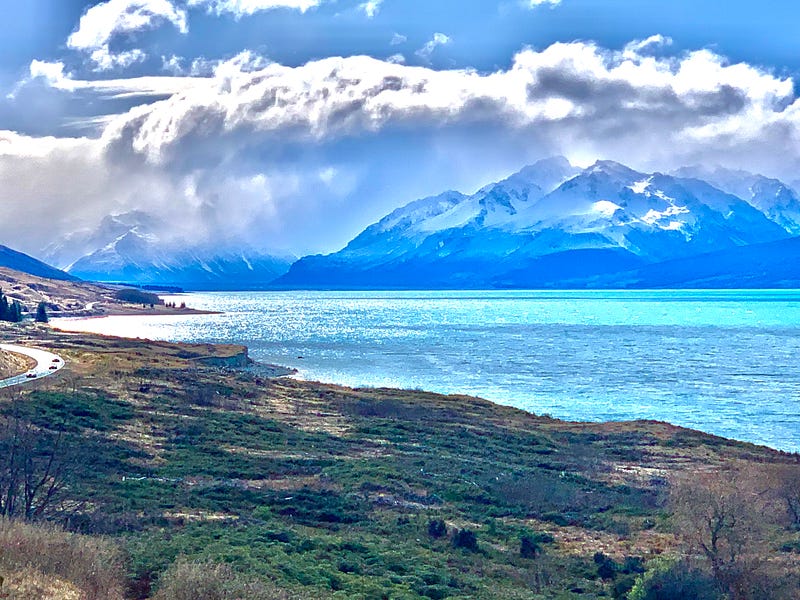
When we reached the shores of Lake Pūkaki, the sky was still bright blue — almost as blue as the lake itself. Lake Pūkaki is glacier-fed. The glacial silt contains fine mineral particles that, suspended in water, reflect the sunlight, turning the lake a brilliant turquoise, Miami-Beach blue. The lake appears to glow.
As we drove along the water’s edge towards Aoraki/Mount Cook, we could see the storm brewing. It was a spectacular sight. New Zealand’s Southern Alps rise up, north to south, creating a wall of rock that is three kilometers high in places. The ferocious, moist winds that swirl around the sub-Antarctic regions blow in from the west, then slam into that massive rock wall, forcing the air up to the peaks. It cools rapidly, condensing into rain on the west coast, and snow higher up, where it spills over the peaks like a giant atmospheric waterfall. Snow deluges the eastern sides of the mountains, but leaves the land further east in the “rain shadow”; it is one of the driest parts of all New Zealand.
We could see that waterfall of snow straight ahead of us, and we were driving right into it. By the time we arrived at the little village of Aoraki/Mount Cook at the entrance to the National Park, big white gobs were falling like cornflakes, leaving huge, melting splotches on our windscreen as we searched for the charging station for our EV. A few hours later, the highways department closed the road.
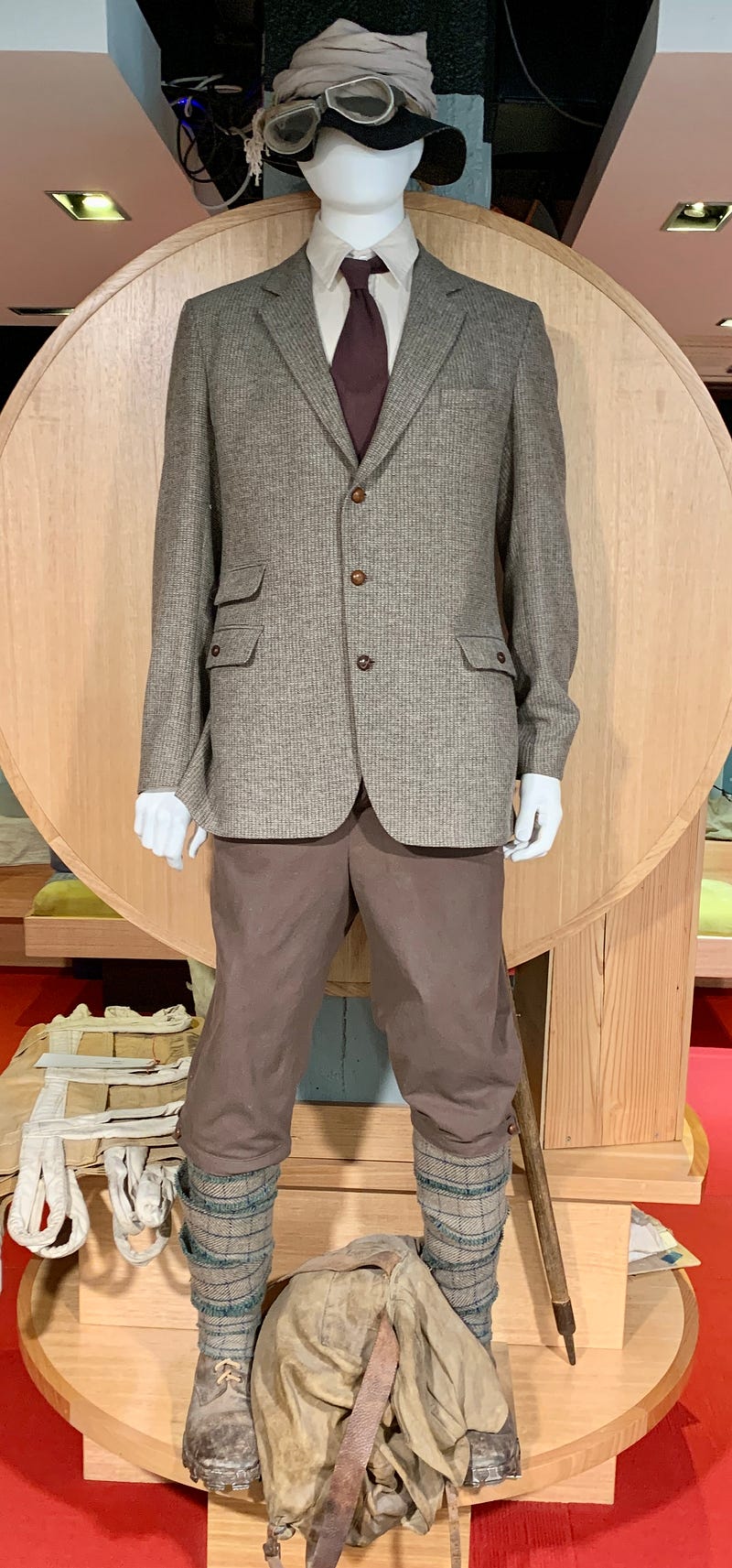
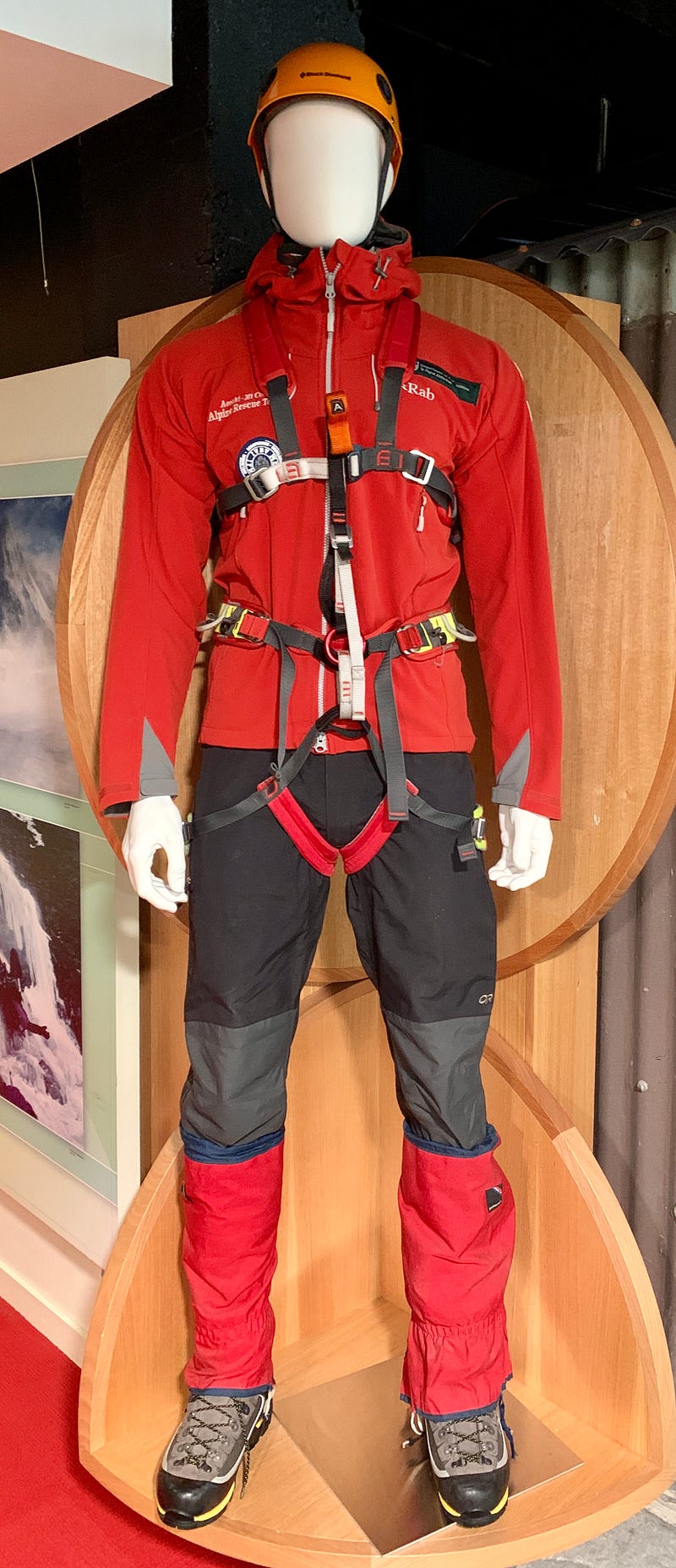
We stayed at the Hermitage Hotel — or rather, the third reconstruction of the original Hermitage. It was built in 1884 for the first tourists drawn to New Zealand’s highest peak. Aoraki/Mount Cook has been attracting hikers and mountain climbers since climbing became a sport. Sir Edmund Hilary trained here, in preparation for his first ascent of Mount Everest, and so there’s a climbing museum attached to the hotel, named in his honor.
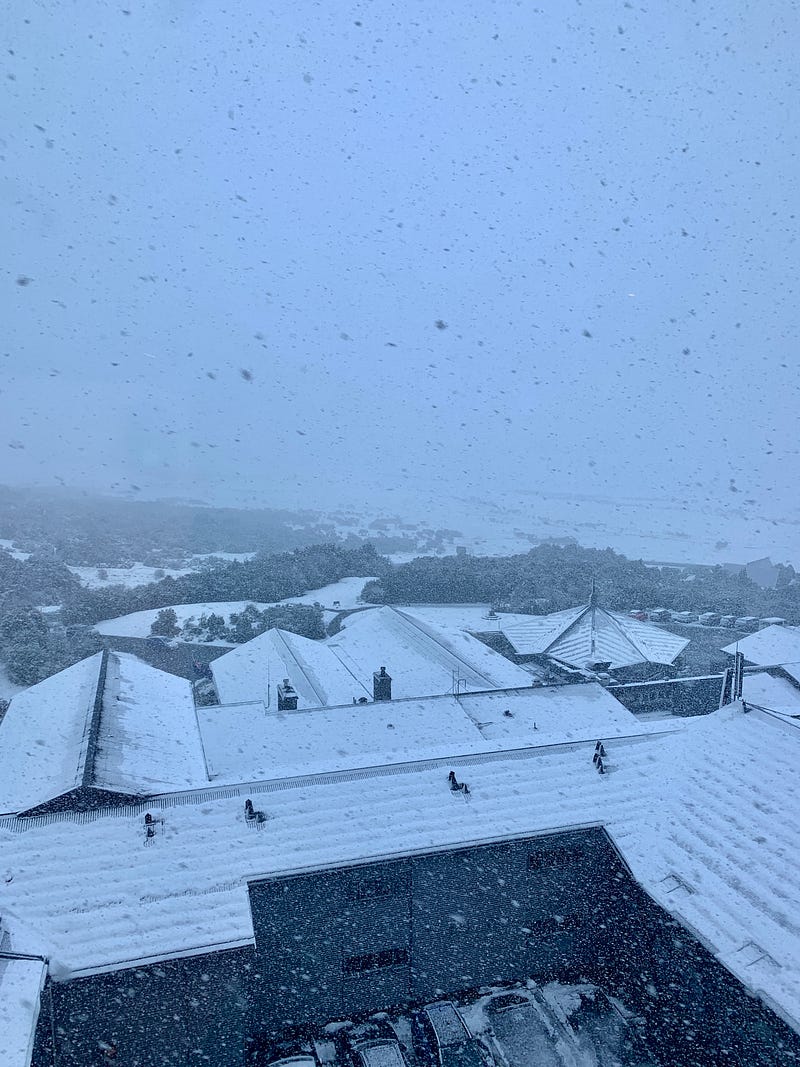
It snowed all the next day, so the road stayed closed, creating havoc for tourists on a tight schedule. But not for us. We snuggled in and enjoyed the white out. The hotel is brilliantly built so that every room has a view of the peak of Aoraki/Mount Cook. Teresa, naturally, had convinced me to get a premium deluxe room on the ninth floor for the best view possible. This is what a premium-deluxe view looked like that morning:
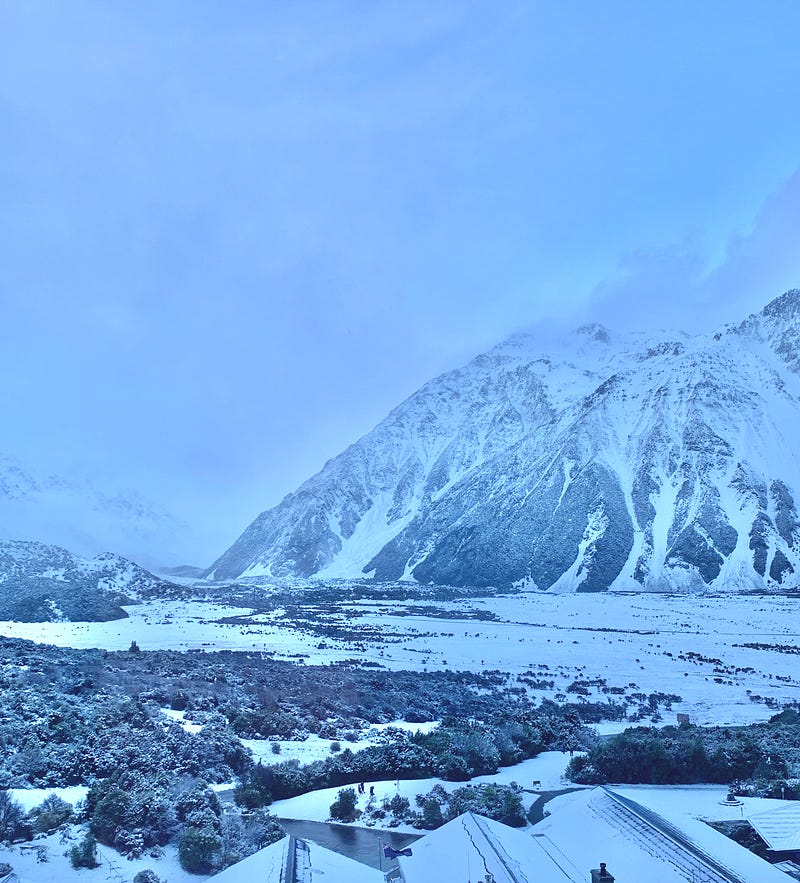
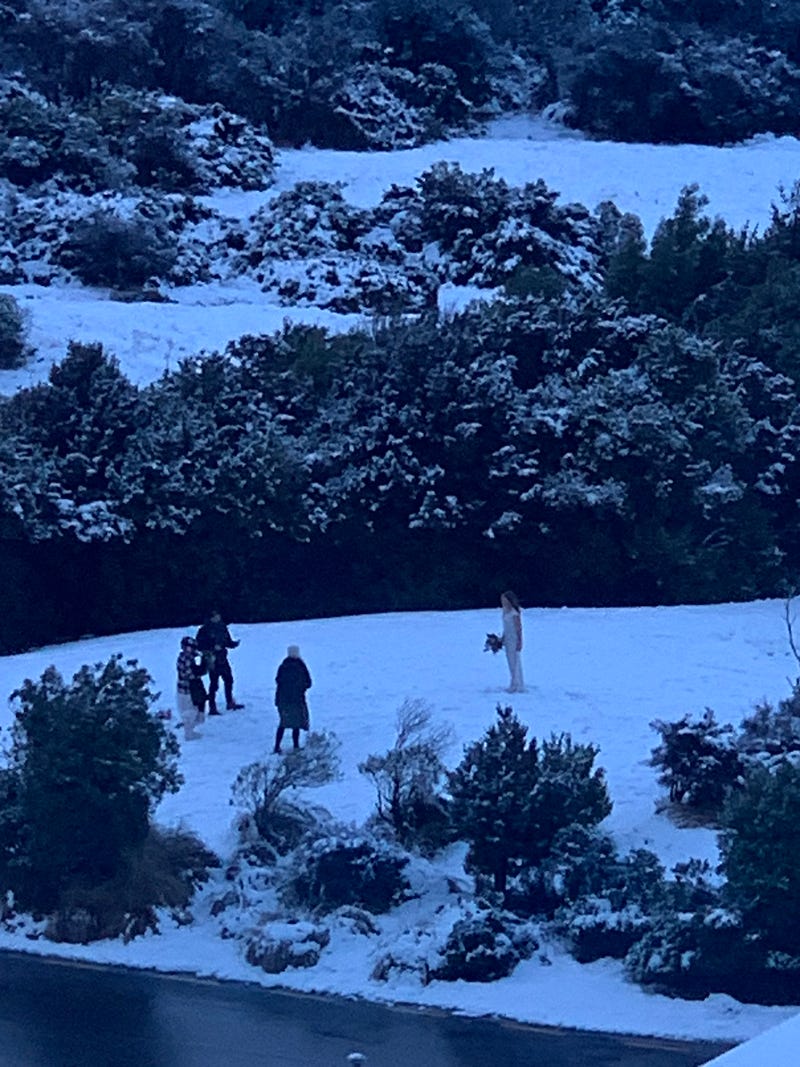
And when the snow subsided for a bit in the late afternoon, it looked like this (Please notice the small cluster of people in the bottom center of the left photo. Enlarged, right, you can see they are taking wedding photos! The bride holding the bouquet looks as if she is about to turn into a popsicle.)
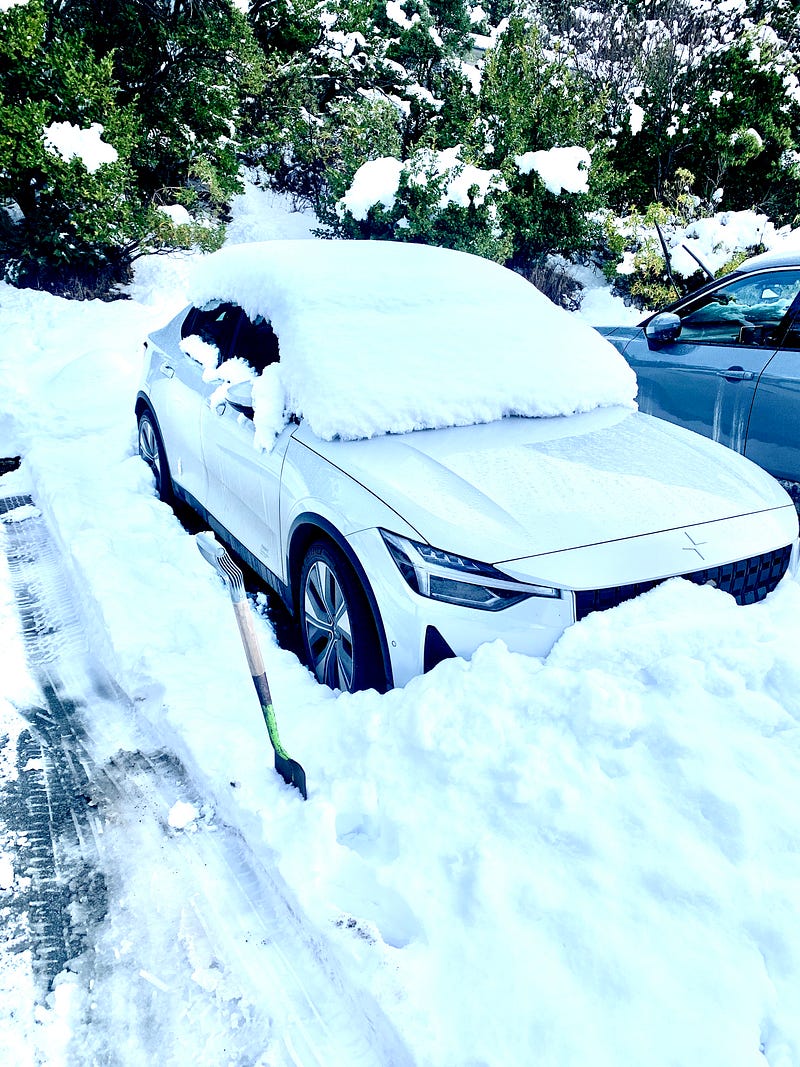
The next morning the hotel lobby was crowded with people and luggage. They were rescheduling flights and negotiating deals to extend their stay — including the whole wedding party. About a foot of snow was on the ground, and our little Polestar was buried so deep I had to shovel it out.
Teresa and I lounged about by the fire, then decided to explore the museum, which featured a terrifying movie about the volunteer mountain rescue teams who put their own lives in danger to save unlucky climbers. Because the weather can change so quickly, and the ice and snow ridges are so unstable, Aoraki/Mount Cook has claimed a lot of mountainers lives over the years — more than 240. A Nepali Sherpa who guided on Aoraki/Mount Cook for 20 years said it was as dangerous as climbing Everest.
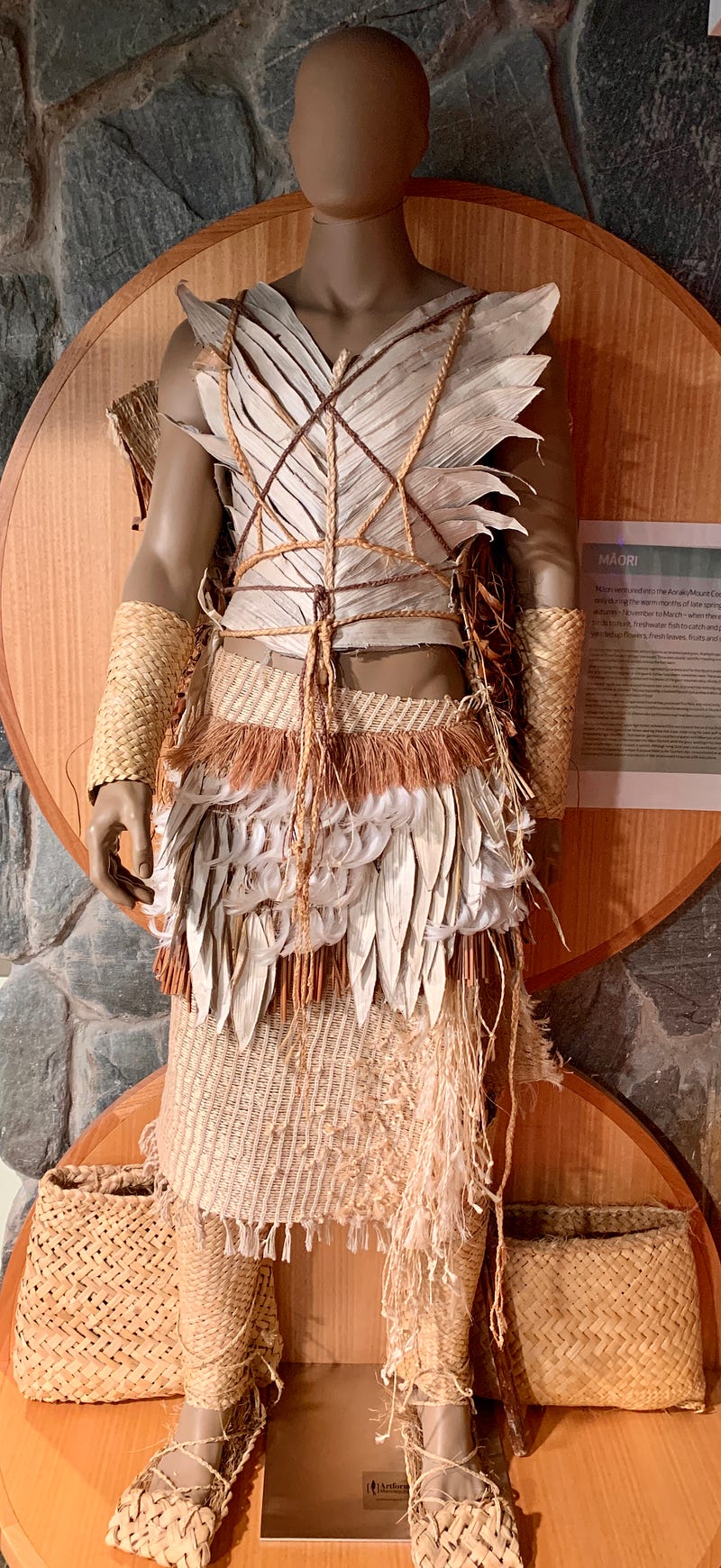
The Department of Conservation also had a display in its own separate info center, which included an explanation of the rather awkward name for the mountain. Aoraki is the Māori name for the peak. According to legend, Aoraki was the eldest son of the Sky God. Together with his brothers, Aoraki piloted a giant canoe from the heavens to the earth to visit his mother, the Earth Goddess. At a crucial moment, Aoraki’s canoe capsized. Aoraki and his brothers climbed to the top of the boat, and there they turned to stone. The canoe became the whole South Island, and the brothers became the five greatest peaks of the Southern Alps — with Aoraki the tallest among them.
The story behind the English name for the mountain seems utterly prosaic in comparison: In 1851 Captain J.L. Stokes sighted the peak while sailing along the west coast, and named it in honour of the English “discoverer” of New Zealand, Captain James Cook. Up until 1998, descendants of the colonizers only referred to the mountain as “Mount Cook.” But, in 1998, following a massive land settlement between the Crown and South Island Māori, a number of South Island place names were amended to include their original Māori names. Aoraki/Mount Cook is especially significant among these changes, because it is the only place where the Māori name legally precedes the English.
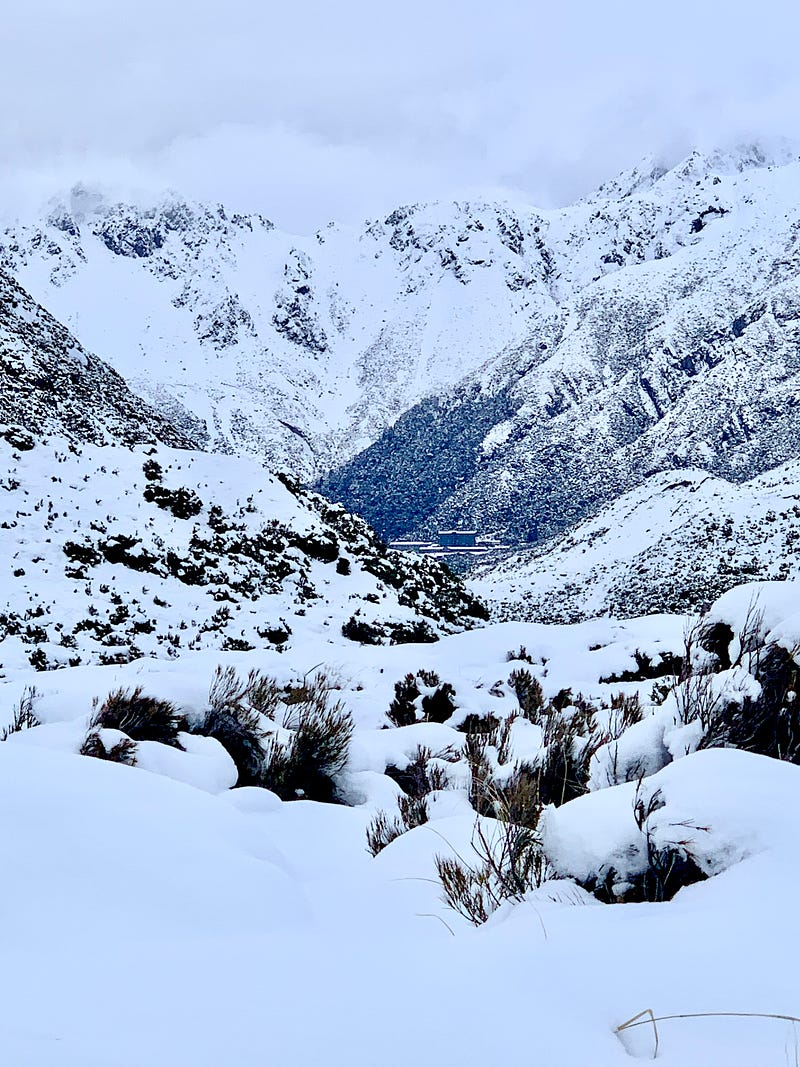
By the afternoon of our third day, the weather, though still overcast, had improved enough that I headed out on one of the more ambitious hikes to the base of Aoraki/Mount Cook. Although over a foot of fresh snow had fallen, the trail had been cleared by park staff with a small snow-blower, making the hiking easy if a bit slippery. The dark green-grey vegetation beneath the thick duvet of snow turned the entire valley into a sepia-tone photograph:
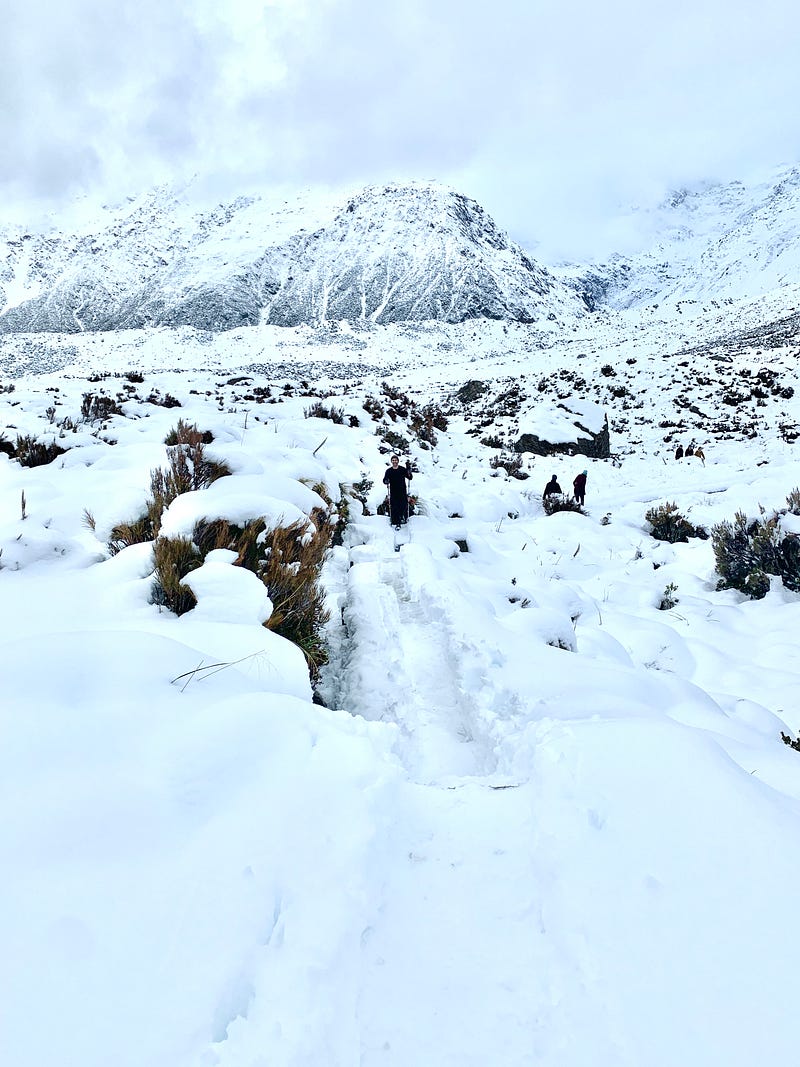
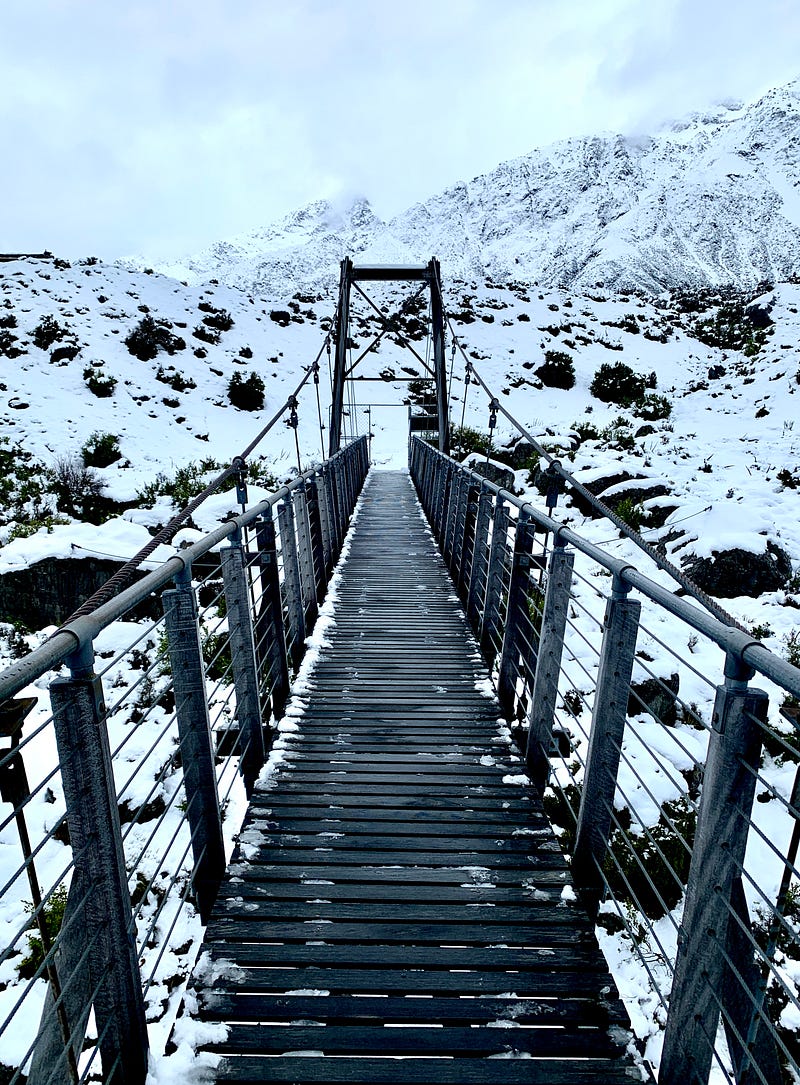
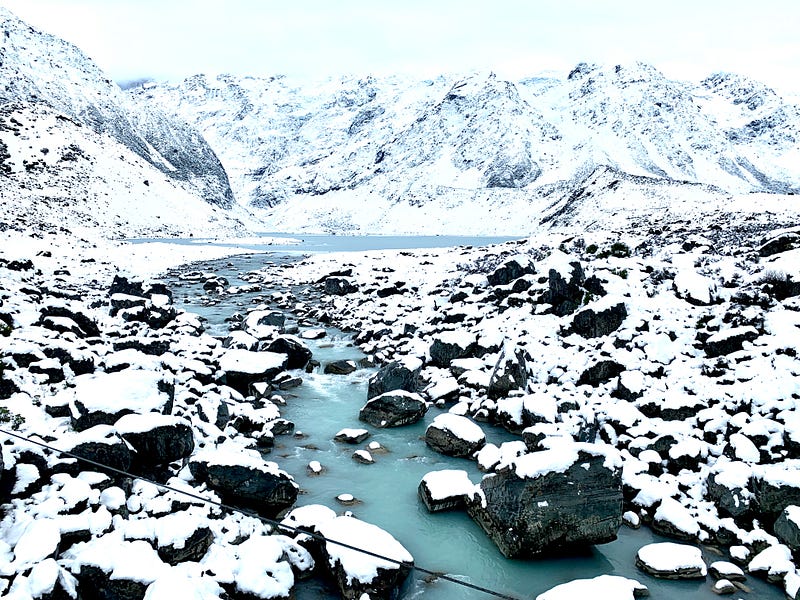
The trail rose to a viewpoint of a small glacial lake, Lake Mueller, which was covered by a thin sheet of slate-blue ice. The remnants of glaciers clung to the mountainsides. Every now and then I heard a rumble like thunder — an avalanche. I counted four of them, way up near the glaciers. Further along, a suspension bridge crossed a small river, its jade waters flowing between white-topped black boulders. I felt as if I had entered Narnia during the perpetual winter of the Ice Queen.
For all its remoteness, this trail was remarkably crowded. There must have been a hundred people out that afternoon. Of course, everyone had been cooped up in the hotel for days, and this hike was reputed as one of the best in all of New Zealand — because of its brilliant views of Aoraki/Mount Cook, which remained shrouded in cloud the whole day. Some of the other hikers seem quite underdressed. For example: young Chinese women in tennis shoes and pretty skirts — clearly prioritizing their Instagram selfies over prevention of frostbite. At the other extreme, I passed burly Australian men (they looked like rugby players) wearing shorts and jerseys. Perhaps that’s all they had packed?
As foot traffic ran both ways along the trench-like trail, whenever two groups needed to pass, one had to stand aside in the much deeper snow. These cross-cultural encounters were managed with surprising civility and courtesy, although in one case, as I moved aside for a young Japanese woman, she also moved aside for me — and stepped right off the edge of a low walkway into waist-deep snow! Her friends and I hauled her back onto her feet, with much giggling and bowing.
Four suspension-bridge crossings later, and ninety minutes after the start, I arrived at the endpoint of the trail: Hooker Lake, with a great view of the Hooker Glacier at the far end of it. Somewhere above in the clouds loomed the frozen face of the god Aoraki.
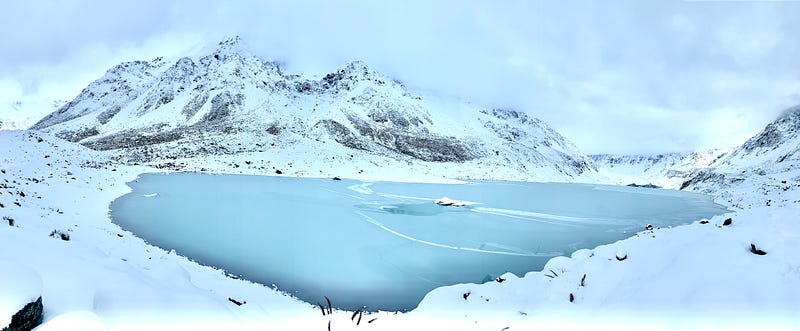
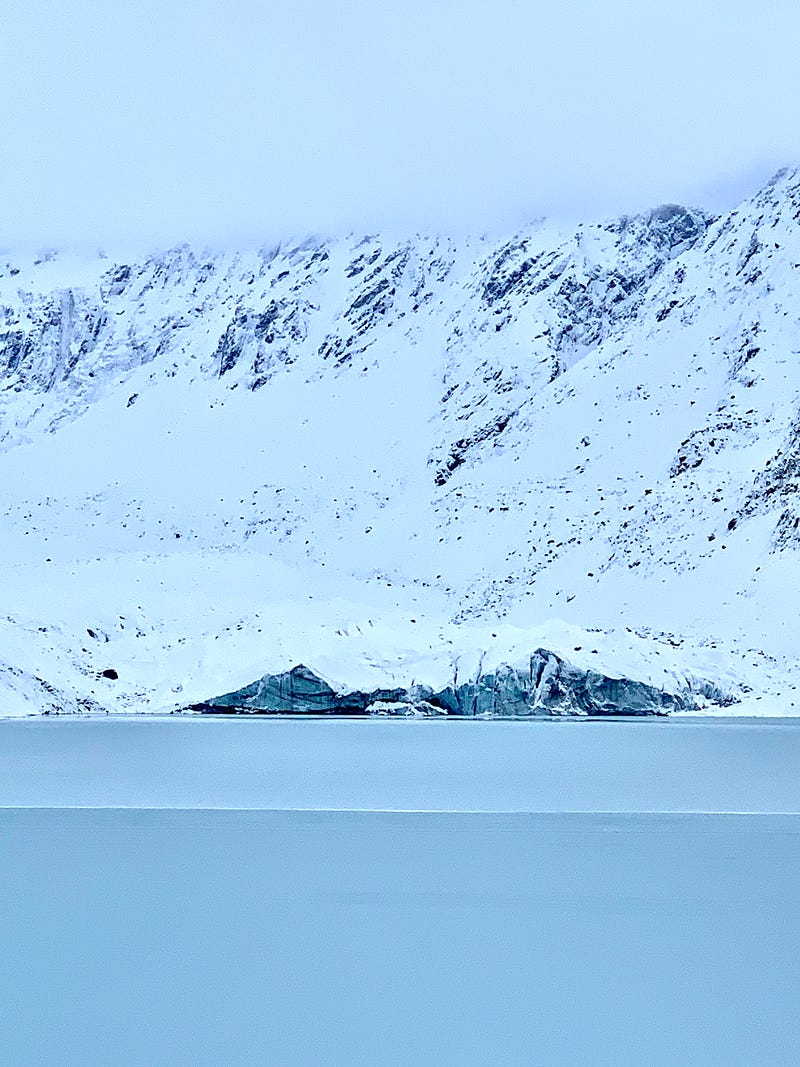
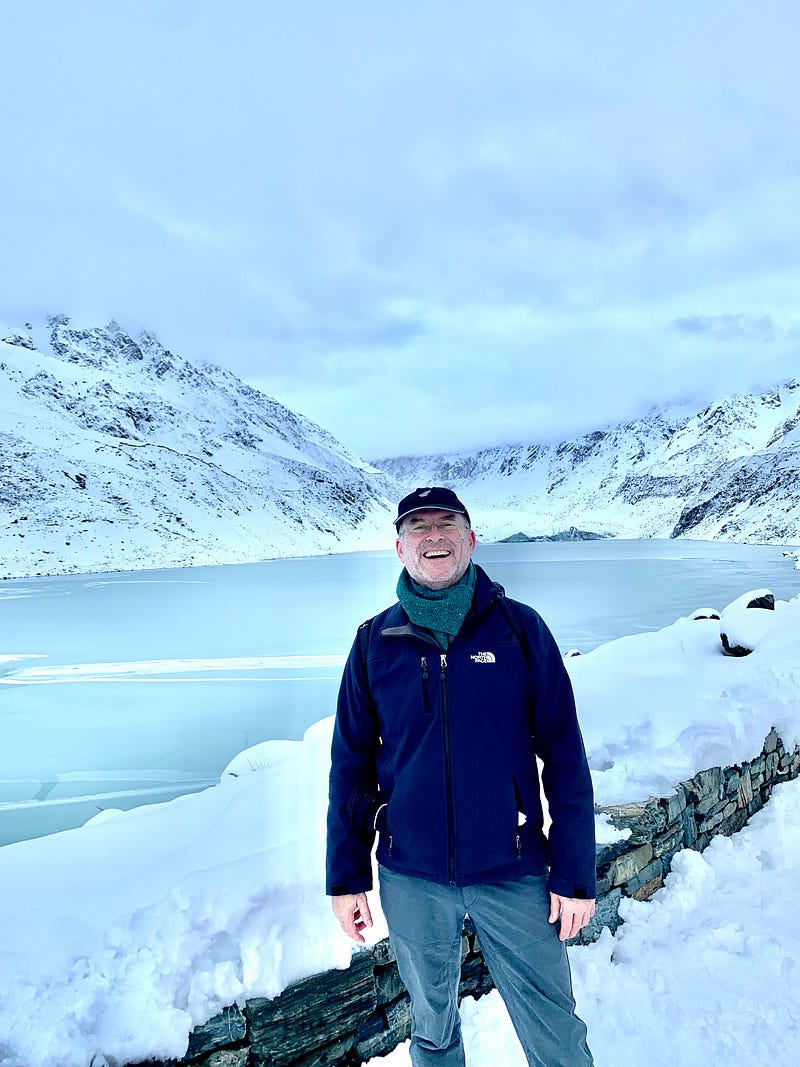
On the walk back to the Hermitage, I could see down the valley to distant Lake Pūkaki. It was shocking to see that land around the lake was beige, not white. No snow at all had fallen on the dry grasses in “rain shadow,” just beyond the mountains.
The final morning of our stay in the Hermitage we woke up to blue sky. The sun was not yet visible, but it reflected hot pink light off the white peak of Aoraki/Mount Cook. Ah! So this is what all the fuss is about:
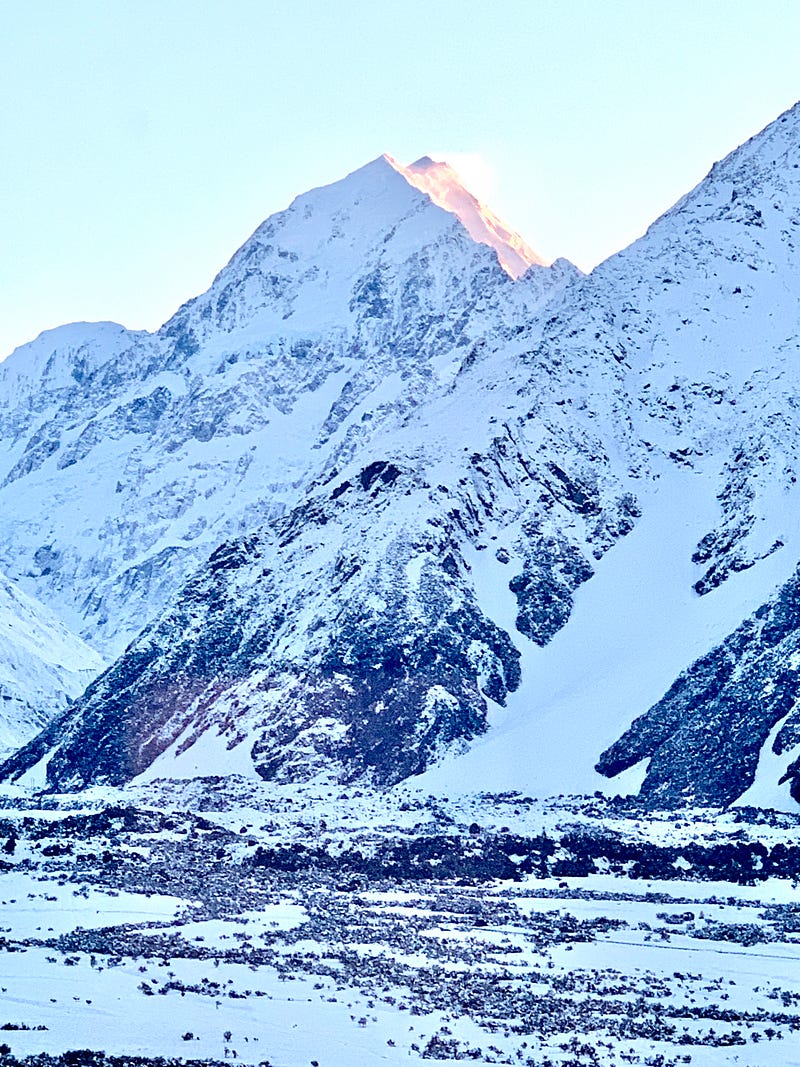
Gradually the rising sun lit the surrounding peaks, dazzling us with their brilliance. As I pulled our Polestar around to the entrance to load our bags, I also noticed long slabs of snow slowly slipping off the hotel rooftops. Every now and then a huge mass would thunder down the outside of the building with a crash.
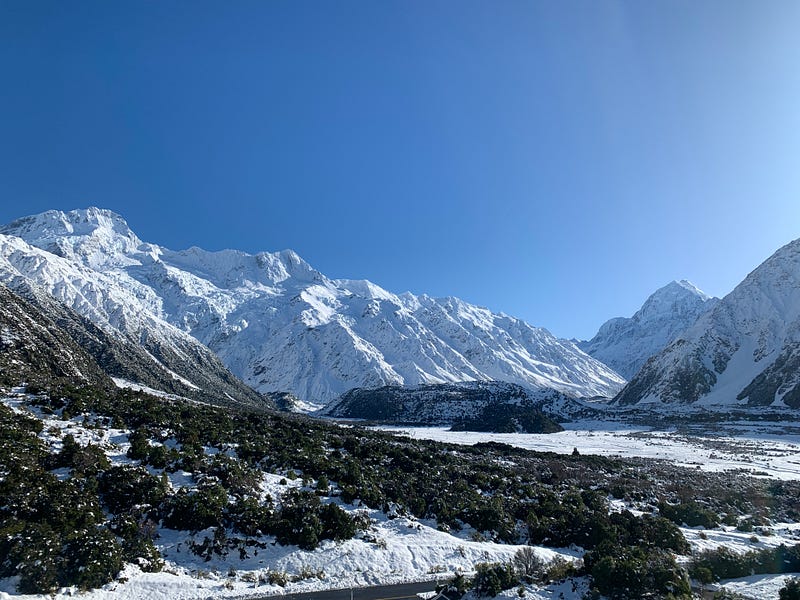
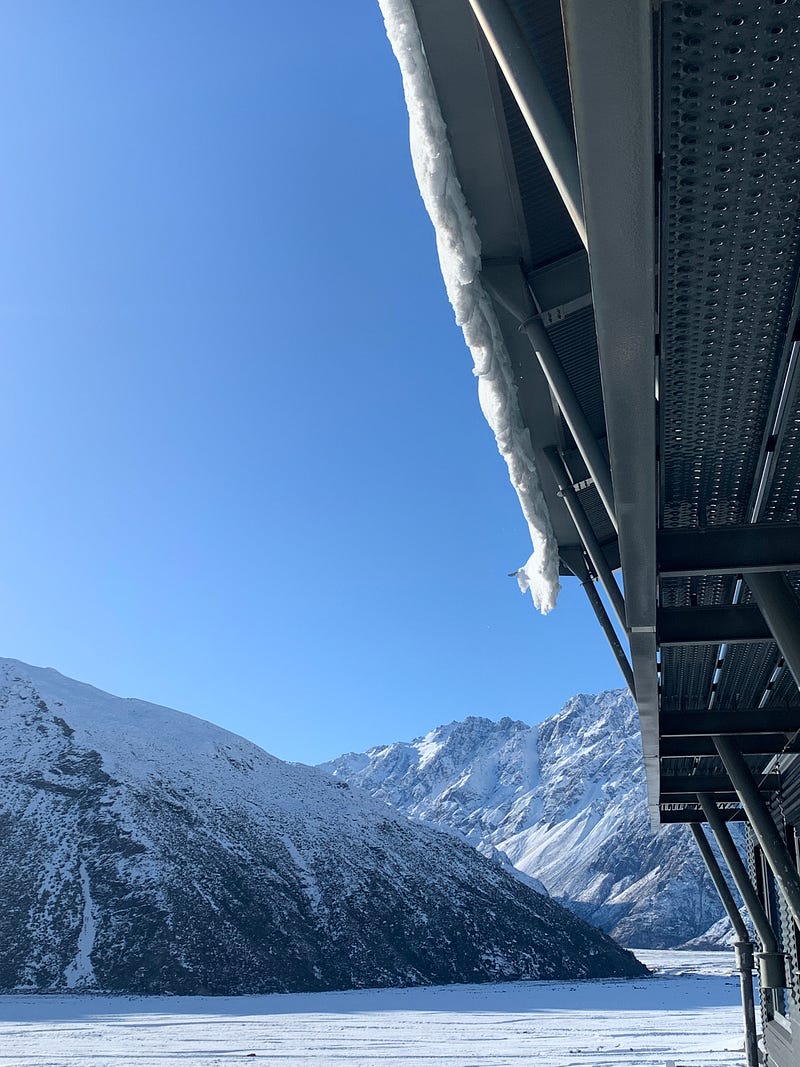
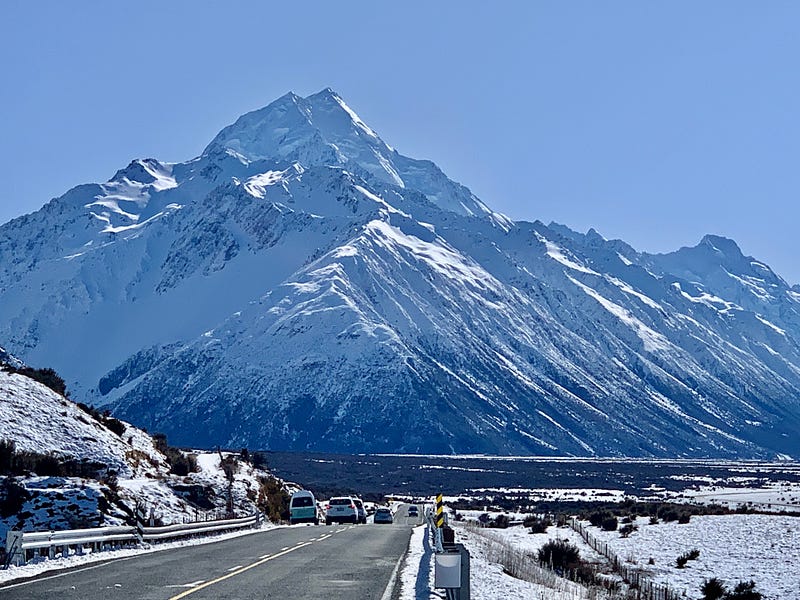
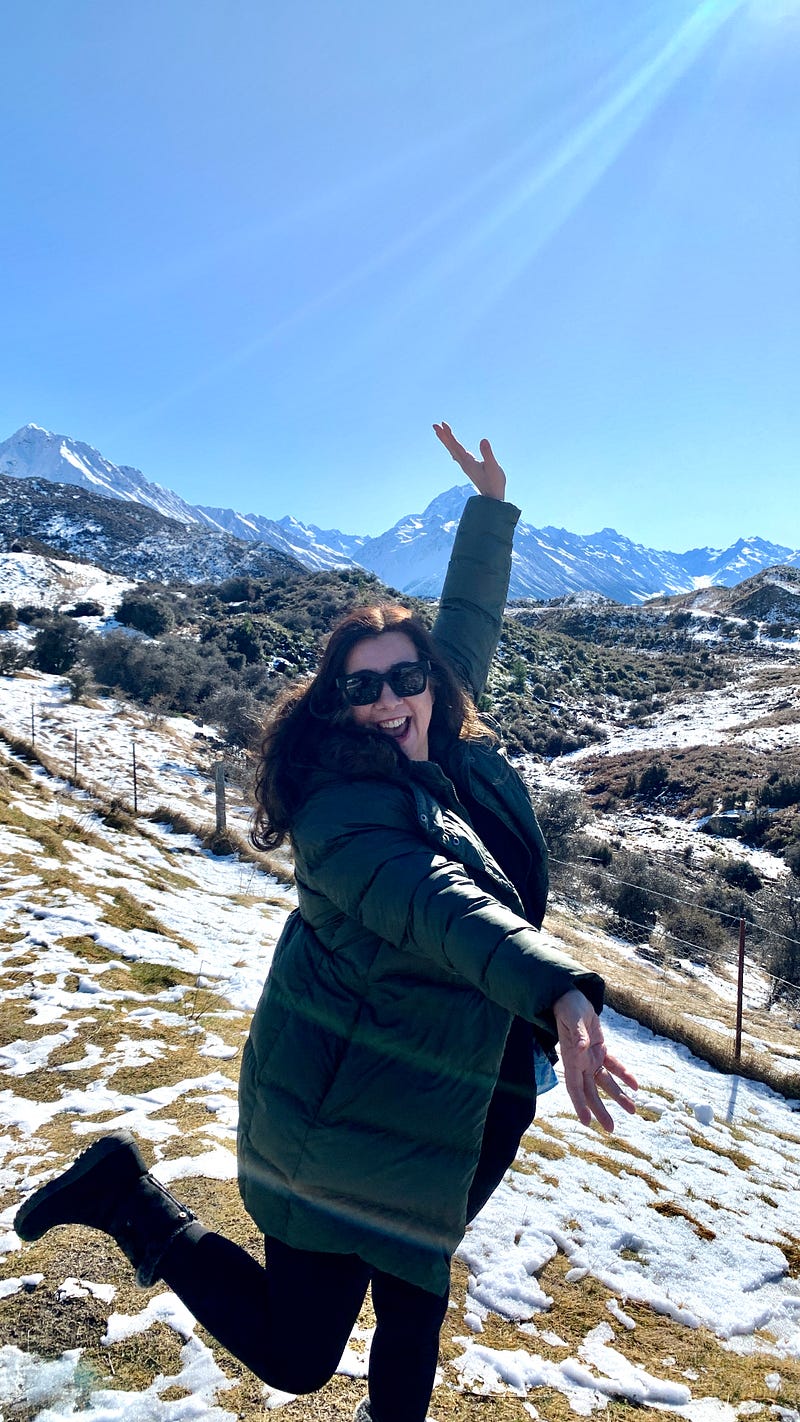
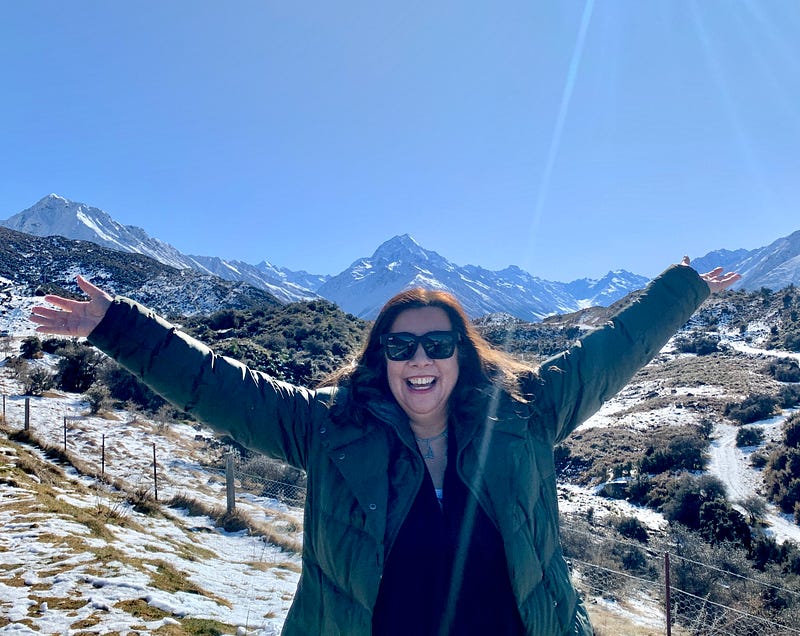
Leaving the mountains on such a sunny day was not easy. Yet, as we drove back along Lake Pūkaki, we noticed something strange. The further away from Aoraki/Mount Cook we got, the larger the mountain seemed to grow. How is this possible? I imagine that from the Hemitage, surrounded by other, closer peaks, we couldn’t get the proper sense of how much higher Aoraki/Mount Cook really is. Barely fifteen minutes down the road, when we looked back it was hard to believe we had actually lived there for three days, at the foot of — oh, I can’t stand it any longer…Let’s do away altogether with this silly British usurpation of the original Māori names — at the foot of Aoraki, the great frozen son of the Sky God and the Earth Goddess.
***
Hey, please check out my new travel book: Mature Flâneur: Slow Travel Through Portugal, France, Italy and Norway.


