
Smells and Bells
And a litany of the spirit
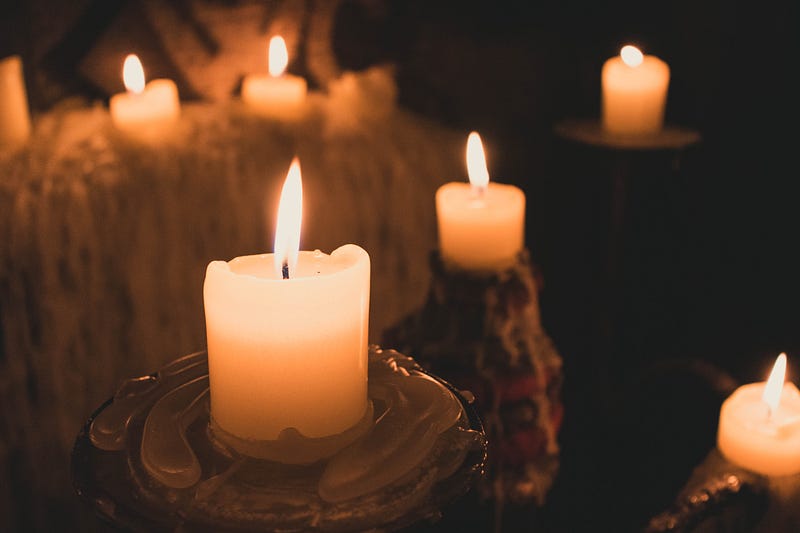
The next time I go to the Alpha lab, Damon Runyon is still dressed up as San Juan de la Cruz. He has dimmed the lights and lit a few candles. There’s also the heavy smell of liturgical incense in the air.
He is kneeling in a corner, facing a framed picture which has two rows of candles in front of it. An organ is playing from somewhere and although it is quiet, the deep bass notes are causing the floor of the lab to vibrate underfoot.
He is intoning a litany, which I first take to be the litany of the saints — Saint this that and the other, ora pro nobis, or pray for us.
As I listen further, I realize that it’s a litany of the spirit pool, or rather of the spirit life in general. It summarizes the lessons Mae and Damon have taught me to date, as well as some others which they haven’t yet covered.
We are one with each other — attack has no meaning. We are one with each other — judgement has no meaning We are one with each other — pride has no meaning We are one with each other — ambition has no meaning We are one with each other — we go to God together We are one with each other — no-one is excluded We are one with each other — forgiving and forgiven We are one with each other — accepting and accepted We are one with each other — loving and beloved
We are one with our father — defense has no meaning We are one with our father — guilt has no meaning We are one with our father — sin has no meaning We are one with our father — fear has no meaning
We are spirit not a body — lust has no meaning We are spirit not a body — pain has no meaning We are spirit not a body — greed has no meaning We are spirit not a body — time has no meaning We are spirit not a body — distance has no meaning We are spirit not a body — death has no meaning
Juan turns towards me and smiles in greeting.
— Juan, why have you taken Damon’s place?
— It’s to do with who you’ll accept instruction from. Damon’s the person who you would naturally turn to for writing advice and general information. I’m here to show you the connections between what you are going through now and your older faith.
— It’s not clear to me that there is any connection.
— Exactly my point. Do you remember the paper you wrote on the three signs of initial contemplation?
— I remember the title, but that’s about all
— Well, let me fill in the blanks. What you used to describe as discursive meditation is nothing more than the work you do here in the alpha lab. You’re relaxed, but conscious, working on projects and visualizing your preferred outcomes.
— Is that really the same as the meditation you used to do?
— In essence yes, although my focus used to be different. I would conjure up pictures of the crucifixion or some other scene from Christ’s life in ever-greater detail, to spur myself to greater passion and devotion.
— And how does that differ from contemplation?
— In contemplation you’re not working any more, at least not consciously. You are just being there, experiencing a generalized loving awareness of God and your oneness with Him.
— Where do I go for that?
— You’ve already been there. Haven’t you noticed that sometimes in the spirit pool you may slip into a blissful state where you are just hanging there slack-jawed without any awareness of time or your surroundings? When you come out after a session like that, how do you feel?
— Refreshed, like my batteries have been supercharged, extra-sensitive to everyone and everything around me. I carry that blissful feeling around me for the next day or so.
— That’s what contemplation is like and that’s the reason why I made such a big deal of it in my works. It’s the nearest thing to Heaven you can experience before death.
— Once you experience it, why wouldn’t you just stay in that state forever?
— Because there are other people who aren’t in that state. You feel a natural desire to go out and round them up and shepherd them towards this knowledge, however long it takes. Remember that we’re all in this together, no-one is excluded.
— I think I understand, but why do you still need the music, the candles,the robes and the rituals.
— Left-brain pacifiers, I think you would call them. They give the brain something logical to fasten onto while the real work is going on underneath it all.