
SMARTER method Prompt with ChatGPT
Don’t prompt ChatGPT randomly

ChatGPT, a powerful language model, has captivated users with its ability to generate text, translate languages, and answer questions in an informative way. However, simply prompting it with random requests can lead to inconsistent or irrelevant outputs.
To harness its full potential, we need a structured approach to interaction. Introducing the SMARTER framework, a practical tool for crafting effective prompts and maximizing ChatGPT’s capabilities.

The SMARTER framework stands for the following:
- S — Setting: Clearly define the context within which your request falls. This helps ChatGPT understand the situation and tailor its response accordingly.
- M — Modality: Specify the desired format of the output. Do you want text, a list, a poem, or something else?
- A — Adaptability: If there are variations in the context, mention them. This allows ChatGPT to adjust its response to different scenarios.
- R — Role: Define the role you want ChatGPT to play in the interaction. Is it a teacher, a writer, a translator, or something else?
- T — Task: Clearly state the specific task or objective you want ChatGPT to complete.
- E — Example: Provide an example of what you’re looking for. This helps ChatGPT understand your expectations and produce a more accurate result.
- R — Relevance: Ensure your request stays within the scope of the previously defined context.
Applying the SMARTER Framework:
Here’s an example of how to apply the SMARTER framework to a specific situation:
Scenario: You’re writing a blog post about the history of artificial intelligence.
SMARTER application:
S: I’m researching for a blog post about the history of artificial intelligence.
M: I need a bulleted list outlining the key milestones in AI development.
A: You can mention the year, the event, and the individual or team involved for each milestone.
R: Act as a research assistant.
T: Generate a bulleted list summarizing the key milestones in AI development.
E: For example, you could include:
- 1950: Alan Turing publishes his paper “Computing Machinery and Intelligence,” introducing the Turing Test.
- 1960s: The first AI programs appear, like ELIZA, capable of simple dialogue.
R: Please ensure all information remains relevant to the history of AI.
Don’t Just Prompt, Get Smart: Using the SMARTER Framework for Effective ChatGPT Interactions
Introduction:
ChatGPT, a powerful language model, has captivated users with its ability to generate text, translate languages, and answer questions in an informative way. However, simply prompting it with random requests can lead to inconsistent or irrelevant outputs. To harness its full potential, we need a structured approach to interaction. Introducing the SMARTER framework, a practical tool for crafting effective prompts and maximizing ChatGPT’s capabilities.
Explication:
The SMARTER framework stands for the following:
- S — Setting: Clearly define the context within which your request falls. This helps ChatGPT understand the situation and tailor its response accordingly.
- M — Modality: Specify the desired format of the output. Do you want text, a list, a poem, or something else?
- A — Adaptability: If there are variations in the context, mention them. This allows ChatGPT to adjust its response to different scenarios.
- R — Role: Define the role you want ChatGPT to play in the interaction. Is it a teacher, a writer, a translator, or something else?
- T — Task: Clearly state the specific task or objective you want ChatGPT to complete.
- E — Example: Provide an example of what you’re looking for. This helps ChatGPT understand your expectations and produce a more accurate result.
- R — Relevance: Ensure your request stays within the scope of the previously defined context.
Applying the SMARTER Framework:
Here’s an example of how to apply the SMARTER framework to a specific situation:
Scenario: You’re writing a blog post about the history of artificial intelligence.
SMARTER application:
S: I’m researching for a blog post about the history of artificial intelligence.
M: I need a bulleted list outlining the key milestones in AI development.
A: You can mention the year, the event, and the individual or team involved for each milestone.
R: Act as a research assistant.
T: Generate a bulleted list summarizing the key milestones in AI development.
E: For example, you could include:
- 1950: Alan Turing publishes his paper “Computing Machinery and Intelligence,” introducing the Turing Test.
- 1960s: The first AI programs appear, like ELIZA, capable of simple dialogue.
R: Please ensure all information remains relevant to the history of AI.
By following this framework, you provide ChatGPT with the necessary context and instructions to perform the task effectively. This approach will lead to more relevant, accurate, and helpful responses, maximizing the potential of your interaction with ChatGPT.
Other example:
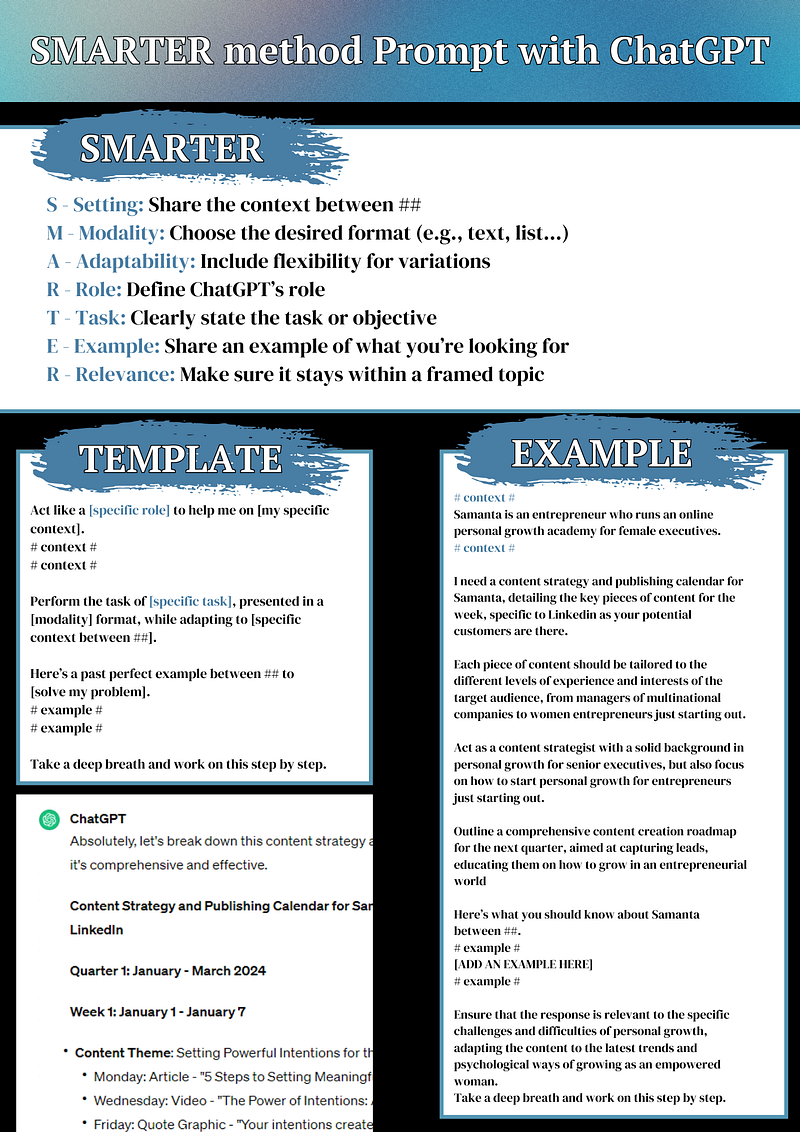
Moving beyond random prompts, the SMARTER framework empowers you to leverage ChatGPT’s capabilities efficiently. By following these steps, you can transform your interactions from hit-and-miss attempts to productive collaborations, unlocking the true potential of this powerful language model.
Hi I’m Anastasia and I write about AI tips, tricks and tools, especially Midjourney ! If you liked the content, I hope you share it and leave me a comment so I can write more articles knowing the tastes of my readers.

This story is published on Generative AI. Connect with us on LinkedIn and follow Zeniteq to stay in the loop with the latest AI stories. Let’s shape the future of AI together!
