avatarRui Ibañez Matoso

Free AI web copilot to create summaries, insights and extended knowledge, download it at here

3382

Abstract

p6xzhWwiwKkr-vSqYds-4vZrg#sdfootnote1sym"><i>1</i></a>), which has been implemented as an immersive and holistic (totalitarian??) environment.</p><p id="0745">This environmental CyberSphere seeks to act in the whole cycle of the feedback process, automating the administration of logical and affective inputs (rationality and emotion) in the expectation of collecting calculable and preemptive outputs (through algorithms), thereby exerting a diffuse form of control and maintaining the homeostasis in all the networks.</p><p id="122d">The cybernetic project has been, since the second half of the 20th century, fueled by the media and network technologies industries, but also by the US military infrastructure, corresponding to what Julian Assange calls the “militarization of cyberspace” (Julian Assange, In <a href="https://en.wikipedia.org/wiki/Cypherpunk"><i>CypherPunks</i></a>).</p><p id="7a95">What we designate here as <i>a holistic or totalitarian cyber environment</i> can be interpreted as the extension of cyberspace to the whole of life (biophysical and psychic) ​​into which <b>Biotechnologies</b> and <b>Psychotechnologies</b>, biopolitics and the multiple applications of cybernetics (organizational, financial, cognitive, aesthetic, etc.) are integrated and corresponds to the implementation of concrete political actions throughout history and in different geographies.</p><p id="6a39"><b>Cybersin, Smart Cities and Biopolitics</b></p><p id="2456">The <a href="https://translate.googleusercontent.com/translate_c?depth=1&amp;hl=en&amp;rurl=translate.google.com&amp;sl=pt-BR&amp;sp=nmt4&amp;tl=en&amp;u=http://www.cybersyn.cl/ingles/cybersyn/index.html&amp;xid=17259,15700023,15700186,15700191,15700256,15700259,15700262,15700265&amp;usg=ALkJrhg33FZu3_ozldigD0N5TUWWowcPww"><i>Cybersyn</i></a> project — Cyber Synergy — developed and directed by the electronic engineer <a href="https://en.wikipedia.org/wiki/Stafford_Beer">Stafford Beer</a>, between 1971 and 1973, in Chile, during the Salvador Allende government, was to create an interactive environment for managing and optimizing support for important decisions to be made within economic policy.</p><p id="0887">The use of information capture devices: videoconferencing rooms, collaborative networking systems and interaction protocols between companies, government, and other organizations were applied to emerging initiatives such as e-government and organizational cybernetics.</p><figure id="14b3"><img src="https://cdn-images-1.readmedium.com/v2/resize:fit:800/0*UpPJ9xXWcVL730B6"><figcaption>Smart Cities Control Center in Rio de Janeiro, Brazil.</figcaption></figure><p id="0d91">The <i>Smart Cities</i> cyber-urban model, based on the idea of ​​intending to control cities through cyber operations centers — designed and produced by IBM ( <a href="https://www.ibm.com/smarterplanet/us/en/smarter_cities/overview/"><i>Smarter Cities</i></a> unit) — makes computational turn evident in governance models with which we have constantly interacted.</p><p id="da98">Rem Koolhaas at the <a href="https://www.archdaily.com/576480/rem-koolhaas-asks-are-smart-cities-condemned-to-be-stupid"><i>Digital Minds for New Europe</i></a><i> </i>conference, hosted by the European Commission, really asks if smart cities are doomed to stupidity? While it states that the citizens that the smart city claims to serve a

Options

re treated like children. One of Koolhaas’s concerns is the apolitical form of the Smart City model, according to which the traditional European values ​​of freedom, equality and fraternity were replaced in the 21st century by comfort, security and sustainability.</p><p id="5c73">On the personal side and with regard to the forms of individuality, the question that has arisen since the early days of cybernetics is, on the one hand, the emergence of artificial intelligence (machinic incorporation of the mind) and the inductive production of docile and submissive subjectivities by technobiopolitical devices, whose digital psychopolitics and <i>Big Data</i> take hold of emotions to influence pre-reflexive actions — because it is through emotions that one reaches the depths of the <i>self</i> , and thus emotion represents an efficient means to establish the psychopolitical control of the individual <a href="https://translate.googleusercontent.com/translate_c?depth=1&amp;hl=en&amp;rurl=translate.google.com&amp;sl=pt-BR&amp;sp=nmt4&amp;tl=en&amp;u=https://www.esquerda.net/artigo/cidades-inteligentes-cibernetica-e-biopolitica/36463&amp;xid=17259,15700023,15700186,15700191,15700256,15700259,15700262,15700265&amp;usg=ALkJrhgFHp6xzhWwiwKkr-vSqYds-4vZrg#sdfootnote2sym">2</a> .</p><p id="25b3">This new regime of global governance and subjectivity annulment, which is now capable of establishing a virtual reality through the digital coding of the world and the algorithmic treatment of accumulated information (algorithmic governance), aims to reduce uncertainty and risk in human behavior and in the dailylife management in general, that is, to establish a global biopolitics and thus fully dispose of the human bodies and their environments.</p><p id="0931"><a href="https://translate.googleusercontent.com/translate_c?depth=1&amp;hl=en&amp;rurl=translate.google.com&amp;sl=pt-BR&amp;sp=nmt4&amp;tl=en&amp;u=https://www.esquerda.net/artigo/cidades-inteligentes-cibernetica-e-biopolitica/36463&amp;xid=17259,15700023,15700186,15700191,15700256,15700259,15700262,15700265&amp;usg=ALkJrhgFHp6xzhWwiwKkr-vSqYds-4vZrg#sdfootnote1anc">1</a> It is a neologism created by me to refer to the inclusion of instrumental rationality promoted by the current devices of technoscience (vigilance, bigdata, biopolitics, etc.) in the historical course of behaviorism and its relation to other close currents of thought: mechanism, positivism, determinism, Darwinism, etc.</p><p id="ebd5"><a href="https://translate.googleusercontent.com/translate_c?depth=1&amp;hl=en&amp;rurl=translate.google.com&amp;sl=pt-BR&amp;sp=nmt4&amp;tl=en&amp;u=https://www.esquerda.net/artigo/cidades-inteligentes-cibernetica-e-biopolitica/36463&amp;xid=17259,15700023,15700186,15700191,15700256,15700259,15700262,15700265&amp;usg=ALkJrhgFHp6xzhWwiwKkr-vSqYds-4vZrg#sdfootnote2anc">2</a> Consider, for example, the experiences of manipulating emotions — emotional contagion — of users of the Facebook social network: <a href="https://translate.googleusercontent.com/translate_c?depth=1&amp;hl=en&amp;rurl=translate.google.com&amp;sl=pt-BR&amp;sp=nmt4&amp;tl=en&amp;u=http://www.pnas.org/content/111/24/8788.full.pdf&amp;xid=17259,15700023,15700186,15700191,15700256,15700259,15700262,15700265&amp;usg=ALkJrhgirxLZ58nB03drrN7zUdYmsJ6lRw">http://www.pnas.org/content/111/24/8788.full.pdf</a> .</p></article></body>

Smart Cities: Cybernetics and Biopolitics

Since World War II, investigations into the automation of life and the digitization of communications, at the time of improvements to the US military’s war machines, have been building on what Norbert Wiener called cybernetics in his famous work published in 1948, Cybernetics: Or Control and Communication in the Animal and the Machine .
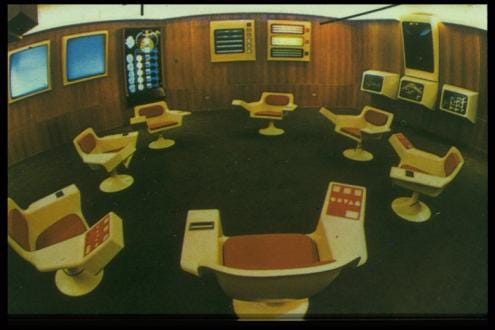
Cybersyn Operating Room — The Cybersyn project — Syber Synergy — was developed and directed by the engineer Stafford Beer, between 1971 and 1973, in Chile during the Salvador Allende government.

The regulation and control of information flows and feedback mechanisms applied by Cybernetics to the investigation of homeostatic regulation mechanisms in humans is one of the main axes of the cybernetization of humans and their environments.

Another key axis of this cyborg perspective it was Wiener’s option for digitizing information through the preferential use of “numerical machines” (digital machines based on binary arithmetic and boolean algebra) rather than “analog machines” as well as the technological improvement of programming, memorization and process automation capabilities — whose increased processing speeds would lead to the desirable replacement of human gesture by automation processes.

This axis of cybernetics, supported by the investigations of John von Neumann and Alan Turing, was what enabled Norbert Wiener to assert that the human and animal nervous systems operated as computer and control systems, since the neuronal network (neuron-synapses) would function similarly to the binary calculation.

On the other hand, the understanding that the conditioned reflex mechanism (Pavlov), or affective tone mechanism as Wiener prefers to designate, is a biological feedback mechanism related to learning and to the ideation systems, and that allowed Wiener to speculate about the capabilities of computer learning, leading him to say that the new industrial revolution is to replace human judgment and discernment with that of machines, in this sense, the computer no longer emerges as a source of strength and power, but as a source of control and communication.
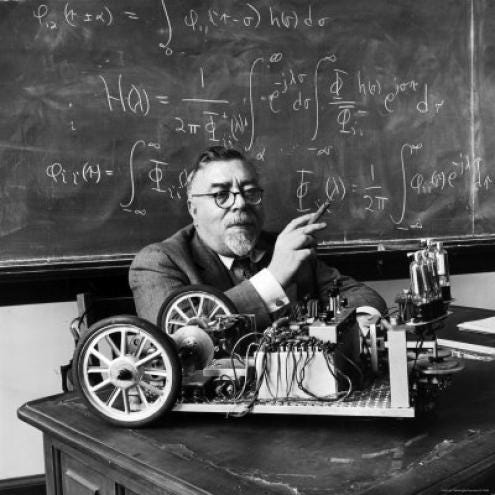
Norbert Wiener

The cyber fusion between the brain (and the central nervous system) and the phenomenological emergence of the mind (mental functions) — referred at diferent times by Wiener — represented since then a new line of action of technological-instrumental behavior (technobehaviorism 1), which has been implemented as an immersive and holistic (totalitarian??) environment.

This environmental CyberSphere seeks to act in the whole cycle of the feedback process, automating the administration of logical and affective inputs (rationality and emotion) in the expectation of collecting calculable and preemptive outputs (through algorithms), thereby exerting a diffuse form of control and maintaining the homeostasis in all the networks.

The cybernetic project has been, since the second half of the 20th century, fueled by the media and network technologies industries, but also by the US military infrastructure, corresponding to what Julian Assange calls the “militarization of cyberspace” (Julian Assange, In CypherPunks).

What we designate here as a holistic or totalitarian cyber environment can be interpreted as the extension of cyberspace to the whole of life (biophysical and psychic) ​​into which Biotechnologies and Psychotechnologies, biopolitics and the multiple applications of cybernetics (organizational, financial, cognitive, aesthetic, etc.) are integrated and corresponds to the implementation of concrete political actions throughout history and in different geographies.

Cybersin, Smart Cities and Biopolitics

The Cybersyn project — Cyber Synergy — developed and directed by the electronic engineer Stafford Beer, between 1971 and 1973, in Chile, during the Salvador Allende government, was to create an interactive environment for managing and optimizing support for important decisions to be made within economic policy.

The use of information capture devices: videoconferencing rooms, collaborative networking systems and interaction protocols between companies, government, and other organizations were applied to emerging initiatives such as e-government and organizational cybernetics.
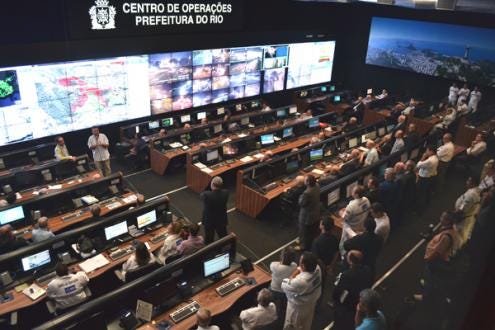
Smart Cities Control Center in Rio de Janeiro, Brazil.

The Smart Cities cyber-urban model, based on the idea of ​​intending to control cities through cyber operations centers — designed and produced by IBM ( Smarter Cities unit) — makes computational turn evident in governance models with which we have constantly interacted.

Rem Koolhaas at the Digital Minds for New Europe conference, hosted by the European Commission, really asks if smart cities are doomed to stupidity? While it states that the citizens that the smart city claims to serve are treated like children. One of Koolhaas’s concerns is the apolitical form of the Smart City model, according to which the traditional European values ​​of freedom, equality and fraternity were replaced in the 21st century by comfort, security and sustainability.

On the personal side and with regard to the forms of individuality, the question that has arisen since the early days of cybernetics is, on the one hand, the emergence of artificial intelligence (machinic incorporation of the mind) and the inductive production of docile and submissive subjectivities by technobiopolitical devices, whose digital psychopolitics and Big Data take hold of emotions to influence pre-reflexive actions — because it is through emotions that one reaches the depths of the self , and thus emotion represents an efficient means to establish the psychopolitical control of the individual 2 .

This new regime of global governance and subjectivity annulment, which is now capable of establishing a virtual reality through the digital coding of the world and the algorithmic treatment of accumulated information (algorithmic governance), aims to reduce uncertainty and risk in human behavior and in the dailylife management in general, that is, to establish a global biopolitics and thus fully dispose of the human bodies and their environments.

1 It is a neologism created by me to refer to the inclusion of instrumental rationality promoted by the current devices of technoscience (vigilance, bigdata, biopolitics, etc.) in the historical course of behaviorism and its relation to other close currents of thought: mechanism, positivism, determinism, Darwinism, etc.

2 Consider, for example, the experiences of manipulating emotions — emotional contagion — of users of the Facebook social network: http://www.pnas.org/content/111/24/8788.full.pdf .

Smart Cities
Cybernetics
Subjectivity
Freedom
Democracy
Recommended from ReadMedium